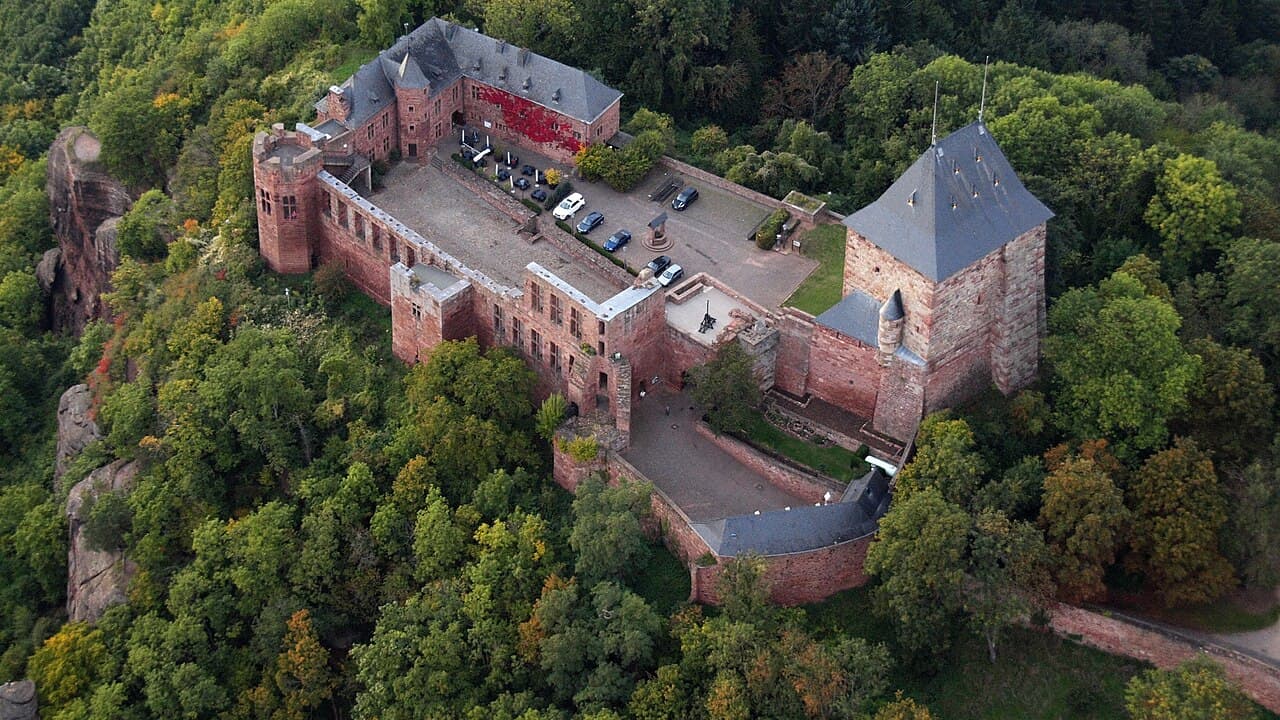
Burg Nideggen
Burg Nideggen stands as a remarkable example of a medieval hill castle strategically perched on a rocky spur overlooking the Rur valley in the town of Nideggen, Germany. Founded in 1177 by Count William II of Jülich, this fortress was originally built to control a vital route to Monschau and to defend the border against the Archbishopric of Cologne. The castle's location at approximately 330 meters above sea level provided a commanding view and significant defensive advantages, typical of hill castles designed for both military and residential purposes during the High Medieval period.
Throughout its history, Burg Nideggen served not only as a military stronghold but also as the residence of the counts and later dukes of Jülich. It played a pivotal role in regional power struggles, especially with the Electorate of Cologne. The castle's function evolved over time, including periods when it was used as a prison for high-profile captives such as Archbishop Conrad of Hochstaden in 1242 and Archbishop Engelbert II of Falkenburg between 1267 and 1271.
Architectural evolution and key structures
The bergfried and defensive features
The oldest surviving part of the castle is the massive stone residential tower, or bergfried, constructed between 1177 and 1190. This tower, initially designed with a deep neck ditch on its eastern side, exemplifies medieval defensive architecture. Originally, the bergfried had an elevated entrance accessible only by ladder, a common security feature to prevent easy access by attackers. In the mid-14th century, the tower was heightened to six stories, enhancing its imposing presence and defensive capabilities. The interior includes a castle chapel and a dungeon on the ground floor, with upper floors housing chambers, storerooms, and quarters for servants or soldiers. Notably, the tower was equipped with fireplaces and toilets from its early construction, reflecting the dual residential and defensive purpose.
The palas: one of the largest medieval halls
The palas, or residential hall, built around 1340 under William V (later Duke William I), is one of the castle's most impressive features. Measuring approximately 61 meters long and 16 meters wide, it ranks among the largest medieval castle halls in Germany. The palas contains two spacious two-nave halls on both the ground and upper floors, illuminated by numerous large cross-shaped windows, allowing ample natural light. Flanking the palas are two octagonal stone towers: the western Damenerker, likely used as chambers for female family members, and the eastern kitchen tower, which originally rose about 14 meters high. The kitchen tower's small windows and storeroom function on the ground floor indicate its combined defensive and practical role.
Outer defenses and courtyard structures
The castle's entrance gate, dating from the 14th century, led into a smaller outer courtyard or zwinger, a defensive enclosure designed to trap attackers. This outer gate was rebuilt in the 16th century and later covered by an 18th-century timber-framed gatehouse known as the Pförtnerhaus, reconstructed in 1979 after World War II destruction. The main inner gate, a late Romanesque structure, remains the sole entrance to the main castle area and is connected to the bergfried by a curtain wall. Restoration efforts between 1901 and 1906 added a western staircase to this gate, enhancing access while preserving historical integrity.
Historical significance and ownership transitions
Burg Nideggen's history is deeply intertwined with the political landscape of the Rhineland. After its foundation by the counts of Jülich, the castle became the official ducal seat in 1356. Following the death of Rainhald IV of Jülich in 1423, the castle passed to the von Berg family, who adopted the title of Dukes of Jülich-Berg. The castle later came under the control of the Duchy of Cleves in 1511 after the Jülich-Berg lineage ended.
The fortress endured significant military conflicts, notably during the Guelders Wars in 1542, when imperial artillery caused extensive damage to both the castle and the town. Repairs followed, but the castle suffered again during the War of the Palatine Succession in 1689, when troops under King Louis XIV of France plundered and burned it. Natural disasters such as earthquakes in 1755 and 1878 further contributed to its decline.
Decline, preservation, and modern restoration
By the late 18th century, Burg Nideggen had fallen into disrepair and was sold for demolition in 1794, with its stones repurposed as building materials. However, local citizens recognized its cultural value and purchased the ruins in 1888 to protect them. Ownership transferred to the district of Düren in 1905, which continues to maintain the site.
Restoration efforts began in the early 20th century, including the establishment of a local history museum within the castle grounds. World War II inflicted severe damage, but reconstruction resumed in the 1950s, focusing on the Romanesque parish church and the medieval residential tower with careful attention to historical accuracy. By 1979, restoration was largely complete, and the bergfried was repurposed as North Rhine-Westphalia's first castle museum, showcasing exhibits on regional history, noble families, and medieval life.
Castle grounds and visitor experience today
The castle complex includes a rectangular garden enclosed by walls, constructed after the medieval period. This garden once featured a Baroque-style house, now lost, and provided a connection to the adjacent settlement known as the Burgflecken. Buildings on the castle's west and north sides were rebuilt on medieval foundations in the early 20th century, destroyed during wartime, and reconstructed again by 1950. These buildings currently house a restaurant, enhancing the visitor experience.
Although parts of Burg Nideggen remain in ruins, many key elements have been stabilized or restored. The museum within the residential tower spans approximately 600 square meters and displays historic weapons alongside exhibits focused on the castles of the Eifel region and the noble families who shaped its history. Visitors can explore the castle's massive bergfried, the expansive palas, and the defensive outer courtyards, gaining insight into medieval castle architecture and the turbulent history of the Rhineland.
Burg Nideggen continues to be a significant cultural landmark, attracting historians, architecture enthusiasts, and tourists interested in the medieval heritage of Germany. Its combination of imposing Romanesque and Gothic architectural features, historical importance, and scenic location make it a compelling destination for those exploring the region's past.
Frequently asked questions (FAQ)
- How do I get to Burg Nideggen?
- Burg Nideggen is located in the town of Nideggen in North Rhine-Westphalia, Germany. It is accessible by car and public transport, with local buses connecting the castle to nearby cities. Visitors can also enjoy scenic walks through the Rur valley to reach the castle.
- What are the main architectural features of Burg Nideggen?
- The castle features a massive Romanesque bergfried, one of the largest medieval palas halls in Germany, and defensive structures including a neck ditch, curtain walls, and a zwinger courtyard. Its octagonal towers and late Romanesque gate are notable highlights.
- When was Burg Nideggen built and who founded it?
- Burg Nideggen was founded in 1177 by Count William II of Jülich during the High Medieval period. It was built as a fortress to control strategic routes and defend territorial borders.
- Is Burg Nideggen wheelchair accessible?
- Due to its medieval hilltop location and historic structures, Burg Nideggen has limited wheelchair accessibility. Some areas may be challenging to navigate, but the museum and main parts of the castle are accessible with assistance.
- What is the best time to visit Burg Nideggen?
- The best time to visit Burg Nideggen is during the warmer months from late spring to early autumn when the weather is pleasant for exploring the castle grounds and enjoying the views of the Rur valley.
Photo gallery

Information
Sources & official resources
Verify the information above using these authoritative references.
Loading map...
Visitor reviews
No reviews yet. Been here? Write the first review and help other travelers!
Write the first reviewVisited this castle? Share your experience
Your review helps other travelers and adds first-hand knowledge to our encyclopedia.


