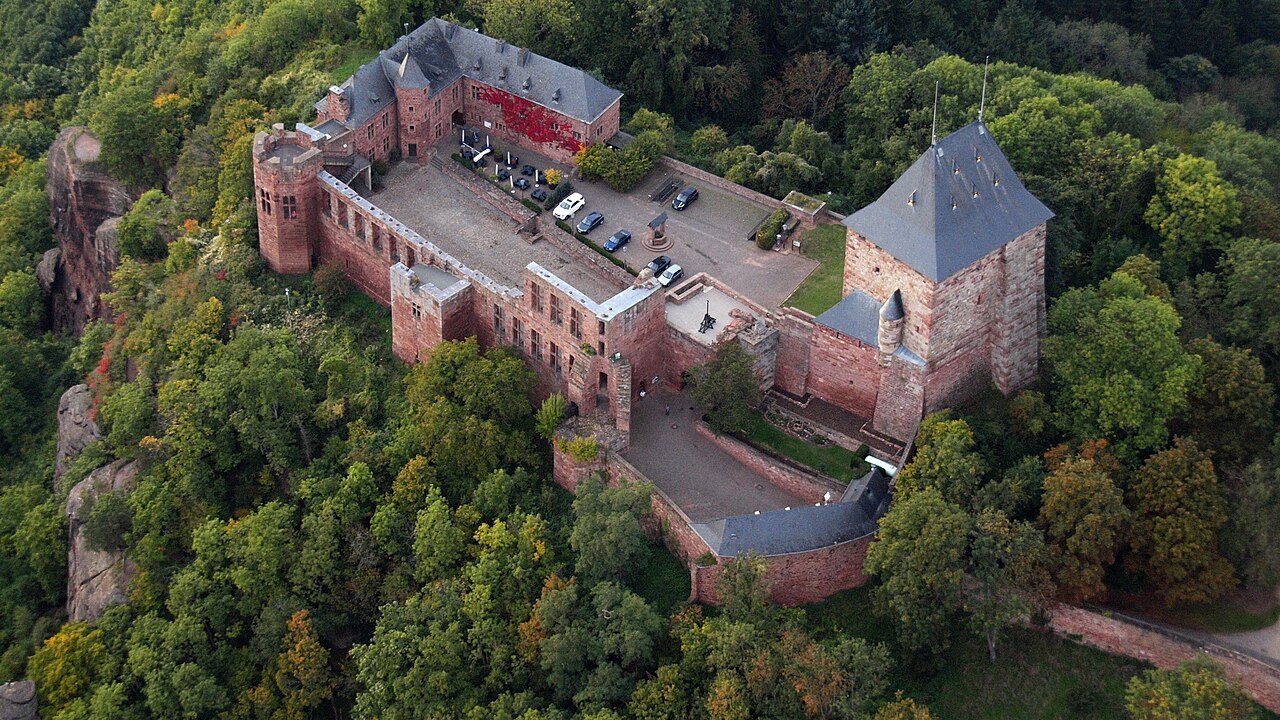
Burg Hengebach
Burg Hengebach stands prominently in the town of Heimbach, Germany, as a striking example of a medieval hill castle with a rich history spanning nearly a millennium. Perched strategically on a ridge overlooking the Rur River valley, this fortress exemplifies the defensive and residential architectural practices of the High and Late Middle Ages. Its origins trace back to the early 11th century, with documented ownership by notable figures such as Godizo von Aspel-Heimbach around 1011 and Count Balderich in the early 1020s, who used the castle as a base for regional military activities.
The castle’s initial construction phase occurred between the 12th and 14th centuries, during which it was developed as an oval-shaped ring fortress typical of hillside fortifications designed for both defense and habitation. The core of Burg Hengebach comprises a western courtyard housing the bergfried—a tall fortified tower serving as a lookout and last refuge—and the palas, the main residential building that accommodated the noble occupants. These elements demonstrate the dual military and domestic functions integral to medieval castles.
Historical evolution and ownership
The castle’s history is marked by a succession of influential owners reflecting the shifting political landscape of the Rhineland region. After its early association with local nobility, Burg Hengebach came under the control of the counts of Metz and Monterberg, followed by the Hengebach family. By the 13th century, figures like Everhard III were recorded as custodians, underscoring the castle’s role as a seat of regional power.
From the late medieval period through the 18th century, Burg Hengebach was governed by the counts and dukes of Jülich, a prominent noble house in the region. In 1609, jurisdiction passed to the Palatinate-Neuburg line, reflecting broader territorial realignments within the Holy Roman Empire. The castle suffered a major setback in 1687 when a devastating fire severely damaged its structures, leaving it largely in ruins.
Architectural development and features
Medieval core and defensive structures
The original medieval layout of Burg Hengebach is characterized by its oval ring fortress design, optimized for defense along the ridge above the Rur valley. The bergfried stands as a dominant feature, constructed to provide a vantage point for surveillance and a refuge during sieges. Adjacent to it, the palas served as the main residential hall, combining living quarters with administrative functions.
14th-century expansions
During the 14th century, the castle underwent significant expansion that included the addition of an eastern outer bailey, which served as an extra defensive courtyard beyond the main walls. This section incorporated a garden and a zwinger, an enclosed killing ground between two defensive walls designed to trap and expose attackers. New residential buildings were also erected on the southern slope overlooking the river, blending habitation with fortification.
Later modifications and modern integration
By the 18th century, a northern courtyard and several buildings along Hengebachstraße were added, initially separate from the medieval core. These structures were reintegrated into the castle complex during restoration efforts completed in 2009, which included the installation of modern amenities such as stairs and an elevator to enhance accessibility. These renovations respected the castle’s historic fabric while adapting it for contemporary use.
Preservation and contemporary use
Following the destructive fire of 1687 and subsequent partial dismantling in the 19th century, efforts to preserve Burg Hengebach began in earnest in the early 20th century. A local citizens’ group prevented its complete demolition, leading to acquisition by the county of Schleiden in 1935. Although restoration was delayed by World War II, significant rebuilding occurred between 1952 and 1954, when a Düsseldorf brewery restored parts of the castle and established a restaurant and hotel on site.
From 1970 onward, more comprehensive restoration was undertaken by local authorities, culminating in the castle’s adaptation to modern functions. Since 2009, Burg Hengebach has hosted the International Art Academy Heimbach alongside municipal offices and hospitality services, blending cultural heritage with active community engagement.
Architectural significance and legacy
Burg Hengebach exemplifies the evolution of a medieval hill castle through centuries of architectural adaptation and historical change. Its preservation of key defensive features such as the bergfried, ring walls, and zwinger offers valuable insight into medieval military architecture. The castle’s layered construction phases—from its early 11th-century origins through later expansions and modern restorations—reflect broader trends in castle building and regional power dynamics within the Rhineland.
Today, Burg Hengebach stands not only as a monument to medieval fortification but also as a vibrant cultural site, demonstrating how historic castles can be preserved and repurposed for contemporary educational and social uses while maintaining their architectural integrity.
Frequently asked questions (FAQ)
- How do I get to Burg Hengebach in Heimbach?
- Burg Hengebach is located in Heimbach, North Rhine-Westphalia. Visitors can reach it by car or local public transport, with parking available nearby.
- What is the historical significance of Burg Hengebach?
- Burg Hengebach served as a strategic hilltop fortress from the 11th century, reflecting medieval military architecture and regional noble power.
- Can I visit the interior of Burg Hengebach?
- Yes, parts of Burg Hengebach have been restored and adapted for public use, including cultural events and a restaurant, allowing visitors to explore its historic courtyards and towers.
- When was Burg Hengebach last restored?
- Major restoration efforts took place from the 1950s through the 1970s, with additional renovations completed in 2009 to improve accessibility and integrate modern facilities.
- Is Burg Hengebach accessible for people with disabilities?
- Recent renovations include the installation of stairs and an elevator, enhancing accessibility for visitors with mobility challenges.
Information
Sources & official resources
Verify the information above using these authoritative references.
Loading map...
Visitor reviews
No reviews yet. Been here? Write the first review and help other travelers!
Write the first reviewVisited this castle? Share your experience
Your review helps other travelers and adds first-hand knowledge to our encyclopedia.