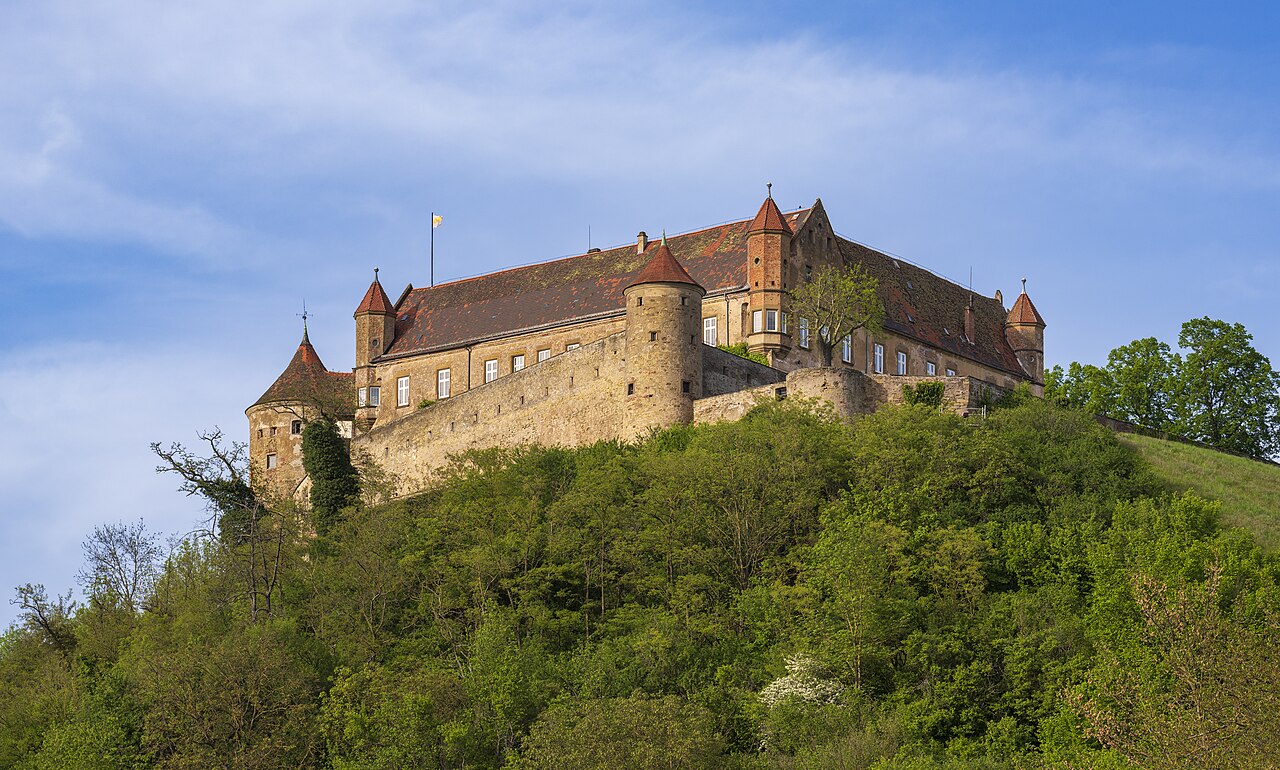
Burg Horkheim
Burg Horkheim is a historic water castle located in the municipality of Heilbronn, Germany. Built during the medieval period, the castle reflects centuries of architectural evolution and social history, particularly notable for its association with local noble families and its later role as a center of Jewish life.
Early history and ownership
The castle first appears in written records in 1344, when it was under the ownership of Eberhard II of Württemberg. Initially, Burg Horkheim was granted as a fief to several lesser nobles, reflecting the feudal structure of the region during the 14th century. In 1389, ownership transferred to the Teutonic Order's Heilbronn commandery, a military and religious institution, which maintained control until 1459. Subsequently, the castle passed into the hands of the Lemlin family, a prominent patrician family in Heilbronn, marking a shift from military to more civic and residential functions.
Development under the lemlin family
By 1461, the Lemlin family aligned the castle under the authority of the Electorate of the Palatinate, distinguishing it politically from the nearby village of Horkheim, which came under Württemberg control in 1504. The Lemlins established a chapel within the castle, supported by an endowment created by Volmar Lemlin and Agnes vom Bach in 1469. This chapel, served by a chaplain, was active until around 1520. Throughout the 16th century, the castle complex expanded to include economic buildings and cultivated vineyards within its gardens, although its land holdings remained limited, relying on external sources for supplies.
Jewish residence and cultural significance
In the 17th century, ownership passed to the Seybold family, and Burg Horkheim increasingly became a residence for Jewish families. By 1725, the castle's residential tower was converted into a synagogue, highlighting its religious and cultural importance. By the mid-18th century, about 17 Jewish families, numbering around 90 individuals, lived within the castle grounds. These families were often exempt from protection fees due to ongoing renovations or new construction projects.
However, tensions arose between the leaseholder Johann Heinrich Buhl, the Jewish residents, the local church, and villagers. These conflicts led to many Jewish families relocating around 1778 to the nearby town of Talheim, where they established a new Jewish community. Later, in the 19th century, Jewish residents began settling in the village of Horkheim itself, culminating in the construction of a synagogue in 1859 on Schlossgasse 5. After 1860, most of the Jewish population moved to the larger city of Heilbronn, and the synagogue was repurposed as a residential building.
Architectural features and castle layout
Burg Horkheim is characterized by a pentagonal layout originally surrounded by a moat approximately 10 meters wide. Today, the moat is partially filled and dry, converted into garden space. The castle lies west of the historic village center of Horkheim, nestled in a low-lying bend of the Neckar River, which contributes to its classification as a water castle.
The steinhaus tower
At the heart of the complex stands the four-story Steinhaus residential tower, reaching about 16 meters in height. This tower dates to the castle's earliest phase and forms part of the southwestern section. Constructed from sturdy stone, it is enclosed by partially preserved walls with remnants of two corner towers. The original entrance was on the second upper floor, an uncommon defensive feature designed to enhance security. A later ground-floor entrance was created by breaching the original structure.
The interior of the Steinhaus contains significant artistic and architectural details. The first floor preserves Gothic vine paintings and traces of painted coats of arms on the north-facing window jamb. The eastern window niches reveal up to 28 layers of whitewash, indicating centuries of maintenance and decoration. The second floor features Hebrew inscriptions and remnants of Renaissance-style decorative painting, reflecting the castle's use by Jewish residents in the 18th century. The third floor was divided into an unplastered anteroom and a plastered hall with seating niches beside early Gothic windows dated to the early 14th century. These windows include simple pointed arches and paired designs topped by trefoil motifs, typical of medieval architecture.
Additional buildings and modifications
East of the Steinhaus is a two-story residential building from 1550, constructed by Volmar Lemlin. This building features decorative half-timbering on the upper floor and bears the coats of arms of Lemlin and Agnes vom Bach on a corner post, inscribed with the construction year. Other residential buildings along the northeastern edge date mainly from the 19th century but have origins in the 16th century. Western economic buildings mostly date from the 18th century, supporting the castle's agricultural functions.
A classical-style building was added at Schlossgasse 18 after demolition of part of the surrounding wall and partial filling of the moat. The castle's residential tower's conversion into a synagogue in 1725 underscores its layered history, from medieval fortification to a center of early modern Jewish life.
Historical transformations and modern era
In 1834, Burg Horkheim entered private ownership. During the 19th century, parts of the moat were filled in, and the area along the castle street was developed with new residential constructions, reflecting changing urban and social dynamics. The castle's defensive role diminished, and it became more integrated into the surrounding village fabric.
The castle today remains a significant cultural monument, illustrating medieval defensive architecture, Renaissance residential development, and early modern Jewish heritage. Its preservation of architectural elements from multiple periods offers valuable insights into the region's history and the diverse communities that inhabited Burg Horkheim.
Frequently asked questions (FAQ)
- How do I visit Burg Horkheim?
- Burg Horkheim is located in Heilbronn, Germany. Visitors can explore the exterior and surrounding gardens, but the interior is generally not open to the public. Check local tourism websites for any special events or guided tours.
- What is the historical significance of Burg Horkheim?
- Burg Horkheim is historically significant as a medieval water castle with connections to the Teutonic Order and later as a residence for Jewish families, including a synagogue within the castle tower.
- When was Burg Horkheim built?
- The castle dates back to at least 1344, with construction phases spanning the 14th to 16th centuries, including significant expansions in the 15th and 16th centuries.
- Can I see architectural features from different periods at Burg Horkheim?
- Yes, Burg Horkheim exhibits architectural elements from the Gothic period, Renaissance decorative painting, and 18th-century Jewish inscriptions, reflecting its layered history.
- Is Burg Horkheim accessible for people with mobility issues?
- Due to the castle's historic structure and partial preservation, accessibility may be limited. Visitors with mobility concerns should check in advance for accommodations.
Information
Loading map...
Visitor reviews
No reviews yet. Been here? Write the first review and help other travelers!
Write the first reviewVisited this castle? Share your experience
Your review helps other travelers and adds first-hand knowledge to our encyclopedia.