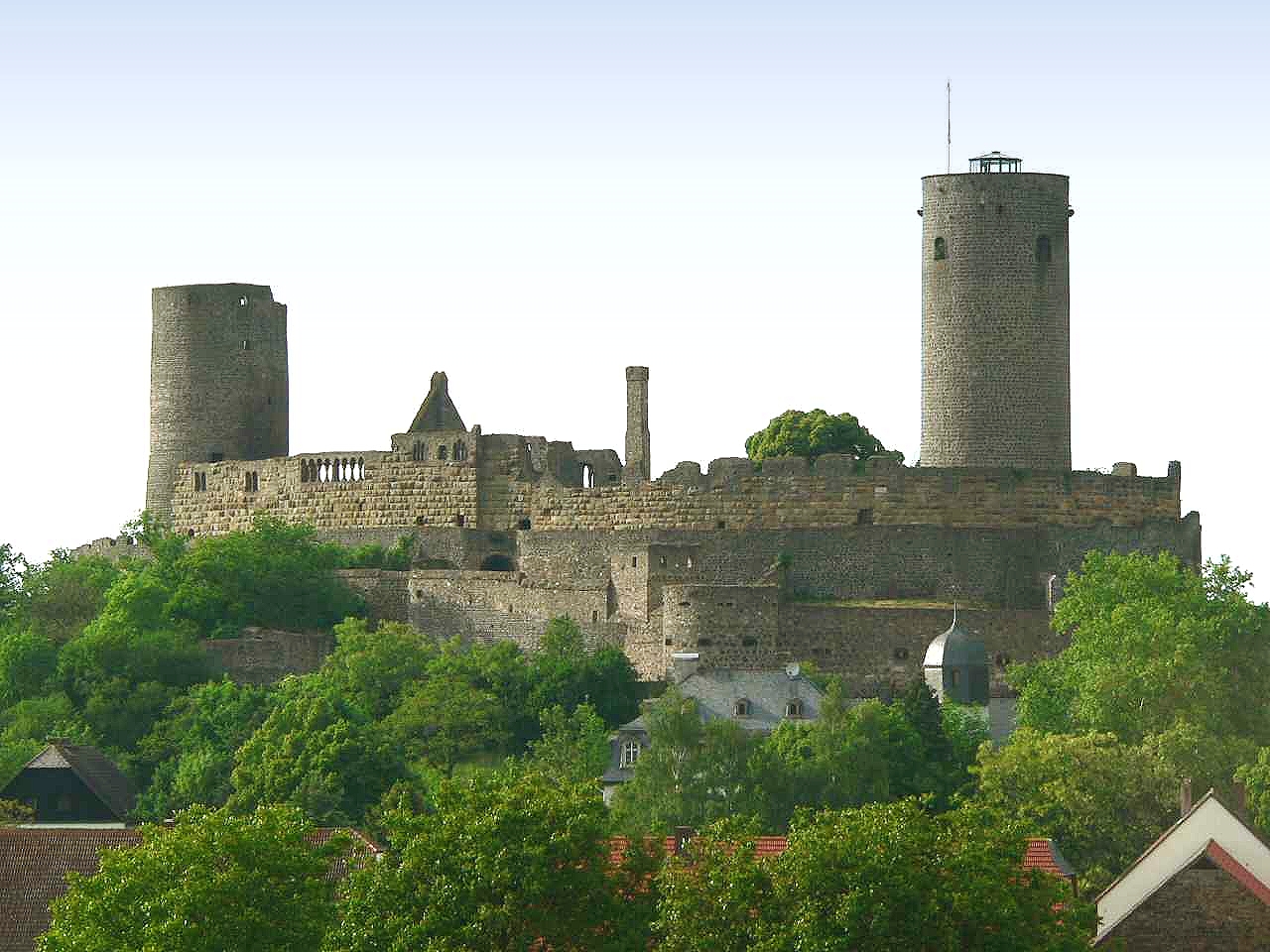
Burg Grüningen
Burg Grüningen stands as a significant late medieval water castle ruin located in the municipality of Pohlheim, Germany. Constructed most likely between the 12th and 13th centuries by local Germanic builders, the castle embodies the architectural and strategic characteristics of fortifications from this turbulent period in European history. Its location within the town's defenses and its historical role reflect the complex feudal and military landscape of medieval Germany.
Historical significance and ownership
The castle first appears in documented history on November 8, 1309, when a church record identifies Philipp the Younger of Münzenberg as its owner. Alongside him, the presence of an administrator named Centgraf Orto is noted, who likely served as a Burgmann — a knight or noble responsible for the castle’s defense and administration. This early record establishes the castle's importance as a feudal stronghold within the region.
Throughout the 14th century, references to the castle appear under various names such as “Schloß Gruningen” and “Schloß Grüninges,” indicating its continued prominence. Around 1394 and shortly before 1400, documents mention a freedom letter issued by Philipp VII of Falkenstein-Münzenberg, which underscores the castle’s role in regional governance and local rights.
In the first half of the 15th century, ownership transferred to Count Gottfried VIII of Eppstein. He is credited with significant rebuilding or expansion efforts, modernizing the castle's defenses to meet the evolving military demands of the period. By 1459, records show Werner von Eppenstein selling half of the castle and the surrounding lands to Count Bernhard of Solms-Braunfels, indicating the castle’s continued strategic and economic value.
Into the early 16th century, Eberhard IV of Eppstein granted a castle peace agreement in 1503, confirming that Burg Grüningen remained an active and governed fortress. However, by the early 17th century, the castle had fallen into disrepair. Notably, a 1603 record describes it as a ruined castle, though it had apparently avoided destruction by fire, suggesting gradual abandonment rather than violent ruin.
Despite the castle's physical decline, the surrounding community maintained legal and customary ties to the site. In 1679, Wilhelm Moritz, Count of Solms-Greifenstein, renewed freedom rights for the peasants and residents, reflecting the enduring cultural and historical significance of Burg Grüningen within the local heritage.
Architectural layout and features
The castle occupies a roughly square footprint measuring approximately 28 meters per side. This compact design was integrated into the town's defensive walls, which replaced earlier village fortifications, demonstrating the castle’s role as both a military bastion and a component of urban defense.
The curtain wall surrounding the castle remains largely intact, with a consistent thickness of about two meters. This robust wall was essential for withstanding assaults and controlling access to the fortress.
At the northwest corner stands a prominent remnant of a round tower, now reduced to a stump. Measuring roughly 9.5 meters in diameter with walls nearly 80 centimeters thick, this tower was a key defensive feature. It has been restored and now serves as a viewing platform, offering visitors a vantage point over the castle grounds and surrounding landscape.
Adjoining the southern corner of the curtain wall is the preserved remains of what is likely the palas — the main residential building or great hall of the castle. This structure includes a reconstructed half-timbered upper floor from recent restoration efforts, while its lower levels contain two vaulted cellars. These cellars, with their arched stone ceilings, were typical of medieval castles and served as durable storage or service areas.
To the north of the palas, visitors can observe the foundations of additional buildings through exposed cellar remains, indicating that the castle once housed multiple internal structures. Further northeast, traces of a well are visible, an essential feature for water supply during sieges and daily life.
Defensive and residential integration
Burg Grüningen’s design reflects a dual purpose: it was both a defensive stronghold and a residential center. The integration of the castle into the town’s fortifications enhanced the overall defense of the settlement while providing a secure residence for its noble occupants.
The combination of thick curtain walls, a strategically placed round tower, and the palas with vaulted cellars illustrates the medieval approach to castle construction, balancing military needs with domestic comfort. The presence of a well within the walls further emphasizes the castle's preparedness for prolonged defense.
Preservation and restoration efforts
In the 20th century, Burg Grüningen became the focus of careful restoration and conservation efforts. These projects aimed to stabilize the remaining structures and reconstruct elements such as the half-timbered upper floor of the palas. The restored round tower now serves as a viewing platform, enhancing visitor experience and providing educational opportunities about the castle’s history and architecture.
These efforts have ensured that Burg Grüningen remains an authentic and valuable cultural heritage site, offering insight into the medieval fortifications and noble residences of the region. The preservation of the curtain walls, tower, and cellars allows visitors to appreciate the castle’s original layout and defensive capabilities.
Visitor experience and cultural importance
Today, Burg Grüningen is accessible to visitors interested in medieval history, architecture, and German heritage. The castle’s ruins provide a tangible connection to the past, illustrating the evolution of fortification techniques and noble life from the 12th century onward.
Visitors can explore the restored tower, walk along the curtain walls, and view the remains of the palas and other internal buildings. The site’s integration into the town’s defensive walls offers a unique perspective on how castles functioned within broader urban fortification systems.
Burg Grüningen stands as a testament to the region’s medieval history, reflecting the complex interplay of military, residential, and administrative functions that characterized castles of its era. Its preservation allows for ongoing education and appreciation of Germany’s rich architectural and feudal heritage.
Frequently asked questions (FAQ)
- When was Burg Grüningen built and by whom?
- Burg Grüningen was constructed during the late medieval period, most likely between the 12th and 13th centuries, by local Germanic builders.
- What remains can visitors see at Burg Grüningen today?
- Visitors can see the largely intact curtain wall, the restored round tower now serving as a viewing platform, the remains of the palas with vaulted cellars, foundations of other buildings, and traces of a well.
- What is the historical significance of Burg Grüningen?
- Burg Grüningen played an important role in regional defense and administration, with documented ownership by notable figures such as Philipp the Younger of Münzenberg and Count Gottfried VIII of Eppstein, reflecting its strategic and feudal importance.
- Is Burg Grüningen accessible to the public?
- Yes, Burg Grüningen is accessible to visitors who can explore the ruins, including the restored tower and castle walls, to learn about its medieval history and architecture.
Information
Loading map...
Visitor reviews
No reviews yet. Been here? Write the first review and help other travelers!
Write the first reviewVisited this castle? Share your experience
Your review helps other travelers and adds first-hand knowledge to our encyclopedia.