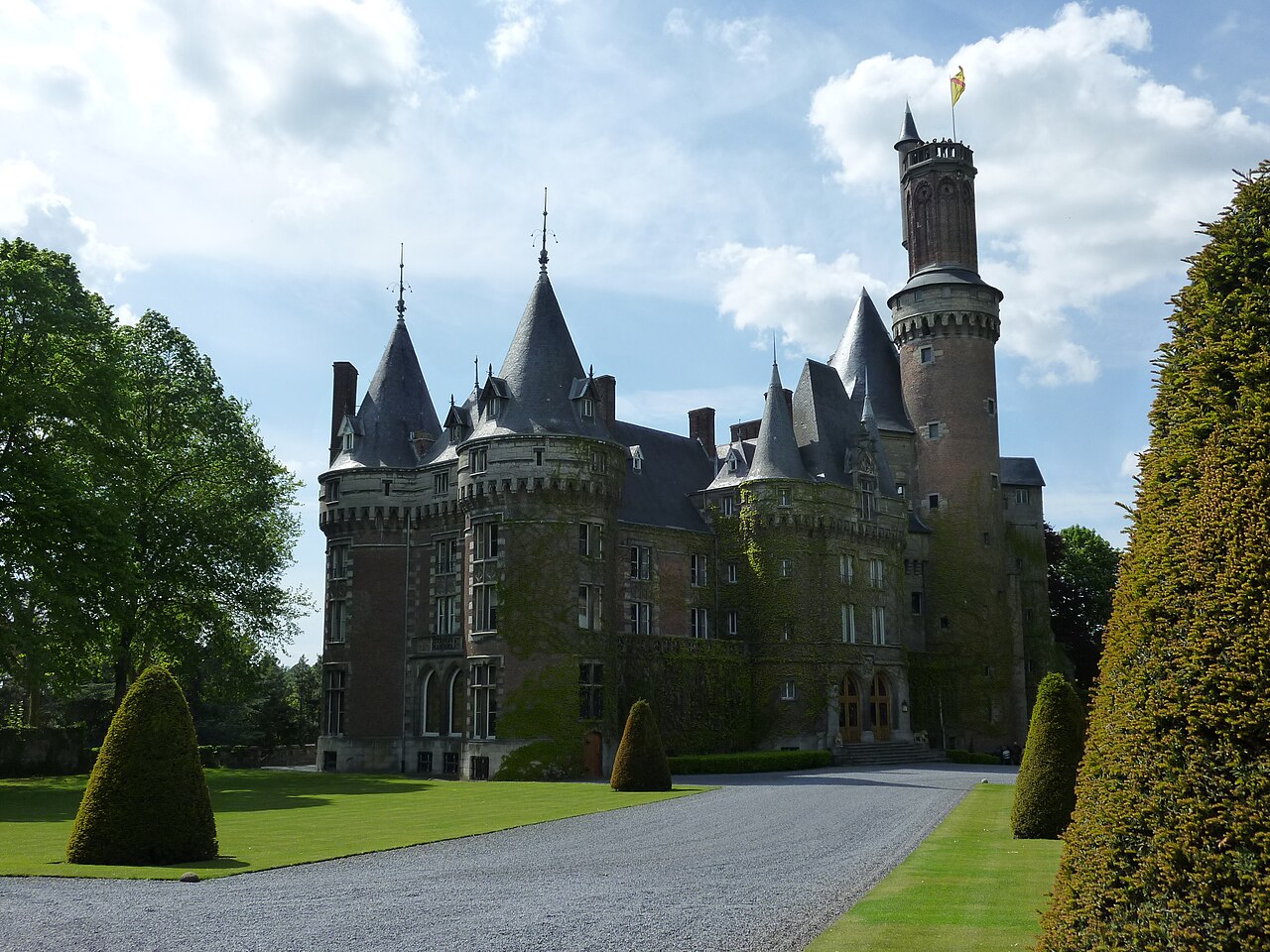
Briffœil Castle
Briffœil Castle, locally known as Château de Briffœil, is a historic medieval castle located east of the hamlet of Briffœil in the province of Hainaut, within the Wallonia region of Belgium. This site has witnessed centuries of military and noble activity, reflecting the turbulent history of the borderlands between the German County of Hainaut and the French Tournaisis territory.
The origins of Briffœil Castle date back to the 12th or 13th century, when an earlier fortification was likely established by the Briffœil family, the original landowners. The castle evolved into a moated quadrangular enclosure by the 15th century, featuring prominent corner towers that provided defensive strength. Within this fortified perimeter stood a seigniorial farm complete with stables, a manor house, and a chapel, indicating the castle’s dual role as both a military stronghold and a noble residence.
Medieval architecture and defensive features
The castle’s quadrangular layout was typical of high medieval fortifications designed to maximize defense and control over the surrounding lands. The moat encircling the castle added a critical layer of protection against siege engines and infantry assaults. The surviving round tower dates from this period and exemplifies the defensive architecture of the time, serving as a lookout and strongpoint.
During the medieval period, the castle was often garrisoned by troops, reflecting its strategic importance near a contested border. The owners, the d'Enghien family, typically resided elsewhere, entrusting the castle’s defense and administration to a squire and a bailiff who managed the estate’s lands.
Sieges and destruction in the late medieval period
Briffœil Castle played a role in the conflicts of the late 15th century. In 1477, it withstood a siege by French forces commanded by the Sire of Mouy acting on behalf of King Louis XI of France. The following year, in 1478, French troops returned, and rather than surrender, the castle’s chatelain, Antoine de Mortagne, deliberately set fire to the fortress, reducing it to ruins to deny its use to the enemy.
Post-medieval ownership and rebuilding
After its destruction, Briffœil Castle was rebuilt and passed through the hands of notable noble families, including the d'Argenteau and Merode families. These owners did not reside in the castle but managed it through appointed bailiffs. In the 17th century, the estate was acquired by the Vilain de Gand family, who likely used the castle as a residence at times and undertook repairs and rebuilding efforts. The ruined stable building and the chapel of Saint-Georges visible today probably date from this period.
Military significance in the 17th and 18th centuries
In 1655, Briffœil Castle again became a military target during the campaigns of Louis XIV of France. French troops led by Turenne, Marshal General of France, besieged the castle, which surrendered after just one day. Following its capture, the French forces dismantled the castle’s defenses and demolished much of the structure. Despite this, partial rebuilding occurred later in the century.
Financial difficulties forced the Vilain de Gand family to sell the castle in 1705 to the Hannecart family from Ath, who made it their primary residence. The castle’s strategic location was again highlighted in 1745 when it served as the headquarters for prominent military leaders preparing for the Battle of Fontenoy. These included Prince William, Duke of Cumberland, Dominik von Königsegg-Rothenfels, Imperial Fieldmarshal, and Karl August, Prince of Waldeck and Pyrmont. The castle was renovated in the same year to accommodate these functions.
Decline and present condition
The French Revolution marked a turning point for Briffœil Castle. The property was confiscated, and the Hannecart family fled, never to return. The castle was left abandoned and fell into disrepair throughout the 19th century. In 1869, the castle was sold at auction for building materials and subsequently demolished, leaving only ruins.
Today, the chapel of Saint-Georges remains accessible to visitors, offering a glimpse into the castle’s religious and residential past. The round tower and stable ruins stand on private farmland and are not generally open to the public. Briffœil Castle remains a relatively forgotten site, rich with history and architectural remnants that reflect its medieval origins and the shifting fortunes of its noble owners.
Frequently asked questions (FAQ)
- How do I get to Briffœil Castle?
- Briffœil Castle is conveniently located next to Rue de Wadergnies in Belgium. You can reach it by car or public transport, with the nearest bus stop just a short walk away. Parking is available nearby for visitors who choose to drive.
- What is the historical significance of Briffœil Castle?
- Briffœil Castle dates back to the 12th century and has played a vital role in the region's history. It served as a strategic fortress during various conflicts and has witnessed numerous historical events. The castle is a testament to the architectural styles and cultural heritage of medieval Belgium.
- Can I take a guided tour of Briffœil Castle?
- Yes, guided tours are available at Briffœil Castle, offering visitors a deeper insight into its history and architecture. These tours are conducted by knowledgeable guides who share fascinating stories about the castle and its significance. It is advisable to book in advance, especially during peak tourist seasons.
- Is Briffœil Castle accessible for visitors with disabilities?
- Briffœil Castle strives to be accessible to all visitors. While some areas may have limited access due to the historic nature of the site, efforts have been made to provide suitable pathways and facilities. It is recommended to contact the castle's visitor services for specific accessibility information before your visit.
- When is the best time to visit Briffœil Castle?
- The best time to visit Briffœil Castle is during the spring and early autumn months when the weather is pleasant and the gardens are in full bloom. Additionally, the castle hosts various events and reenactments during these seasons, enhancing the visitor experience. Summer can be busy, so plan accordingly.
- What are the opening hours for Briffœil Castle?
- Briffœil Castle is open to visitors from 10 AM to 6 PM, Tuesday through Sunday. It is closed on Mondays, so be sure to plan your visit accordingly. Special holiday hours may apply, so checking the official website for any updates is recommended.
- How much does it cost to enter Briffœil Castle?
- The ticket prices for Briffœil Castle are quite reasonable, with adult tickets priced at €10 and discounts available for children and seniors. Family tickets are also offered at a reduced rate, making it an affordable outing for visitors. Tickets can be purchased at the entrance or online in advance.
- Are there any nearby attractions to visit along with Briffœil Castle?
- Yes, there are several nearby attractions worth exploring, including local museums and beautiful parks. The charming town of Wadergnies offers quaint shops and cafes, perfect for a leisurely stroll after your visit to the castle. Consider adding these sites to your itinerary for a full day of exploration.
Information
Address
Next to Rue de Wadergnies, Belgium
Loading map...
Visitor reviews
No reviews yet. Been here? Write the first review and help other travelers!
Write the first reviewVisited this castle? Share your experience
Your review helps other travelers and adds first-hand knowledge to our encyclopedia.