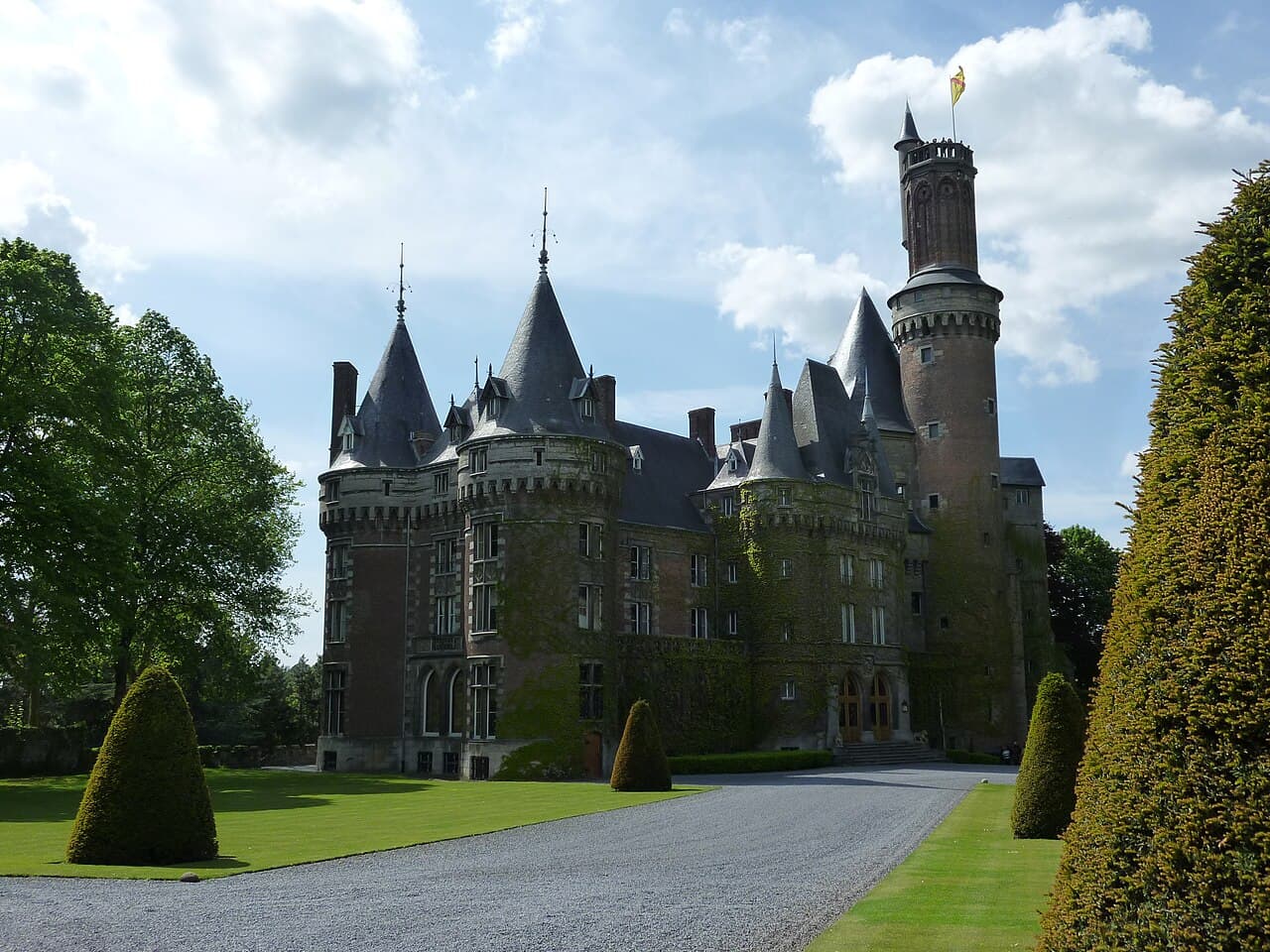
Antoing Castle
Antoing Castle, also known as Château d'Antoing or Château des Princes de Ligne, is a remarkable historic fortress located in the town of Antoing, in the province of Hainaut within Belgium's Wallonia region. This castle stands on the right bank of the Scheldt River, commanding strategic views over the surrounding plains that stretch from Tournai to Mons. Its origins trace back to the 10th century, when it was initially constructed as a wooden motte-and-bailey castle by the Count of Flanders, serving as a defensive refuge for the local population.
The early fortification was modest, consisting of a raised earth motte topped by a wooden keep and surrounded by a palisade and deep ditch, inspired by Roman military camps. This primitive structure was primarily intended to protect the territory and its inhabitants from invasions or raids. By the 12th century, the wooden defenses were replaced with robust stone walls and a solid stone keep, reflecting advancements in medieval military architecture and the rising status of the castle's castellan, who became a lord in his own right.
Medieval transformations and the melun era
In 1327, the castle passed by marriage to the influential House of Melun. Between 1436 and 1452, under the direction of Jean de Melun, Antoing Castle underwent significant reconstruction. The old keep was transformed into a more luxurious and comfortable tower house, blending defensive strength with residential refinement. The fortifications were modernized to withstand the emerging threat of artillery, featuring thick curtain walls, round towers, and gunports. A barbican was added in front of the gate tower, serving as a fortified outwork to protect the main entrance from direct attack and artillery fire.
The Melun family elevated the castle's prominence by hosting numerous notable visitors, including Philip the Good in 1464, Charles the Bold in 1468, the Holy Roman Emperor Maximilian I accompanied by his daughter Margaret of Austria, Henry VIII of England in 1513, and the Holy Roman Emperor Charles V with his son Philip II of Spain in 1546. This illustrious guest list underscores Antoing's importance as a political and military hub in the region during the late Middle Ages and Renaissance.
16th-century expansions and the birth of the corps de logis
During the mid-16th century, a new corps de logis was constructed adjacent to the gate tower, which today functions as a coach house. At this time, a large, slender brick tower was also added against the old tower house, becoming the tallest tower of the current castle complex. Additionally, a manor house was built in the Flemish Renaissance Revival style, reflecting the architectural tastes of the period and the castle's evolving residential function.
The princes de ligne and later history
In 1634, Antoing Castle passed by marriage to the De Ligne family, who had been elevated to princes of the Holy Roman Empire by Emperor Rudolf II in 1601. The De Ligne family has maintained ownership of the castle to the present day, preserving its historical legacy and architectural heritage.
The castle continued to attract royal attention, with visits from Louis XIV of France in 1670 and later from Louis XV accompanied by the Dauphin in 1745. These visits highlight Antoing's sustained significance as a noble residence and strategic site through the early modern period.
19th-century neo-gothic restoration
In the 19th century, the castle underwent a major restoration led by the French architect Clément Parent, a pupil of the renowned Eugène Viollet-le-Duc. Parent reimagined Antoing Castle in the Neo-Gothic style, a romantic revivalist movement that sought to restore medieval architectural forms with modern techniques. This restoration gave the castle its present-day appearance, blending authentic medieval elements with 19th-century stylistic flourishes, including pointed arches, decorative battlements, and ornate stonework.
20th-century uses and cultural significance
By 1901, Antoing Castle had been unoccupied for about a decade. It was then repurposed as a Jesuit college, known as the College of the Sacred Heart, accommodating French Jesuits and their students who had been exiled due to French secular laws. Among its students was the future French president and wartime leader Charles de Gaulle, who studied here from 1905 to 1908.
During World War I, in 1914, the Jesuits were forced to vacate the castle when the German Army converted it into a military hospital. Despite these changes, the castle has remained a private residence of the De Ligne family and retains much of its historical character.
Visiting antioing castle today
Currently, Antoing Castle is not open to the public on a regular basis but can be visited on special guided tours organized by the town of Antoing. Visitors can explore the courtyard, the chapel located within the courtyard, and ascend to the top of the highest tower for panoramic views. The main residential areas of the castle remain private and off-limits, preserving the castle's status as a family home.
The castle is classified as a heritage site of Wallonia since 1949, recognizing its cultural and historical importance. Nearby, visitors can also explore the César Castle, adding to the rich tapestry of medieval and renaissance heritage in the region.
Architectural features and defensive elements
Antoing Castle exemplifies a blend of medieval military architecture and romantic 19th-century restoration. Its original motte-and-bailey layout evolved into a formidable stone fortress with a keep, curtain walls, round towers, and a barbican protecting the main gate. The corps de logis and the brick tower reflect later additions that enhanced residential comfort and status.
The castle's Neo-Gothic restoration introduced decorative elements typical of the revival style, including pointed windows, intricate stone carvings, and ornamental battlements, which complement the original medieval structures. The combination of defensive and residential architecture makes Antoing Castle a unique example of a fortress adapted over centuries to changing needs and tastes.
Strategic location and landscape
Situated on the right bank of the Scheldt River, Antoing Castle's location was chosen for its commanding views and control over the surrounding plains. The adjacent parkland still overlooks the river, maintaining the castle's historic role as a vantage point and defensive stronghold. This strategic position contributed to its military and political significance throughout its history.
Historical events and notable figures
Antoing Castle was a focal point during pivotal moments in European history. In 1565, it hosted an important assembly of future leaders of the Dutch Revolt, including William of Orange and the Counts of Egmont, Horne, Brederode, and Marnix of Saint-Aldegonde. This meeting underscored the castle's role as a political hub during turbulent times.
The castle's guest list reads like a who's who of European nobility and royalty, featuring visits by Philip the Good, Charles the Bold, Maximilian I, Henry VIII, Charles V, Philip II of Spain, and French kings Louis XIV and Louis XV. These visits highlight Antoing's importance as a diplomatic and noble residence.
Cultural heritage and preservation
Today, Antoing Castle stands as a testament to centuries of European history, architectural evolution, and noble lineage. Its classification as a heritage site ensures ongoing preservation efforts. While private, its occasional public access allows visitors to appreciate its rich history and architectural beauty, making it a significant cultural landmark in Belgium.
Frequently asked questions (FAQ)
- What is the history of Antoing Castle?
- Antoing Castle dates back to the 12th century and has served various roles throughout its history, including a fortress and residence. It played a significant part in regional conflicts and has witnessed many historical events, making it a notable landmark in Belgium.
- When is Antoing Castle open for visitors?
- Antoing Castle is typically open to the public from April to October. Opening hours may vary, so it is advisable to check the official website or local tourism information for the most current visiting times before planning your visit.
- Can I take guided tours of Antoing Castle?
- Yes, guided tours are available at Antoing Castle, providing visitors with in-depth insights into its history and architecture. These tours are often led by knowledgeable guides who can enhance your experience with fascinating stories about the castle.
- Is Antoing Castle accessible for visitors with disabilities?
- While efforts have been made to improve accessibility, some areas of Antoing Castle may still pose challenges for visitors with mobility issues due to its historical architecture. It is recommended to contact the castle staff in advance to inquire about specific accessibility options available during your visit.
- What are the ticket prices for Antoing Castle?
- Ticket prices for Antoing Castle are generally affordable, with discounts available for children, seniors, and groups. It is best to check the official website for the latest pricing information and any special promotions that may be offered.
- What nearby attractions should I visit while at Antoing Castle?
- While visiting Antoing Castle, you can also explore the charming town of Antoing, which features beautiful architecture and local shops. Additionally, nearby attractions include the scenic landscapes of the Scheldt River, perfect for leisurely walks and picnics.
- When is the best time to visit Antoing Castle?
- The best time to visit Antoing Castle is during the spring and summer months when the weather is pleasant, and the gardens are in full bloom. During these seasons, visitors can fully enjoy both the castle and its surrounding natural beauty.
Photo gallery

Information
Website
Visit websiteSources & official resources
Verify the information above using these authoritative references.
Loading map...
Visitor reviews
No reviews yet. Been here? Write the first review and help other travelers!
Write the first reviewVisited this castle? Share your experience
Your review helps other travelers and adds first-hand knowledge to our encyclopedia.



