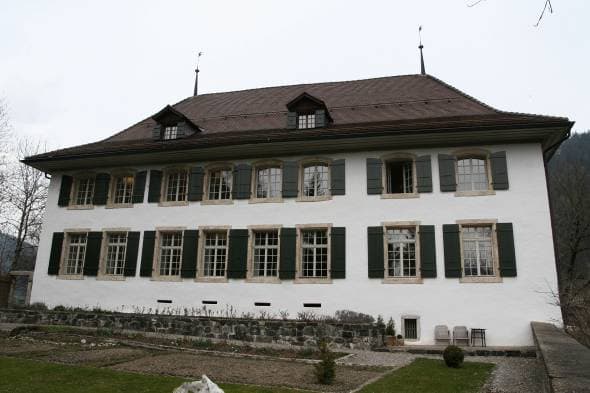
Blankenburg Castle with castle barn — Switzerland castle

Blankenburg Castle with castle barn

Blankenburg Castle with castle barn in Zweisimmen, Switzerland
Zweisimmen, Bern, Switzerland
Late Medieval (14th–15th c.)

Blankenburg Castle, known in German as Schloss Blankenburg, is a significant hill castle located in the municipality of Zweisimmen in the canton of Bern, Switzerland. Constructed in the 14th century, this castle served as an important administrative center during the late medieval period. It stands as a remarkable example of medieval architecture adapted to the Swiss landscape, combining defensive features with residential and administrative functions.

Historical background and significance

The origins of Blankenburg Castle date back to the late medieval era, specifically the 14th century, a time when many castles were built across Europe to assert control over territories and provide protection. The castle was strategically positioned on a hill, allowing for commanding views of the surrounding valleys and routes, which was essential for both defense and governance.

Throughout its history, the castle served as the seat of local rulers and administrators who managed the surrounding lands and upheld the authority of the ruling powers in the region. Its location in Zweisimmen placed it at a crossroads of trade and communication routes in the Bernese Oberland, enhancing its administrative importance.

Architectural features and layout

Blankenburg Castle exemplifies the characteristics of a hill castle with robust fortifications adapted to the terrain. The castle complex includes a main residential building, defensive walls, and a notable castle barn that reflects the agricultural and economic activities associated with the castle estate.

The castle's defensive structures typically include thick stone walls, battlements, and towers positioned to maximize surveillance and protection. The placement on elevated ground provided natural defense advantages, supplemented by man-made fortifications.

The castle barn is an important component, indicating the castle's role not only as a military and administrative center but also as an economic hub that managed agricultural production and storage. This barn would have been essential for sustaining the castle's inhabitants and supporting local farming communities.

Role in regional governance and economy

As an administrative center, Blankenburg Castle was integral to the governance of the surrounding territories. It housed officials responsible for collecting taxes, administering justice, and overseeing local affairs. The castle's presence reinforced the authority of the ruling nobility or appointed administrators in the Bernese region.

The agricultural facilities, including the castle barn, highlight the castle's function in managing and storing resources. This dual role of defense and economic management was typical of many medieval castles, which served as focal points for regional control and sustenance.

Preservation and current status

Today, Blankenburg Castle remains a notable historical site in the canton of Bern. While detailed information about its current condition is limited, its recognition as a cultural landmark underscores its importance in Swiss heritage. The castle's architecture and historical associations continue to attract interest from historians, architects, and visitors.

Efforts to preserve such medieval castles in Switzerland often focus on maintaining structural stability and promoting public awareness of their historical value. Blankenburg Castle's location and features make it a valuable example of late medieval hill castle architecture in the region.

Visiting Blankenburg Castle

Visitors to Zweisimmen interested in medieval history and architecture can explore the area around Blankenburg Castle. While specific visitor information such as opening hours and ticket prices is not widely documented, the castle's setting offers a glimpse into the medieval past of the Bernese Oberland.

The surrounding region is also known for its scenic beauty and cultural heritage, making it a worthwhile destination for those interested in Swiss history and landscapes.

Frequently asked questions (FAQ)

How do I get to Blankenburg Castle?
Blankenburg Castle is located in Zweisimmen, Switzerland, and can be easily reached by car or public transport. If you're using public transport, take a train to Zweisimmen and then a short bus ride or a pleasant walk to the castle.
What is the historical significance of Blankenburg Castle?
Blankenburg Castle dates back to the 13th century and has played a crucial role in the region's history. It served as a strategic fortification and residence for local nobility, showcasing the architectural styles and historical events of its time.
When was Blankenburg Castle built?
Blankenburg Castle was constructed in the early 13th century, around 1250. It reflects the medieval architecture of the period and has undergone various renovations, preserving its historical integrity.
Can I visit Blankenburg Castle year-round?
Yes, Blankenburg Castle is open to visitors year-round, although certain areas may have restricted access during the winter months. It’s advisable to check the official website for specific seasonal hours and any special events.
Why is the castle barn significant?
The castle barn is an important historical structure that demonstrates the agricultural practices of the region during the castle's operational years. It adds to the overall charm and context of the castle's history, giving visitors insight into the daily life of its past inhabitants.
Is it possible to book guided tours of Blankenburg Castle?
Yes, guided tours of Blankenburg Castle are available and can enhance your visit by providing in-depth knowledge of its history and architecture. It's recommended to book in advance, especially during peak tourist seasons.
What are the ticket prices for visiting Blankenburg Castle?
Ticket prices for Blankenburg Castle vary based on age and group size, with discounts typically available for children and seniors. Check the official website for the most current pricing and any special offers.
What are the opening hours for Blankenburg Castle?
Blankenburg Castle generally opens at 10 AM and closes at 5 PM, but these hours may vary seasonally. Always confirm the exact hours before your visit to ensure you have ample time to explore the site.
What nearby attractions can I visit while in Zweisimmen?
While in Zweisimmen, you can explore the stunning landscapes of the Swiss Alps, hike the scenic trails, or visit nearby villages such as Lenk and Gstaad. The area is also known for winter sports and outdoor activities, making it a perfect destination year-round.

Photo gallery

Blankenburg Castle with castle barn
Click to view

Photo by Kanton Bern•Public domain

1 photo • Click any image to view in full screen

Information

Hill Castle

Loading map...

Visitor reviews

No reviews yet. Been here? Write the first review and help other travelers!

Write the first review

Visited this castle? Share your experience

Your review helps other travelers and adds first-hand knowledge to our encyclopedia.

Write a review

(5/5)

0/2000 characters

Your review will be visible after admin approval

Nearby castles

14.8 km

Weissenburg Castle

Weissenburg, Switzerland

Weissenburg Castle is a significant medieval fortress located on a steep hill west of the village of Weissenburg in Switzerland. Its strategic position near the confluence of the Bunsch stream and the Simme river allowed it to dominate the surrounding landscape and control important regional routes. The castle's origins are tied to the Freiherr von Weissenburg family, first recorded in 1175 as vassals of Duke Berthold IV of Zähringen, although the castle itself is not explicitly mentioned until later. The rise of the Weissenburg family and castle expansion By the mid-13th century, the Weissenburg family had begun significant construction and expansion efforts. When Rudolf III assumed the title in 1259, he undertook extensive repairs and expansions that brought Weissenburg Castle to its full medieval form. This included strengthening the defensive walls, adding towers, and enhancing the gatehouse to withstand sieges. The castle's layout took advantage of the natural topography, with steep hills protecting three sides and a man-made ditch guarding the gentler western approach. Portions of a round tower remain visible above this ditch, illustrating the defensive design typical of hill castles of the high medieval period. Territorial ambitions and conflicts Starting around 1250, the Weissenburgs expanded their Herrschaft (lordship) by acquiring nearby territories such as Wimmis, Weissenau Castle in Unterseen, and the villages of Rothenfluh and Balm. However, political alliances and rivalries shaped their fortunes. Rudolf III’s alignment with the powerful Habsburgs antagonized the neighboring city of Bern, leading to military confrontations. In 1288, Rudolf III suffered a defeat at Wimmis against Bernese forces, resulting in the plundering of the village. Subsequent disputes with the Habsburgs and the Counts of Neu-Kyburg led to the loss of Rothenfluh and Weissenau Castles around 1298. Later history and decline Despite setbacks, Rudolf’s son Johann the Elder continued to expand the family’s holdings, acquiring parts of the Hasli valley as well as Oberhofen and Unspunnen Castles. However, in 1334, Johann the Elder faced a decisive defeat by Bern, forcing him to recognize Bernese overlordship over Weissenburg Castle and its territories. The Weissenburg lineage ended in 1368 with the death of Johann the Younger, after which their estates passed to the Lords of Brandis. Bernese administration and abandonment In the mid-15th century, the Lords of Brandis sold their lands in the Bernese Oberland, including Weissenburg Castle, to the city of Bern. Under Bernese rule, administrative functions shifted to Wimmis Castle, leading to the abandonment of Weissenburg Castle. Over subsequent centuries, the castle fell into ruin, with its walls dismantled to provide building materials for local houses. Today, the castle remains as partially preserved ruins, with the massive south wall and gate still standing. Foundations of medieval townhouses east of the castle provide further archaeological insight into the castle's associated settlement. Architectural features and site layout Weissenburg Castle exemplifies a hill castle typical of the high medieval period in Switzerland. Its defensive design capitalizes on natural terrain, with steep slopes protecting most sides and a constructed ditch on the western side. The surviving round tower above the ditch would have served as a lookout and defensive strongpoint. The castle's massive south wall and gatehouse reflect the emphasis on fortification during a time of frequent regional warfare and shifting allegiances. The nearby medieval town, whose foundations remain visible, suggests that Weissenburg Castle was not only a military stronghold but also a center of local governance and settlement. The proximity to the Simme river and Bunsch stream would have supported both defense and economic activities such as trade and agriculture. Weissenburg Castle in the context of Swiss medieval history The castle's history mirrors the broader political dynamics of the Swiss region during the high medieval period. The rise and fall of the Weissenburg family, their alliances with the Zähringens and Habsburgs, and conflicts with Bern illustrate the complex feudal relationships and territorial struggles of the time. The eventual absorption of the castle into Bernese control reflects the growing power of city-states in the late medieval period. Today, Weissenburg Castle stands as a historical site offering insights into medieval fortification techniques, noble family dynamics, and regional politics. Its ruins, while partially preserved, continue to attract interest from historians, archaeologists, and visitors seeking to understand the medieval heritage of the Bernese Oberland.

High Medieval (11th–13th c.)
Details
20.6 km

Tellenburg Castle

Frutigen, Switzerland

Tellenburg Castle stands as a significant relic of High Medieval fortifications in Frutigen, Switzerland. Constructed around 1200 by the Lords of Kien, this castle was strategically positioned to oversee and control trade routes and collect tolls, a function reflected in its name where "Telle" likely derives from the German word "Zoll," meaning toll, and "burg" meaning fortress. Early history and ownership transitions The castle's initial role as an administrative center and toll station was crucial in the medieval period for managing regional commerce and asserting control over the surrounding territory. After the Lords of Kien, ownership passed to the Lords of Wädenswil, and in 1312, it was acquired by the Lords of Turn. This sequence of noble proprietors reflects the castle's importance in local power dynamics during the 13th and 14th centuries. Architectural evolution and features Originally built in the early 13th century, Tellenburg Castle underwent expansions and repairs throughout the 13th and 14th centuries. While detailed architectural records are limited, the castle likely featured typical High Medieval defensive elements such as thick stone walls, a central keep or donjon, and possibly a gatehouse to control access. Its position would have taken advantage of natural terrain for defense, characteristic of hill castles common in the region. Structural layout The castle complex included a fortified courtyard, residential quarters for the lords and their retainers, and administrative buildings to manage toll collection and local governance. Defensive structures such as battlements and arrow slits would have been integral to its design, providing protection against attacks during periods of conflict. Bernese administration and later uses Following its transfer to the city of Bern, Tellenburg Castle served as the administrative seat for the surrounding area. This role continued until the establishment of the Helvetic Republic in 1798, marking the end of feudal administration in the region. Subsequently, the castle was repurposed as a poor house, reflecting changing social and political conditions. Decline and current condition In 1885, a devastating fire gutted the castle, leaving it largely ruined. The structure was never rebuilt, and over time it has fallen into a state of ruin. Today, the remains of Tellenburg Castle are a protected historic site, offering insight into medieval architecture and feudal administration in Switzerland. Cultural and historical significance Tellenburg Castle is an important example of a High Medieval hill castle that played a vital role in regional governance and trade control. Its history encapsulates the shifts in power from local lords to city-state control and the eventual transformation of feudal structures in Switzerland. The castle's ruins serve as a tangible connection to the medieval past and the evolution of Swiss territorial administration.

High Medieval (11th–13th c.)
Details
21.8 km

Felsenburg Castle

Kandergrund, Switzerland

Felsenburg castle is a medieval hill castle ruin perched on a rocky spire above the historic Gemmi pass road in Kandergrund, Switzerland. Constructed in the 12th century, it was originally built for the Freiherr of Kien to control this vital alpine route connecting the Bernese Oberland with the Valais region. The castle's strategic location allowed its occupants to monitor and defend the mountain passage, a crucial transit point during the high medieval period. Early history and ownership transitions Felsenburg castle was part of the broader lordship known as the Herrschaft of Frutigen. In 1290, the castle and its surrounding domain were inherited by the Freiherr of Wädenswil. Subsequently, in 1312, ownership passed to the Freiherr of Turn. These noble families maintained control of the castle during a period marked by territorial disputes and shifting allegiances in the Swiss Alps. The castle is first referenced in written records in 1339 under the Latin name castrum de Petra, meaning "castle of stone," emphasizing its robust stone construction and rocky site. Later, in 1368, it was mentioned as Stein, the German word for stone, again highlighting the castle's defining geological and architectural characteristics. Bern acquisition and decline By the year 1400, the powerful city-state of Bern acquired Felsenburg castle along with the entire Herrschaft of Frutigen. Bern established its administrative center nearby at Tellenburg, a more accessible and strategically favorable location. Consequently, Felsenburg was abandoned and left without maintenance or a permanent garrison. Over time, the castle fell into ruin, reflecting the changing political and military priorities of the region during the late medieval period. Architectural features and surviving remains The castle's remains occupy a commanding position on a rocky spur, overlooking the ancient route through the Gemmi pass. This elevated site was carefully chosen for its defensive advantages, providing clear views of approaching travelers or potential threats. The most prominent surviving structure is the rectangular main tower, also known as the donjon. This central keep would have served as the last defensive refuge and residential quarters for the castle's lord. Surrounding the donjon are fragments of the curtain walls, the stone fortifications that once enclosed the castle's courtyard and protected its inhabitants. Although detailed records of construction materials and decorative elements are lacking, the existing ruins clearly illustrate the castle's primary function as a fortified stronghold designed to control a key alpine passage. The use of local stone and the castle's integration with the natural rocky outcrop reflect typical high medieval defensive architecture in the Swiss Alps. Regional context and significance Felsenburg castle forms part of a network of medieval fortifications in the Bernese Oberland region, including nearby sites such as Tellenburg and Mülenen. These castles collectively controlled important trade and military routes through the challenging alpine terrain. The castle's strategic role in overseeing the Gemmi pass underscores its importance in regional power dynamics during the high medieval period. Today, Felsenburg stands as a partially preserved ruin, attracting visitors interested in medieval history, alpine geography, and castle architecture. Its rugged location and surviving structures provide valuable insights into the defensive strategies and feudal governance of the Swiss Alps in the 12th to 14th centuries. Visitor information and accessibility While the castle is largely in ruins, the site is accessible via hiking trails from Kandergrund. Visitors can explore the remains of the donjon and curtain walls, enjoying panoramic views of the surrounding mountains and the historic Gemmi pass road. The castle's elevated position offers a tangible connection to the medieval past and the strategic importance of alpine routes. Due to its ruinous state, visitors should exercise caution when exploring the site. There are no formal facilities or guided tours on-site, so preparation and appropriate footwear are recommended. The castle is best visited during the warmer months when trails are clear and weather conditions are favorable.

High Medieval (11th–13th c.)
Details
