Berezhany Castle
Berezhany Castle stands as a remarkable example of a Renaissance fortress combined with a noble residence, located in the historic town of Berezhany in present-day Ukraine. Established in the mid-16th century by the influential Polish-Lithuanian Sieniawski family, the castle reflects the era's military innovations and aristocratic ambitions. Its strategic placement on an island formed by two branches of the Zolota Lypa River provided natural defenses that were enhanced with extensive fortifications, making it a formidable stronghold in the region.
The castle's construction began in the early 1500s and was completed in 1554 under the direction of Mikołaj Sieniawski, a prominent figure who held the titles of Crown Hetman and Voivode of Rus'. Berezhany Castle earned the nickname "Eastern Wawel" due to its combination of military strength and Renaissance elegance, drawing a parallel with the grand Wawel Castle in Kraków. It was designed to serve both as a defensive fortress and a luxurious family residence, embodying the dual purpose typical of many noble castles of the period.
Architectural design and fortifications
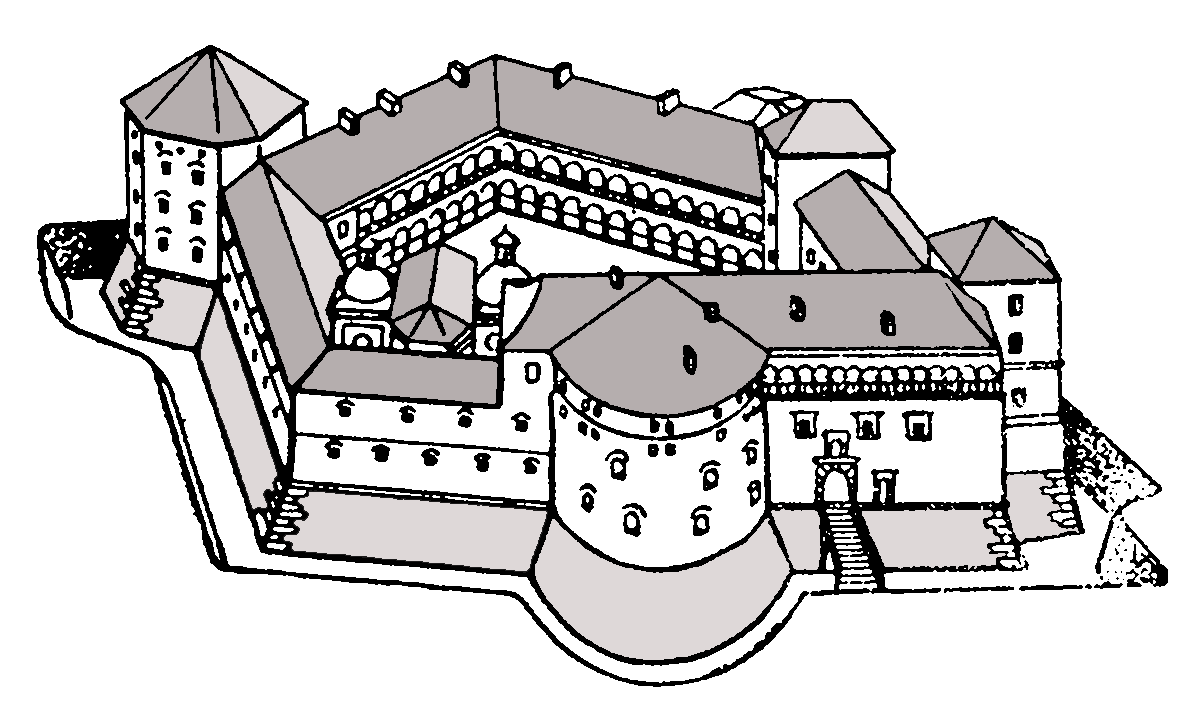
The castle is laid out on an irregular five-sided plan, incorporating four bastions and four defensive towers, three of which partially survive today. The fortifications were constructed using carefully hewn stone blocks, with thick walls forming a robust defensive perimeter. These walls are surrounded by moats filled with water from the Zolota Lypa River, which also created the island setting of the castle, adding a natural barrier against attackers.
One of the castle's most distinctive features is the main entrance, protected by a ravelin—a detached triangular fortification designed to shield the gate from direct assault. The gate itself was adorned with intricate carved stonework and originally featured a drawbridge operated by a chain mechanism, enhancing its defensive capabilities. Above the southern gate, a Latin inscription from 1554 credits Mikołaj Sieniawski for financing the castle's construction in honor of God and for the defense of Christianity, underscoring the religious and military significance of the fortress.
The defensive structures include multiple floors with firing slits designed for muskets and artillery, arranged to provide overlapping fields of fire. The northwest corner features a pentagonal tower, while the southern gate is guarded by a large semicircular bastion. The southeast corner hosts a smaller quadrangular tower. These elements reflect a blend of medieval defensive concepts with innovations from Italian and Dutch fortification systems, which were introduced during expansions in the late 16th and early 17th centuries.
Italian and dutch influences
Between 1570 and 1622, Italian architects were commissioned to modernize the castle's defenses by incorporating the Dutch-style bastioned fortification system. This system included the addition of four bastions and a ravelin, which significantly enhanced the fortress's ability to withstand artillery sieges. The bastions were multi-level structures equipped with firing positions that allowed defenders to cover all approaches effectively.
Foundations and engineering
Constructed on swampy and unstable ground, the castle's builders employed advanced engineering techniques for the time. They drove numerous oak piles deep into the earth to stabilize the foundations before laying the heavy stone walls and constructing underground cellars. This method prevented settling and ensured the longevity of the massive stone structures despite the challenging terrain.
Historical significance and military role
Berezhany Castle played a crucial role in the military and political landscape of the region throughout the 16th and 17th centuries. It was a key defensive stronghold against invasions and raids, particularly during a period marked by frequent conflicts involving Crimean Tatars, Cossack uprisings, and Ottoman incursions.
In 1620, the castle successfully resisted an attack by Crimean Tatar forces. It again withstood sieges during the Cossack uprisings of 1648 and 1649, a tumultuous period that saw widespread rebellion in the Polish-Lithuanian Commonwealth. The fortress also survived a Turkish-Tatar assault in 1676, demonstrating its strategic resilience and the effectiveness of its fortifications.
Beyond its military function, Berezhany Castle served as a venue for significant political events. Notably, in 1703, it hosted a meeting related to the Kuruc uprising, during which the Brzeżany patent was signed by Francis II Rákóczi, a leader of anti-Habsburg forces. This event highlights the castle's role as a center of regional power and political activity.
Ownership changes and later uses
Ownership of the castle passed through several prominent noble families over the centuries. After the Sieniawski family, it was acquired by the Czartoryski family in 1726, followed by the Lubomirski and Potocki families. By the late 18th century, the castle ceased to function as a noble residence and was repurposed for military and industrial uses, including serving as a military post and housing a brewery and barracks.
The castle church of the holy trinity
Adjacent to the fortress stands the church of the Holy Trinity, constructed in 1554 as a mausoleum for the Sieniawski family. The church was expanded during the 17th century with side chapels funded by family members, reflecting a fusion of Gothic, Renaissance, and Baroque architectural elements. The interior once featured sculptural tombs by renowned artists Heinrich Horst and Jan Pfister, which were significant examples of funerary art. Unfortunately, the church suffered extensive damage and looting during wartime, diminishing its original artistic heritage.
Damage, decline, and conservation efforts
The 20th century brought considerable challenges to Berezhany Castle. It sustained heavy damage from artillery shelling during World War I and further destruction during World War II, including explosions in 1941 and vandalism by Soviet forces. These events accelerated the castle's deterioration, leading to the loss of significant architectural features.
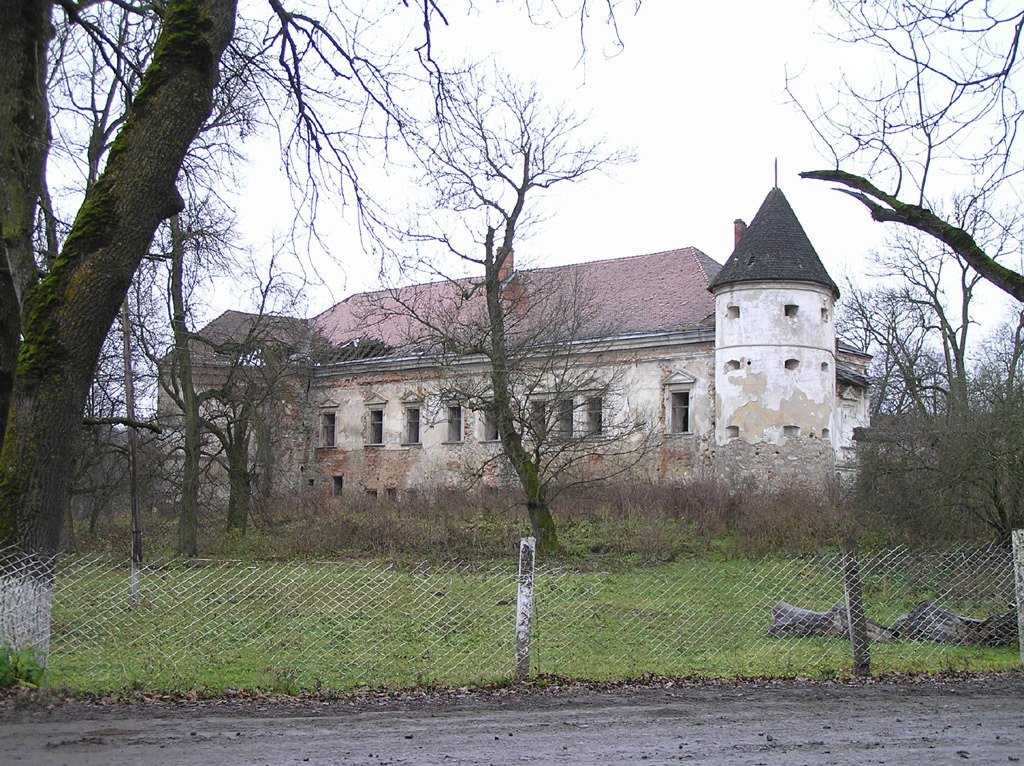
After World War II, the site fell into neglect, with only partial conservation efforts undertaken between the wars and following Ukrainian independence in 1999. Despite its status as a protected architectural monument, restoration has been slow and incomplete. The collapse of a section of the castle wall in 2011 underscored the ongoing vulnerability of the ruins.
Today, the castle remains a fragile but invaluable cultural and historical landmark. The surviving walls, towers, bastions, gatehouse, and church ruins provide insight into the castle's complex history as a military fortress, noble residence, and regional center of power. Ongoing preservation efforts aim to stabilize the structure and promote awareness of its significance in Ukrainian and European heritage.
Frequently asked questions (FAQ)
- When was Berezhany Castle built and by whom?
- Berezhany Castle was built in the mid-16th century, completed in 1554, by Mikołaj Sieniawski, a Polish-Lithuanian noble and military leader.
- What architectural styles are represented in Berezhany Castle?
- The castle features a mix of Renaissance military architecture with Gothic and Baroque elements, especially visible in the adjacent church of the Holy Trinity.
- What defensive features made Berezhany Castle formidable?
- Its location on an island, surrounded by moats, thick stone walls, bastions, towers, a ravelin, and a drawbridge contributed to its strong defenses.
- What significant historical events took place at Berezhany Castle?
- The castle withstood sieges by Crimean Tatars, Cossack uprisings, and Turkish-Tatar assaults; it also hosted political meetings such as the 1703 Kuruc uprising gathering.
- What is the current condition of Berezhany Castle?
- Berezhany Castle is currently in ruins, with partial preservation and ongoing conservation efforts to stabilize the remaining structures.
Photo gallery

Information
Current owner
State museum
Loading map...
Visitor reviews
No reviews yet. Been here? Write the first review and help other travelers!
Write the first reviewVisited this castle? Share your experience
Your review helps other travelers and adds first-hand knowledge to our encyclopedia.