Bar Hill Fort
Bar Hill Roman Fort is a significant archaeological site located near the summit of Bar Hill, offering commanding views over the Kelvin Valley towards the Campsie Fells in Scotland. Constructed between AD 142 and 144, it was one of the key military installations along the Antonine Wall, the north-west frontier of the Roman Empire for a brief period. The fort and the wall together represent a remarkable example of Roman military engineering and frontier control in Britain.
The Antonine Wall and its strategic importance
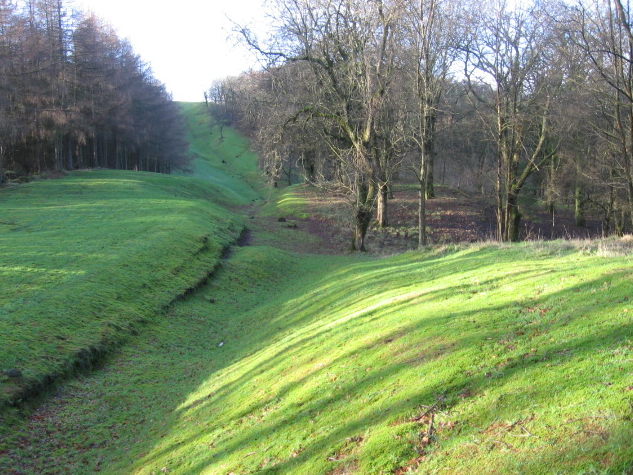
The Antonine Wall stretched approximately 60 kilometers (37 miles) from Bo'ness on the River Forth to Old Kilpatrick on the River Clyde. Built as a turf rampart on stone foundations, it marked the northernmost boundary of Roman Britain for about two decades. Unlike the more famous Hadrian's Wall to the south, the Antonine Wall was constructed primarily from turf laid over a stone base, measuring about 4.3 meters wide and rising to about 3.6 meters in height. The top of the wall likely featured a wooden walkway with a protective breastwork, allowing Roman soldiers to patrol and defend the frontier effectively.
In front of the wall, a substantial ditch was excavated, up to 3.6 meters deep and 12 meters wide, with the excavated earth piled on the northern edge to form a defensive mound. Defensive pits with sharpened stakes were also used in some sections, such as at Rough Castle, to impede attackers. The wall was complemented by a Roman road known as the Military Way, which ran just south of the wall and connected the forts along its length.
Bar Hill Fort's unique location and layout
Bar Hill Fort is distinctive among the Antonine Wall forts because its north wall does not form part of the wall itself. Instead, the fort is positioned on the summit and upper slopes of Bar Hill, while the Antonine Wall runs slightly lower down the hill's northern shoulder. This elevated position gave the fort a commanding view of the surrounding landscape, enhancing its strategic value.
The Military Way passed between the fort and the wall, facilitating the movement of troops and supplies. The fort's location allowed it to serve as a strongpoint overseeing the frontier and controlling movement through the Kelvin Valley.
Architectural features and excavations
Excavations conducted between 1979 and 1982 revealed the layout of the fort's buildings and some surviving stone foundations. Among the structures uncovered, the headquarters building (principia) is the largest visible, situated on the south-facing slope to maximize sunlight. This building would have been the administrative center of the fort, housing offices, the shrine to the standards, and other essential functions.
Another prominent feature is the bathhouse, located near the north wall on the steep northern slope. The bathhouse was vital for hygiene and social life, reflecting the Roman emphasis on bathing culture. Enough remains of this building to convey its original purpose and layout, making it one of the most impressive surviving structures at the site.
Life at Bar Hill Fort and the Antonine Wall
The fort housed a garrison of Roman troops responsible for manning the Antonine Wall and securing the frontier. The relatively short occupation of the wall, roughly 20 years, meant that the fort's structures were built quickly, often using timber and turf, which has affected their preservation compared to Hadrian's Wall.
Despite this, Bar Hill Fort provides valuable insights into Roman military life in northern Britain. The soldiers stationed here would have lived in barracks, trained regularly, and maintained the wall and its defenses. The presence of the bathhouse and headquarters indicates a well-organized military community with facilities to support daily life and command functions.
Preservation and visitor experience
Today, Bar Hill Roman Fort is recognized as one of the best places to appreciate the scale and function of the Antonine Wall. While the wall itself is less well-preserved here than at Rough Castle, the fort's elevated position offers visitors a strong sense of the landscape's strategic importance. The visible remains of the headquarters and bathhouse provide tangible connections to the Roman soldiers who once lived and worked at this frontier post.
Interpretive signage and preserved foundations allow visitors to understand the fort's layout and the wall's construction techniques. The site is accessible to the public and forms part of the wider Antonine Wall World Heritage Site, which celebrates the Roman frontier's historical and cultural significance.
Frequently asked questions (FAQ)
- What is the historical significance of Bar Hill Fort?
- Bar Hill Fort is a significant archaeological site that dates back to the Roman Empire, serving as a fortification on the Antonine Wall. It played a crucial role in the defense and control of the northern frontier of Roman Britain, showcasing the military architecture of the time.
- When was Bar Hill Fort built?
- Bar Hill Fort was constructed around AD 142 during the reign of Emperor Antoninus Pius. It was part of a series of forts built to secure the Antonine Wall, which marked the northern boundary of Roman influence in Britain.
- What are the opening hours for visiting Bar Hill Fort?
- Bar Hill Fort is open to visitors throughout the year, typically from 10 AM to 4 PM. However, it is advisable to check the local visitor information for any seasonal changes or special events that may affect opening times.
- Is it possible to access Bar Hill Fort with mobility issues?
- Bar Hill Fort has some uneven terrain, which may pose challenges for visitors with mobility issues. While the site is partially accessible, it is recommended to contact local heritage services for the best advice on accessibility options before planning your visit.
- Can I bring my dog to Bar Hill Fort?
- Yes, dogs are welcome at Bar Hill Fort, but they must be kept on a lead at all times to ensure the safety of wildlife and other visitors. Be sure to clean up after your pet to help maintain the site's natural beauty.
- What is the best time to visit Bar Hill Fort?
- The best time to visit Bar Hill Fort is during the late spring and early autumn months when the weather is mild, and the surrounding landscape is at its most beautiful. These seasons also typically see fewer crowds, allowing for a more enjoyable experience.
- Are there any nearby attractions to visit after Bar Hill Fort?
- Yes, after exploring Bar Hill Fort, visitors can enjoy nearby attractions such as the Antonine Wall Heritage Trail and the scenic parks in the surrounding area. This allows for a full day of historical and natural exploration in the region.
- How much are the ticket prices for Bar Hill Fort?
- Admission to Bar Hill Fort is usually free, but donations are encouraged to help maintain the site. Special events or guided tours may have separate fees, so it’s best to check in advance for any updates on pricing.
Information
Website
Visit websiteSources & official resources
Verify the information above using these authoritative references.
Loading map...
Visitor reviews
No reviews yet. Been here? Write the first review and help other travelers!
Write the first reviewVisited this castle? Share your experience
Your review helps other travelers and adds first-hand knowledge to our encyclopedia.