Babruysk Fortress (Belarusian: Бабруйская крэпасць; Russian: Бобруйская крепость) is a significant 19th-century bastioned fortress located in the historic city of Babruysk, Belarus. Constructed between 1810 and 1836, it stands as one of the best-preserved examples of early 19th-century fortification architecture in Eastern Europe. Situated strategically at the confluence of the Babruyka and Berezina rivers, the fortress was part of the western defensive line of the Russian Empire, playing a crucial role in military operations during the Napoleonic Wars and beyond.
Strategic location and initial construction
The fortress's site was selected following a detailed military survey initiated by Tsar Alexander I in 1810. The Tsar commissioned military engineer Teodor Narbutt to identify a suitable location for a fortress along the Dnieper River between Mogilev and Rogachev to counter threats from Western Europe. Narbutt recommended the confluence of the Berezina River near Babruysk for its superior strategic advantages, a suggestion approved by Count Carl Operman, Chief of Military Engineers overseeing Russian fortifications.
Construction began under Narbutt's supervision but was soon transferred to General Major Gabriel Ignatiev due to Narbutt's health issues. The initial design featured five bastions, extensive earthen ramparts, and a network of water channels to enhance defense. The fortress incorporated existing structures, including the Babruysk Jesuit house and a smaller Polish fortress, integrating them into the new fortification system.
Role during the Napoleonic Wars
Though incomplete, Babruysk Fortress played a pivotal role during the French invasion of Russia in 1812. Following the capture of Minsk by Napoleon's forces, General Ignatiev assumed command of the fortress and the city. Babruysk served as a critical refuge for retreating Russian troops, providing food, medical care, and logistical support. The fortress's location on the Berezina River facilitated the evacuation of wounded soldiers and troops to Smolensk, where the main Russian army regrouped.
The fortress endured a prolonged siege by the forces of General Jan Henryk Dąbrowski, commander of the Polish Corps allied with Napoleon. The siege lasted approximately four months, with the fortress successfully resisting until the French retreat. Throughout the siege, Ignatiev conducted intelligence operations, relaying vital information to the Russian high command.
Expansion and architectural development
After the Napoleonic Wars, the Babruysk Fortress underwent significant expansion beginning in 1820. The fortification was extended with the addition of 18 more bastions and towers, enhancing its defensive capabilities. A notable structure from this phase is the Fort Friedrich Wilhelm, designed by architect A. Staubert in 1822. The completion of this expansion was marked by a visit from Tsar Alexander I and his brother on September 24, 1825, underscoring the fortress's importance within the Russian Empire's military infrastructure.
Military use and later history
By the late 19th century, Babruysk Fortress remained a key military installation, housing the 1st Brigade of the 40th Infantry Division of the Imperial Russian Army in 1892. However, advances in military technology and changing strategic priorities led to its decline in military significance by 1900. Subsequently, the fortress was repurposed as a prison.
The fortress's military role briefly revived during the tumultuous period of World War I and the Polish-Bolshevik War (1919–1920), when it was captured by the Polish I Corps and used by Polish forces. During World War II, the fortress's facilities were exploited by German occupation forces as a concentration camp, where approximately 80,000 deaths occurred, marking a tragic chapter in its history.
Architectural features and preservation
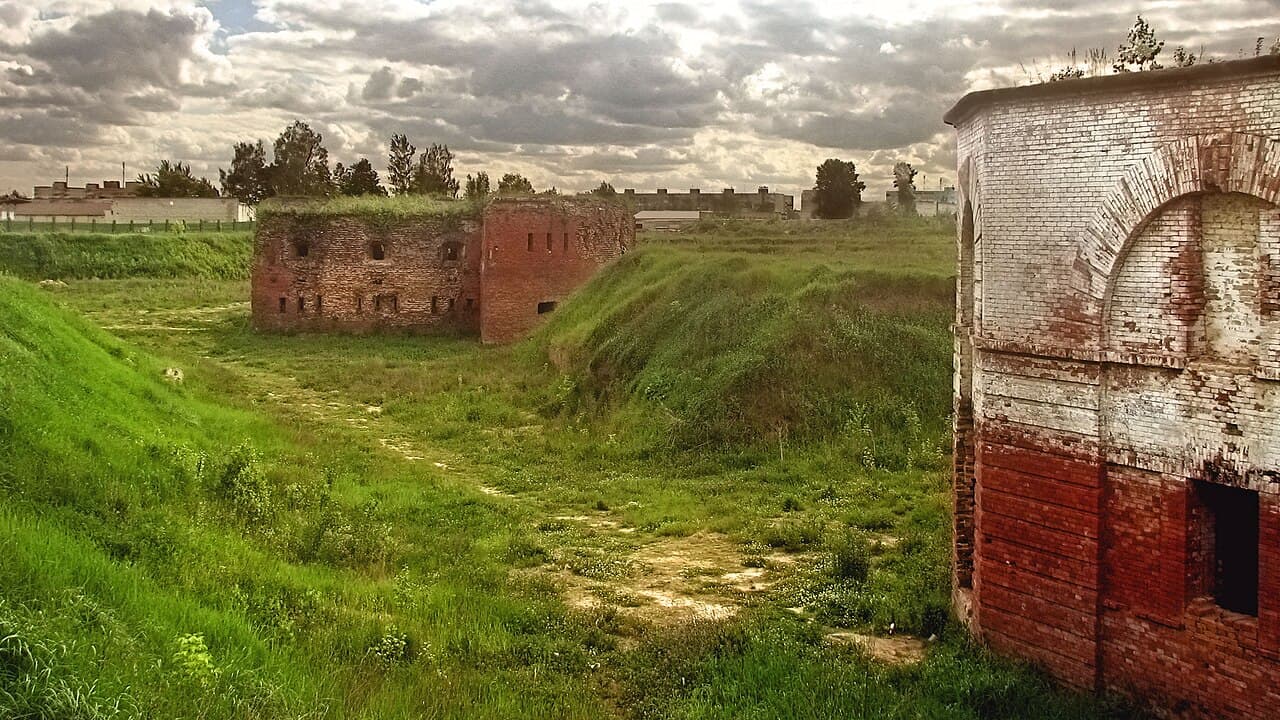
Babruysk Fortress exemplifies the bastioned fortress design typical of the early 19th century, featuring a complex system of bastions, ramparts, and water defenses. Its integration with earlier structures, such as the Jesuit house and Polish fortifications, adds layers to its architectural significance. Despite the impacts of warfare and changing uses, the fortress remains well-preserved and is recognized as a national architectural monument of Belarus.
Today, Babruysk Fortress stands not only as a monument to military engineering but also as a site of historical memory, reflecting the region's turbulent past from the Napoleonic era through the 20th century conflicts. Its preservation allows for ongoing study and public education about fortress architecture and Eastern European military history.
Frequently asked questions (FAQ)
- What is the historical significance of Babruysk Fortress?
- Babruysk Fortress, built in the late 18th century, is a remarkable example of military architecture in Belarus. It played a crucial role in the defense of the region during various conflicts, including the Napoleonic Wars and World War II, making it a site of considerable historical importance.
- When was Babruysk Fortress constructed?
- The construction of Babruysk Fortress began in 1810 and was completed in 1833. It was designed as part of a series of fortifications to protect the Russian Empire's western borders, showcasing the military engineering of its time.
- Can I visit Babruysk Fortress?
- Yes, visitors can explore Babruysk Fortress and its impressive architecture. Guided tours are available that provide insights into its history and significance, making it an enriching experience for history enthusiasts.
- What are the opening hours of Babruysk Fortress?
- Babruysk Fortress is generally open to visitors from 9 AM to 6 PM, but it is advisable to check the specific opening hours before your visit, as they may vary by season or due to special events.
- Is it possible to access the fortress with public transport?
- Yes, Babruysk Fortress is accessible via public transport, with regular buses and trains connecting Babruysk to major cities in Belarus. Once in Babruysk, local transport options and taxis are available to reach the fortress.
- What is the best time to visit Babruysk Fortress?
- The best time to visit Babruysk Fortress is during the spring and early autumn when the weather is mild and pleasant. This allows for a more enjoyable exploration of the outdoor areas and surrounding landscape.
- Are there any nearby attractions to Babruysk Fortress?
- Yes, nearby attractions include the picturesque Babruysk Park and the local museum, which offers further insights into the region's history and culture. Visitors can also enjoy local dining options and shops within walking distance.
- What are the ticket prices for visiting Babruysk Fortress?
- Ticket prices for Babruysk Fortress are generally quite affordable, with discounts available for students and groups. It is advisable to check for any special offers or changes in pricing before your visit.
Photo gallery

Information
Loading map...
Visitor reviews
No reviews yet. Been here? Write the first review and help other travelers!
Write the first reviewVisited this castle? Share your experience
Your review helps other travelers and adds first-hand knowledge to our encyclopedia.