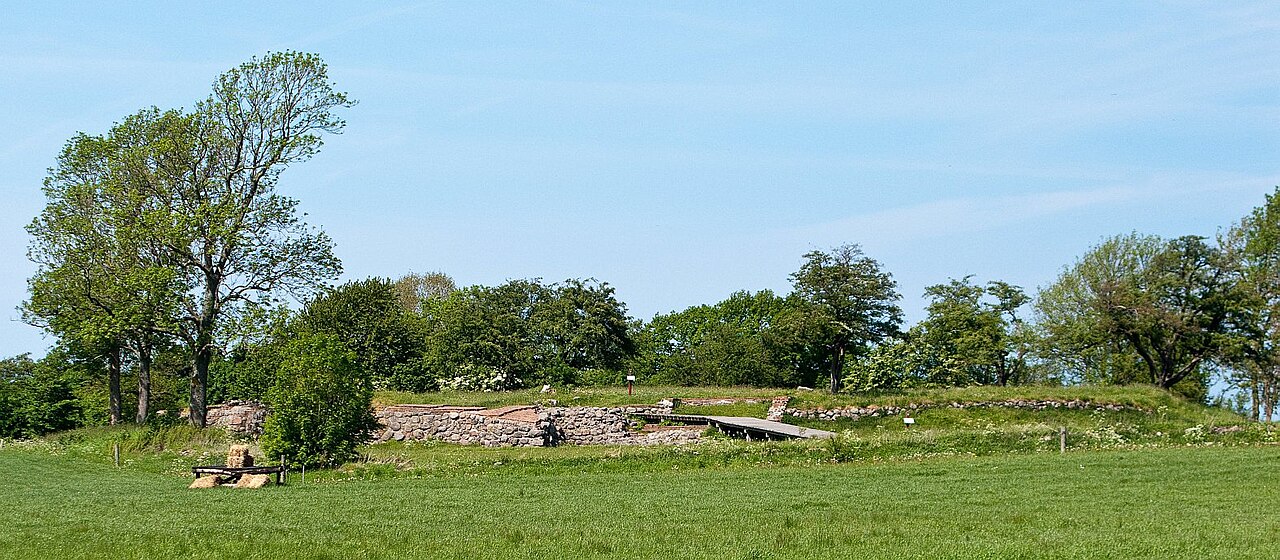
Asserbo Castle Ruins
Asserbo Castle ruins stand as a significant medieval heritage site located in Frederiksværk, Denmark. Founded in the 12th century by Bishop Absalon, a prominent figure from the influential Hvide family, the site originally served as a monastic establishment for the Carthusian Order. Although the monastic phase was brief, the castle's evolution into a fortified complex and later a monastic grange reflects important aspects of Danish medieval religious and agricultural history.
Foundation and early monastic history
The origins of Asserbo Castle trace back to the early High Medieval period, around 1162 or 1163, coinciding with the exile of Archbishop Eskil of Lund in France. During this time, Bishop Absalon initiated contact with the Carthusian monks to establish a monastery on his family lands in North Zealand. This resulted in the founding of a small monastic community at Asserbo, marking the introduction of the Carthusian Order into Denmark. However, the monks abandoned the site by 1169, finding the location unsuitable for their austere monastic lifestyle.
Transition to monastic grange and noble ownership
After the Carthusians left, the site did not fall into disuse but transitioned into a monastic grange, managed initially by Sorø Abbey and later by Esrum Abbey. This role as an agricultural estate was typical for monastic properties, supporting the economic needs of the abbeys. By the mid-13th century, records from 1248 indicate that a small settlement had developed around the estate, known as Asserbo.
From the 15th century onward, the estate was leased to various noble families. Notably, in 1490, it was acquired by Poul Laxmand, Steward of the Realm. Ownership alternated between the Danish Crown and noble proprietors until the early 18th century, during which the estate maintained its agricultural and administrative functions.
Environmental challenges and abandonment
One of the defining challenges faced by Asserbo was the encroachment of drifting sands in the late medieval and early modern periods. By the early 1700s, the advancing sand dunes rendered the area increasingly uninhabitable, forcing abandonment of the estate. This natural hazard was a common problem in parts of Denmark where coastal and inland sands shifted dramatically.
The problem was eventually addressed in the 1730s through the planting of the Tisvilde Hegn forest, a deliberate afforestation project that stabilized the dunes and halted further sand drift. This intervention significantly altered the landscape around Asserbo and helped preserve what remained of the site.
Architectural features and site layout
The architectural remains of Asserbo Castle illustrate its origins as a fortified monastic complex. The core of the site included a main building with an attached tower featuring a cellar beneath, as well as several other cellars scattered throughout the complex. The buildings were constructed using large, specially made "monk bricks", a hallmark of medieval ecclesiastical architecture in Denmark.
Surrounding the settlement was a defensive earth embankment that defined the perimeter and provided protection. Access was controlled by a drawbridge on the northern side, emphasizing the fortified nature of the complex. The site's natural defenses were enhanced by wetlands and marshes to the south and west, which made direct assault difficult during the Middle Ages.
Construction materials and techniques
The use of monk bricks at Asserbo is particularly notable. These bricks were larger than typical medieval bricks and were specially produced for ecclesiastical buildings, indicating the importance of the site. The half-timbered houses around the complex complemented the brick structures, reflecting typical medieval Danish construction methods.
Archaeological investigations and preservation efforts
The ruins of Asserbo Castle were largely obscured by drifting sands until the mid-19th century. In 1849, King Frederik VII initiated efforts to clear the sand and reveal the ruins, marking the first phase of the site's modern rediscovery. Later, in 1972, extensive excavations by the National Museum of Denmark further uncovered the foundations and restored the protective earth embankments.
Today, visitors can observe the lower portions of the main building's cellar and the tower, with the distinctive monk brickwork still visible. The restoration of the earthworks helps outline the original fortified perimeter, offering insight into the site's defensive design.
Changing landscape and modern context
The natural environment surrounding Asserbo Castle has changed considerably since the Middle Ages. The original wetlands and marshes that provided natural defense have largely disappeared, replaced by forested areas and summer residences. The planting of the Tisvilde Hegn forest not only stabilized the sand dunes but also transformed the local ecosystem.
Despite these changes, the ruins remain a valuable cultural and historical landmark, illustrating the interplay between medieval monastic life, noble ownership, and environmental challenges in Denmark's history.
Frequently asked questions (FAQ)
- What is the historical significance of Asserbo Castle Ruins?
- Asserbo Castle, built in the late 15th century, is an important example of Danish medieval architecture. It served as a royal residence and played a key role in the region's history until it fell into disrepair in the 17th century. Today, its ruins offer insight into Denmark's feudal past and attract many history enthusiasts.
- When was Asserbo Castle built?
- Construction of Asserbo Castle began in 1475 and continued into the late 1500s. The castle was commissioned by King Christian I and served as a stronghold, reflecting the architectural styles of the time. Its ruins are a testament to the castle's former grandeur and historical importance.
- Can I visit Asserbo Castle Ruins?
- Yes, Asserbo Castle Ruins are open to the public, allowing visitors to explore the remnants of this historical site. While there are no guided tours, visitors can freely walk around the ruins and enjoy the scenic surroundings. It's a great spot for photography and appreciating medieval architecture.
- What are the opening hours for Asserbo Castle Ruins?
- Asserbo Castle Ruins are accessible year-round, with no specific opening hours as it is an outdoor site. However, it's advisable to visit during daylight hours to fully appreciate the ruins and the surrounding landscapes. Always check local guidelines for any seasonal changes or restrictions.
- Is it possible to reach Asserbo Castle Ruins by public transport?
- Yes, Asserbo Castle Ruins can be reached by public transport. There are bus services that connect Frederiksværk to nearby towns, and from there, it's a short walk to the castle ruins. Visitors are encouraged to check local transport schedules for the most convenient routes.
- What is the best time to visit Asserbo Castle Ruins?
- The best time to visit Asserbo Castle Ruins is during the spring and summer months when the weather is mild and the grounds are lush and beautiful. This allows for a more enjoyable experience while exploring the ruins and taking in the scenery. Early mornings or late afternoons are also ideal for fewer crowds.
- Are there any nearby attractions to visit?
- Yes, there are several nearby attractions, including the scenic Arresø Lake and the charming town of Frederiksværk. Visitors can also explore the beautiful nature trails in the surrounding area, making it a perfect day trip destination. Consider visiting local cafes and shops to enhance your experience.
- What are the ticket prices for Asserbo Castle Ruins?
- Asserbo Castle Ruins are free to visit, making it an accessible destination for all. While there are no entry fees, donations to help maintain the site are appreciated. This allows visitors to enjoy the historical site without any financial burden.
Information
Website
Visit websiteSources & official resources
Verify the information above using these authoritative references.
Loading map...
Visitor reviews
No reviews yet. Been here? Write the first review and help other travelers!
Write the first reviewVisited this castle? Share your experience
Your review helps other travelers and adds first-hand knowledge to our encyclopedia.