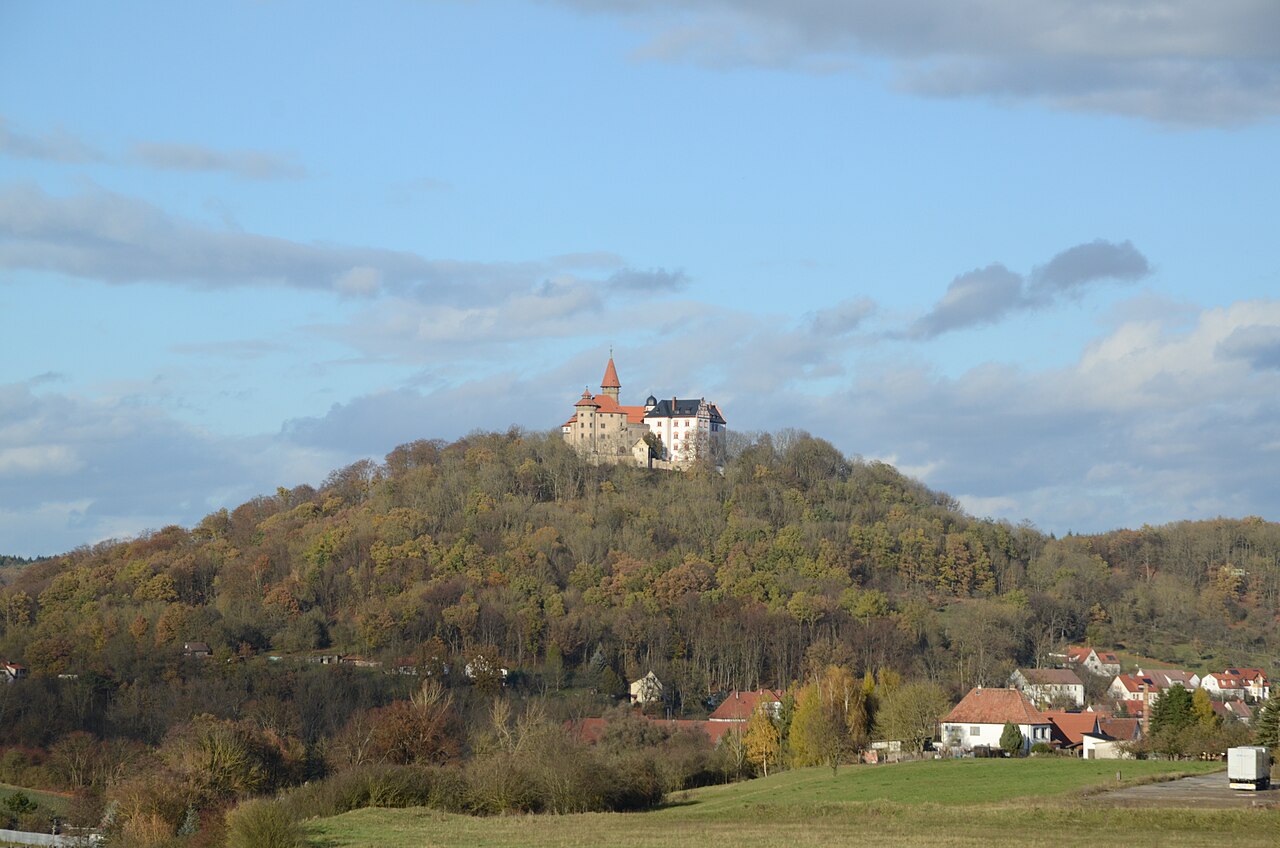
Altenstein Castle
Altenstein Castle stands as one of the most significant medieval hill castles in the Franconian region of Germany. Perched strategically on a ridge approximately 452 meters above sea level and towering about 150 meters above the Weisach river valley, the castle's location offered commanding views and natural defenses. Its origins date back to the high medieval period, with the earliest indirect mention in 1225 and a direct record in 1231, marking it as a notable fortified residence of the noble lords of Stein zu Altenstein.
The castle evolved from an initial rock castle known as Teufelsstein, situated below the nearby Lichtenstein Castle, which was the seat of the Steins of Lichtenstein. The Altensteins became vassals of the Prince-Bishops of Würzburg in the early 14th century, holding various fiefs from ecclesiastical authorities such as the abbeys of Banz and Langheim. Over time, Altenstein Castle developed into a Ganerbenburg, a shared castle system occupied by multiple branches of the Stein family, a rare example of joint inheritance and cohabitation documented as early as 1296 with eight family lines residing within.
Historical significance and family legacy
The castle's history is closely intertwined with the fortunes of the Stein family. Throughout the 14th and 15th centuries, the Altensteins consolidated scattered lands around the castle, establishing a minor lordship. The castle and its inhabitants endured significant challenges, including damage during the Peasants' War of 1525. In 1549, Emperor Charles V granted the Altensteins the high court jurisdiction, including the right to administer capital punishment under the Imperial Court Hanging Law, underscoring their regional importance.
However, political turmoil followed. In 1567, William of Stein zu Altenstein was executed after opposing the Prince-Bishopric of Würzburg during the Grumbach Feud, resulting in the family losing their fiefs. The Thirty Years' War further devastated the castle, with marauding mercenaries killing Caspar von Stein in 1634. Despite an elevation to imperial free baron status in 1695, the family’s decline led them to abandon Altenstein Castle by 1703, relocating to a newly built schloss in Pfaffendorf. The castle subsequently fell into ruin, with restoration efforts only beginning in the late 19th century and continuing sporadically until comprehensive preservation work was undertaken after 1972 when the site was donated to the Haßberge district.
Architectural features and defensive structures
Altenstein Castle exemplifies medieval military architecture adapted over centuries. The castle's outer ward is accessed via a well-preserved gatehouse built on 13th-century foundations but largely reconstructed in the 17th or 18th century. This gatehouse once protected the Romanesque core of the castle and remains inhabited. Its southeastern outer ward is supported by a massive retaining wall reinforced with flying buttresses, an advanced technique to stabilize the structure on the steep ridge.
A notable feature is the dry neck ditch, approximately 15 meters wide, which separates the outer ward from the main gate. Spanning this ditch is an 18th-century stone bridge leading to the main gate flanked by two massive round towers. These towers, rising three floors without vaulted ceilings, contain T-shaped keyhole openings designed for archers and early firearm operators to defend the entrance while minimizing exposure. The gatehouse forms part of a zwinger defensive enclosure constructed around 1430 during the Hussite period, replacing the original southern entrance which was walled up for enhanced defense.
The main gate dates to about 1567 and features a bretèche, a projecting stone platform above the gateway allowing defenders to attack assailants directly below. Above the gate, the weathered stone display of the Stein family coat of arms with three hammers flanked by shield-bearing figures remains visible, symbolizing the family's legacy.
The castle's bergfried, a tall square Romanesque keep, remains partially standing with its north wall rising about 10 meters. Measuring roughly 9.8 meters per side, the bergfried showcases impressive masonry with large rusticated stones fitted without visible lifting marks, indicating sophisticated medieval construction techniques. Its inner core features bricks laid in a herringbone pattern (opus spicatum). Originally, the bergfried had a raised entrance facing the courtyard and included a garderobe shaft at its base, suggesting a neck ditch once protected the front.
Inner ward and residential buildings
The inner courtyard contains the remains of several residential buildings that housed the various branches of the Stein family. These include vaulted cellars partly hewn from solid rock, the main residential building or palas located in the southwest, a castle well, and a chapel constructed in the late Gothic style. Some vaulted cellars have been sealed during recent renovations to protect bat populations, though key areas remain accessible to visitors.
The castle chapel and religious architecture
The castle chapel, dedicated to St. Nicholas and the Virgin Mary, was built beginning in 1438 after the Prince-Bishop of Würzburg elevated the castle church to parish status. The chapel features a rectangular nave constructed atop the barrel-vaulted old southern gate and an adjoining choir with intricately ribbed vaulting. The choir housed the family crypt and is supported by stepped buttresses with pointed-arch Gothic windows, one preserving original tracery.
South of the choir stands a two-story tower-like annex divided by stone ledges, with narrow windows illuminating a groin-vaulted ground floor. An elevated door connects the annex to an older chapel wall projection, while a small staircase tower accessible from the nave completes the complex. The nave and choir are separated by a profiled arch, and decorative shields adorn the intersections of the choir vault ribs. The chapel's sandstone walls bear tool marks from the use of an external Lewis lifting device, highlighting medieval stone masonry craftsmanship. Embedded gravestone fragments once lined the chapel floor.
Due to ongoing geological instability caused by the Rhaetian sandstone subsoil prone to slow sliding downhill, the chapel walls lean noticeably. Extensive renovation and stabilization efforts starting around 2000 have preserved the chapel, securing its structural integrity for future generations.
Preservation, visitor experience, and cultural significance
Altenstein Castle is currently owned by the Haßberge district and is part of the Haßberge Castle Educational Path, which provides visitors with interpretive trails and signage to explore the castle's rich history and architecture. Since 2003, a circular walking path around the inner ward has allowed access to previously unreachable sections of the ruins, enhancing the visitor experience.
The castle's location on unstable sandstone necessitates ongoing stabilization measures to prevent further collapse, with restoration projects focusing on preserving the remaining structures, including the gatehouse, bergfried, residential buildings, and chapel. The castle's extensive ruins offer a vivid window into the high medieval castle architecture and the complex social history of the Stein family and their role in Franconia's feudal landscape.
As one of the largest ruined medieval castles in Franconia, Altenstein Castle stands as a testament to the region's turbulent history, architectural evolution, and noble heritage. Its combination of Romanesque and Gothic elements, along with adaptations for early firearms and shared ownership structures, make it a unique site of cultural and historical importance in Germany.
Frequently asked questions (FAQ)
- What is the historical significance of Altenstein Castle?
- Altenstein Castle, located in Maroldsweisach, Germany, dates back to the 13th century and is a remarkable example of medieval architecture. It played a significant role in the region's history, serving as a noble residence and a strategic military site during various conflicts.
- When was Altenstein Castle built?
- Construction of Altenstein Castle began in the early 1200s, with various modifications and expansions occurring over the centuries. The castle's architecture reflects the evolving styles from the Gothic period through the Renaissance.
- What are the opening hours for Altenstein Castle?
- Altenstein Castle is typically open to visitors from April to October, with hours varying slightly depending on the season. Generally, the castle opens at 10 AM and closes at 6 PM, but it's advisable to check the official website for any updates before planning your visit.
- Can I access Altenstein Castle with mobility issues?
- While Altenstein Castle is a beautiful site, its historical structure may pose challenges for visitors with mobility issues. However, efforts have been made to improve accessibility, and we recommend contacting the castle staff in advance to discuss specific accommodations.
- What are the ticket prices for Altenstein Castle?
- Ticket prices for Altenstein Castle are generally affordable, with discounts available for students and seniors. A typical adult ticket costs around €5, while children under 12 may enter for free. Group rates are also available, making it a great option for school trips or family outings.
- When is the best time to visit Altenstein Castle?
- The best time to visit Altenstein Castle is during the late spring and early fall when the weather is pleasant, and the surrounding landscape is vibrant. Additionally, special events and guided tours are often scheduled during these months, enhancing your visitor experience.
- Are there any nearby attractions to explore?
- Yes, there are several nearby attractions to explore, including beautiful hiking trails in the surrounding nature and other historical sites in the area. The charming town of Maroldsweisach also offers local shops and eateries, making it a perfect stop for a full day of exploration.
Information
Sources & official resources
Verify the information above using these authoritative references.
Loading map...
Visitor reviews
No reviews yet. Been here? Write the first review and help other travelers!
Write the first reviewVisited this castle? Share your experience
Your review helps other travelers and adds first-hand knowledge to our encyclopedia.