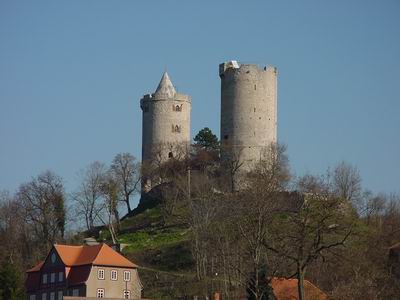
Alte Burg, meaning "The old castle," is a prominent example of a late medieval moated hill castle situated in Burgsinn, Germany. Constructed primarily between 1339 and 1342, this fortress was established under the authority of Dietz von Tungden, who received it as a fief from the Bishop of Würzburg in 1337. The castle's strategic location atop a hill, combined with its extensive moat fed by a natural underground spring, reflects the defensive priorities of the period.
Architectural layout and defensive features
The castle's trapezoidal plan is anchored by towers at each corner, providing comprehensive defensive coverage and commanding views over the surrounding landscape. The wide moat encircling the castle is a critical defensive element, sustained by a reliable underground spring that ensured a constant water supply to deter attackers. Access to the castle is controlled via a bridge on the west side, a vital point for regulating entry and enhancing security.
The outer curtain wall is constructed of rusticated sandstone blocks, giving the castle a robust and formidable appearance. Behind this outer layer, the main structural fabric consists of rubble stone masonry, a typical medieval building technique that provided strength and durability. The southern residential building is notable for its upper floors featuring timber framing, combining defensive stonework with traditional domestic architectural elements.
Towers and keep
The castle's corner towers each have distinct architectural features and functions. The square northeastern tower includes a small elevated residential chamber, indicating its dual role in defense and habitation. The southeastern tower, completed in 1543 by Martin I von Thüngen, is accessed through a pointed arch door, illustrating the incorporation of Gothic stylistic elements alongside military functionality. The southwestern tower features a round-arched gate with corbels, reflecting adaptations made to improve fortification over time.
Dominating the castle complex is a square, five-story keep standing approximately 22 meters tall, dating back to the 12th century. This imposing structure, built of rusticated stone, predates much of the castle and serves as both a central defensive stronghold and a symbol of feudal power. Its preservation within the castle complex highlights the layered construction history, combining early medieval fortifications with later additions.
Historical context and ownership
The history of Alte Burg is closely linked to the Barons of Thüngen, a noble family influential in the region's feudal landscape. The castle was granted as a fief by the Bishop of Würzburg to Dietz von Tungden, marking its integration into the ecclesiastical and noble power structures of the time. Over the centuries, the castle underwent various modifications to adapt to evolving military technologies and residential needs, including the insertion of windows in the southern wall to improve living conditions.
Restoration and current condition
Today, Alte Burg is classified as restored, reflecting extensive preservation efforts to maintain its structural integrity and historical authenticity. Restoration work has preserved much of the castle's medieval character, while ensuring safety and accessibility for visitors. The blend of original medieval masonry with later architectural interventions provides a visible narrative of the castle's evolution through time.
Cultural significance and visitor experience
Alte Burg serves as a significant example of medieval fortification architecture in Bavaria, offering insight into the defensive strategies and lifestyle of the late Middle Ages. Its well-preserved features, including the moat, towers, and keep, make it an important site for historical study and tourism. Visitors can explore the castle's strategic design, appreciate the craftsmanship of its construction, and learn about the noble families who shaped the region's history.
Architectural styles and influences
The castle displays characteristics typical of the late medieval period, with its strong defensive elements such as rusticated stone walls and fortified towers. The timber framing on the southern residential building reflects vernacular building traditions that complemented the stone fortifications. The pointed arch door in the southeastern tower suggests Gothic architectural influences, while the overall design prioritizes military functionality.
Moat and water management
The castle's moat is a defining defensive feature, sustained by an underground spring that provided a constant water supply. This natural water source exemplifies the strategic use of the landscape to enhance the castle's resilience against siege. The moat not only served as a physical barrier but also demonstrated medieval engineering skills in water management.
Notable architectural details
- Rusticated sandstone blocks forming the outer curtain walls for strength and imposing appearance.
- Rubble stone masonry as the primary structural material behind the outer walls.
- Timber framing on upper residential levels, combining defensive and domestic architecture.
- Square five-story keep dating to the 12th century, central to the castle's defense and symbolism.
- Pointed arch doorway in the southeastern tower, reflecting Gothic stylistic influence.
- Corbelled round-arched gate in the southwestern tower, illustrating later fortification adaptations.
Frequently asked questions (FAQ)
- How do I get to Alte Burg in Burgsinn?
- Alte Burg is located on a hill in Burgsinn, Germany. Visitors can reach the castle by car or local transport, with the castle situated within walking distance from the town center.
- What is the historical significance of Alte Burg?
- Alte Burg was a strategic medieval fortress granted as a fief by the Bishop of Würzburg to the Barons of Thüngen. It reflects the military and noble power dynamics of the late Middle Ages in Bavaria.
- Can I visit the towers and keep of Alte Burg?
- Visitors can explore the castle grounds, including the towers and the 12th-century keep, which are key features showcasing medieval defensive architecture.
- When is the best time to visit Alte Burg?
- The castle is best visited during the warmer months from spring to early autumn when the weather is favorable for outdoor exploration of the hilltop site.
- Is there an entrance fee to Alte Burg?
- Information about entrance fees varies, but many historic castles in the region offer free or low-cost access. It is advisable to check locally for current ticket prices.
Information
Loading map...
Visitor reviews
No reviews yet. Been here? Write the first review and help other travelers!
Write the first reviewVisited this castle? Share your experience
Your review helps other travelers and adds first-hand knowledge to our encyclopedia.