Almería Alcazaba
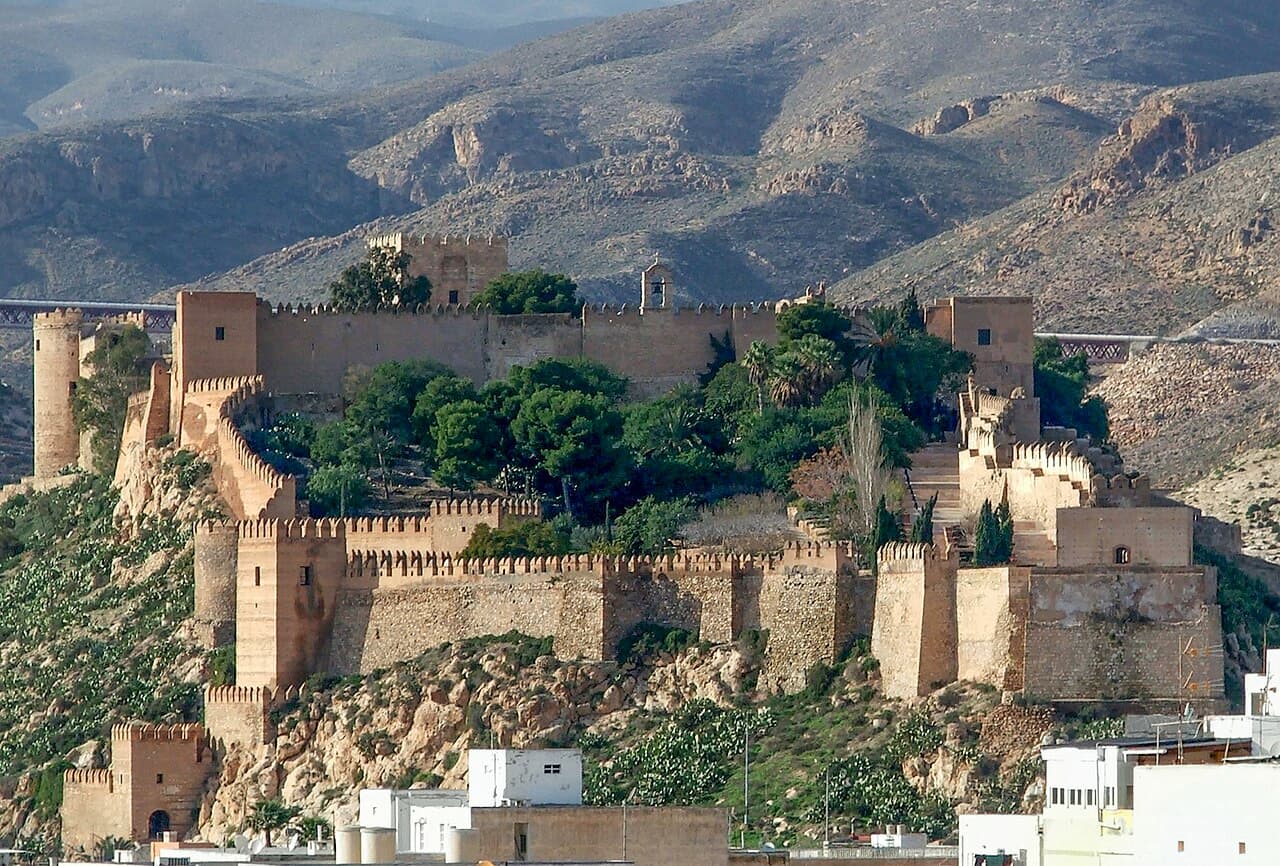
Alcazaba of Almería, also known locally as Alcazaba de Almería, is a prominent fortified Moorish complex situated on a commanding hill overlooking the city of Almería and its bay in southern Spain. This historic site is one of the most significant examples of Islamic military architecture on the Iberian Peninsula, with construction phases spanning from the 10th century through the 18th century. Its strategic location and layered fortifications reflect the turbulent history of Almería, shaped by Muslim and Christian rule.
Early foundations and moorish expansion
The origins of the Alcazaba date back to 955 A.D., when Abd ar-Rahman III, the first Caliph of Al-Andalus, commissioned its construction shortly after granting Almería the status of a medina or city. It was built over an elongated hill, likely on the site of an earlier Arab fortification from around 840 A.D.. The fortress was designed with two main enclosures: a lower enclosure intended to protect the city's inhabitants during attacks, equipped with large cisterns for water storage, and an upper enclosure housing the mosque, baths, and residences for the Moorish rulers.
During the late 10th century, the fortress was expanded under the direction of the powerful military leader Almanzor. Further fortifications were added in the early 11th century under Al Jayrán, ruler of the independent Taifa of Almería between 1014 and 1028. These expansions included strengthening the walls and adding defensive towers, reflecting the need for enhanced protection amid regional conflicts.
Medieval conflicts and christian conquest
The Alcazaba's history is marked by shifts in control between Muslim and Christian forces. In 1147, the city was captured by Christian armies led by Alfonso VII of León. However, Muslim forces regained control within a decade, illustrating the contested nature of the region during the Reconquista.
The definitive Christian conquest occurred in 1489 under the Catholic Monarchs, Queen Isabella I of Castile and King Ferdinand II of Aragon. Following their victory, a new castle was constructed at the highest point of the upper enclosure, effectively creating a third enclosure within the complex. This addition symbolized the change in power and introduced new architectural elements aligned with Christian military design.
18th-century modifications and defensive walls
One of the most notable later additions to the Alcazaba is the Muro de la Vela (Wall of the Sail), a curtain wall built in 1763 during the reign of Charles III of Spain. This wall features a bell atop it, historically used to alert the city of approaching enemy ships or pirates in the bay, highlighting the ongoing strategic importance of the fortress well into the post-medieval period.
To the north of the Alcazaba, the Jayrán Walls form an extensive curtain wall with numerous towers, closing off the valley and connecting to a stronger wall on the Cerro de San Cristóbal hill. These walls date back to the early 11th century under Al Jayrán and were reinforced during the brief Christian occupation in the 12th century. They served as part of the city's defensive perimeter and are sometimes referred to as the Castillo de San Cristóbal.
Architectural features and layout
The Alcazaba's layout is a classic example of Islamic military architecture adapted to the local topography. The lower enclosure provided refuge for the civilian population during sieges, while the upper enclosure contained the administrative and residential quarters, including the mosque and baths. The later Christian castle added a third defensive layer, demonstrating the evolution of military architecture over centuries.
The fortress includes massive curtain walls, defensive towers, and strategically placed gates. The Muro de la Vela is particularly notable for its robust construction and the bell tower, which served as an early warning system. The extensive Jayrán Walls further emphasize the importance of layered defenses in medieval fortifications.
Present-day access and visitor experience
Today, the Alcazaba of Almería is open to visitors for a fee, offering a rich historical experience with its well-preserved structures and panoramic views over the city and bay. The adjacent Jayrán Walls can be visited freely, although walking on the walls themselves is not permitted for safety reasons. The site provides insight into the complex history of Almería, showcasing architectural elements from both Moorish and Christian periods.
Visitors can explore the various enclosures, admire the Islamic baths, and see the remains of the mosque and residences. The fortress's position on the hill offers excellent vantage points for photography and understanding the strategic importance of the location throughout history.
Historical significance and cultural heritage
The Alcazaba of Almería stands as a testament to the region's multicultural past and the interplay between Islamic and Christian civilizations in medieval Spain. Its construction and successive modifications reflect the political and military changes from the Caliphate of Córdoba through the Reconquista and into the modern era.
As one of the largest Moorish fortresses in Spain, it is a key cultural landmark and an essential destination for those interested in medieval military architecture, Islamic art, and the history of Al-Andalus. The Alcazaba's preservation allows for ongoing study and appreciation of the architectural techniques and urban planning of the period.
Frequently asked questions (FAQ)
- How do I get to the Alcazaba of Almería?
- The Alcazaba is located in the city center of Almería, accessible by foot from most central points. Public transport and taxis are also available for easy access.
- What are the opening hours for visiting the Alcazaba?
- The Alcazaba is open daily from 10:00 to 18:00, allowing visitors ample time to explore the site.
- Is there an entrance fee to visit the Alcazaba?
- Yes, the entrance fee is €5 for adults and €3 for children, which helps maintain the preservation of the site.
- Can I walk on the Jayrán Walls?
- Visitors can access the area around the Jayrán Walls freely, but walking directly on the walls is not permitted to protect their structural integrity.
- What architectural styles are present in the Alcazaba?
- The Alcazaba features a mix of Islamic military architecture from the High Medieval period, with later Christian additions reflecting Renaissance and post-medieval influences.
- Why is the Alcazaba historically significant?
- The Alcazaba of Almería illustrates the complex history of Muslim and Christian rule in southern Spain, showcasing fortification techniques and cultural exchanges over several centuries.

Information
Opening hours
10:00-18:00, daily
Ticket prices
€5 adult, €3 child
Current owner
Municipality
Address
Calle Almanzor, Almería, Spain
Loading map...
Visitor reviews
No reviews yet. Been here? Write the first review and help other travelers!
Write the first reviewVisited this castle? Share your experience
Your review helps other travelers and adds first-hand knowledge to our encyclopedia.