Alcazaba of Almeria
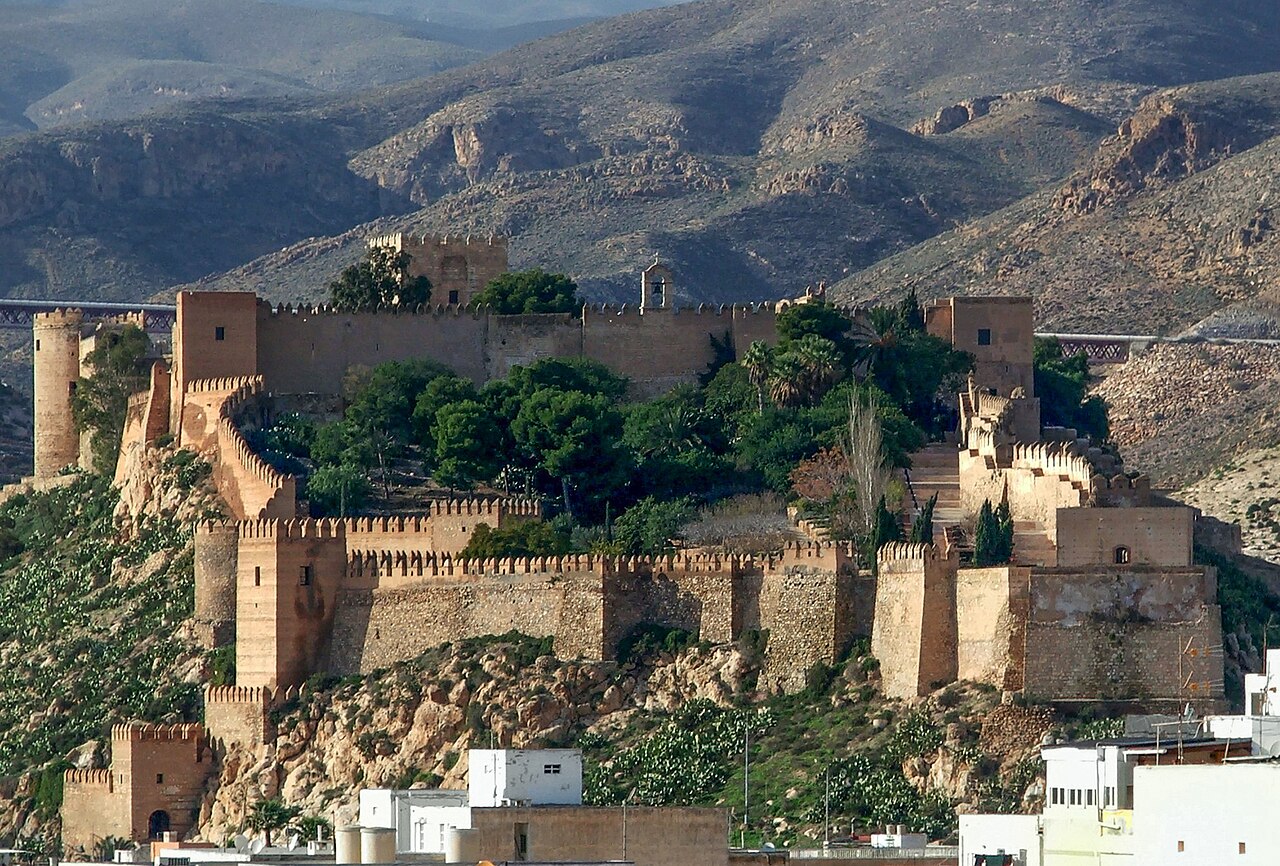
The Alcazaba of Almería stands as one of the most impressive and historically significant hill castles in southern Spain. Perched on Cerro de San Cristóbal, this vast fortified complex dominates the city of Almería and offers commanding views over the Mediterranean Sea. Its origins date back to the 10th century, when it was constructed as a defensive citadel and administrative center under the auspices of the Caliph Abd ar-Rahman III. The Alcazaba exemplifies the architectural and cultural fusion of Islamic military design with later Christian adaptations, reflecting the region's complex history of conquest and coexistence.
Construction began in the second half of the 10th century, establishing the Alcazaba as a crucial military stronghold and the seat of local government. The term "alcazaba" derives from the Arabic al-qasbah, meaning a walled fortress within a city. Originally, the complex included walls, towers, residential quarters, a mosque, and administrative buildings, serving both as a refuge during sieges and a center of governance. The strategic position of the Alcazaba allowed control over the city of Almería and its maritime approaches, underscoring its military and political importance.
Early islamic construction and taifa expansion
The initial fortress was built over an earlier structure and expanded significantly during the early 11th century. Under the reign of Caliph Al-Mansur and later Khayran as-Saqlabi, the first king of the independent Taifa of Almería (1012–1028), the complex grew to include extensive fortifications and urban elements. This period saw the Alcazaba protect the nearby city of Pechina, then the largest urban center in the region. The fortified area was divided into three main enclosures, each serving distinct functions from military defense to residential and religious uses.
First enclosure: military camp and refuge
The first enclosure acted as a military camp and last refuge during attacks. It is characterized by robust walls and towers, including the notable Torre de los Espejos (Tower of Mirrors), which local tradition credits with a signaling system using mirrors to communicate with ships approaching the bay. The gate known as Puerta de la Justicia (Gate of Justice) provides access to this area. Within this enclosure are large cisterns (aljibes) for water storage, essential for withstanding sieges, and a well that draws water from 70 meters below ground. The military function of this enclosure was vital for the defense of the entire complex.
Second enclosure: residential and religious quarters
The second enclosure served as the residential area for governors, soldiers, and servants. It contained a mosque, which was later converted into the hermitage of San Juan following the Christian conquest. The area also housed Roman-style baths known as the Baños de la Tropa, several shops, and cisterns. Archaeological excavations have uncovered remnants of original houses, which have been partially reconstructed to serve as exhibition spaces for visitors. A surviving wall from the 11th-century Almotacín palace features openings overlooking the Barranco de la Hoya ravine, illustrating the blend of residential comfort and defensive architecture.
Christian conquest and fortress modernization
The Christian reconquest of Almería in 1489 marked a new chapter in the Alcazaba's history. The Catholic Monarchs, Isabella I of Castile and Ferdinand II of Aragon, commissioned the construction of a new castle within the Alcazaba complex, built between 1490 and 1534. This addition, occupying the highest and westernmost part of the hill, was designed to counter the emerging threat of gunpowder artillery. The new castle features three semicircular towers: the Torre del Homenaje (Keep), Torre de la Noria del Viento (Wind Tower), and Torre de la Pólvora (Powder Tower). Defensive enhancements included a moat and drawbridge, reflecting advances in military architecture.
The Torre del Homenaje is the largest tower with a square plan and was intended as a residence. Its main doorframe was prepared to display the coat of arms of Charles I, though this emblem was never installed. The walls of the castle are constructed from local sandstone blocks marked with over 25 different geometric mason’s marks, some matching those found in the nearby cathedral, indicating shared craftsmanship. The Torre de la Pólvora was used to store gunpowder and was fitted with the city’s first lightning rod around 1845, funded by local elite families.
Earthquake damage and restoration efforts
The Alcazaba suffered significant damage during the 1522 earthquake and endured periods of neglect that led to partial ruin. Restoration and archaeological excavations began in earnest in the 20th century, with efforts focused on preserving the sandstone structures and recovering historical elements. The site was declared a historic-artistic monument in 1931 and later designated a Bien de Interés Cultural in 1985, providing legal protection to the castle, walls, and towers from the 15th and 16th centuries.
Architectural features and cultural significance
The Alcazaba covers a perimeter of approximately 1,430 meters and is primarily constructed from Canteras Califales, a local sandstone. The complex’s three main enclosures are arranged to maximize defensive capability and administrative functionality. The surviving Murallas de Jayrán (walls of Jayrán), built by King Jayrán in the early 11th century, include seven towers—three of Arab origin with square plans and four circular towers added by Christians in 1147. These walls are about 3 meters thick and 5 meters high, with the Puerta de la Almudaina gate still intact.
The site also features gardens and ornamental elements introduced during 20th-century restorations, inspired by the famous Alhambra. A marble statue of the Sacred Heart of Jesus crowns the hilltop, originally erected in 1928, destroyed during the Spanish Civil War, rebuilt in 1944, and restored in 2000.
The Campana de la Vela (Bell of the Sail) located on the Muro de la Vela was historically used to signal important events such as ship arrivals, fires, or dangers. This bell remains a symbol of the Alcazaba’s enduring role in the life of Almería.
Cinematographic and cultural uses
The Alcazaba has served as a dramatic backdrop for numerous films and television productions, including Conan the Barbarian, Indiana Jones and the Last Crusade, and Never Say Never Again. The syndicated TV series Queen of Swords also utilized the inner courtyard and gardens, showcasing the castle’s evocative medieval atmosphere.
Archaeological discoveries and visitor experience
Ongoing archaeological excavations since the 1950s have revealed significant insights into the Andalusi houses and palatial structures within the Alcazaba. These findings have informed restoration projects and enhanced the educational value of the site. Visitors today can explore reconstructed houses, cisterns, towers, and walls, gaining a comprehensive understanding of the castle’s multifaceted history.
The Alcazaba’s combination of military fortifications, residential quarters, and religious buildings provides a unique glimpse into medieval life in Almería. Its layered history from Islamic rule through the Christian reconquest and beyond makes it a vital cultural landmark in Spain’s rich architectural heritage.
Frequently asked questions (FAQ)
- What is the historical significance of the Alcazaba of Almeria?
- The Alcazaba of Almeria is one of the largest fortresses in Spain, built in the 10th century during the rule of the Caliphate of Cordoba. It served as a defensive stronghold and royal residence, showcasing the architectural brilliance of Islamic Spain. Its strategic location also made it a vital point for trade and military defense against invaders.
- When was the Alcazaba of Almeria built?
- Construction of the Alcazaba began in 955 AD and continued over several centuries. The fortress reflects various architectural styles, evolving through the Islamic period and later influences. Its impressive walls and towers were designed to protect the city from attacks and demonstrate the power of its rulers.
- What are the opening hours for the Alcazaba of Almeria?
- The Alcazaba is typically open to visitors every day, with hours varying by season. Generally, it opens at 9:00 AM and closes at 8:00 PM during the summer months, while winter hours may vary slightly. It is advisable to check the official website for the most current information before your visit.
- Can I take photos inside the Alcazaba of Almeria?
- Yes, visitors are welcome to take photos throughout the Alcazaba, allowing you to capture its stunning architecture and scenic views. However, please be respectful of any signs indicating restrictions in certain areas, especially during special events or exhibitions. Remember to enjoy the moment while preserving memories through your lens.
- Is the Alcazaba of Almeria accessible for visitors with mobility challenges?
- The Alcazaba has some areas that may be challenging for visitors with mobility issues due to its steep paths and uneven surfaces. However, there are accessible routes and services available to help navigate the site. It's best to check in advance for the latest accessibility information to ensure a smooth visit.
- What is the best time to visit the Alcazaba of Almeria?
- The best time to visit the Alcazaba is during the spring (March to May) and fall (September to November) when the weather is mild and pleasant for exploring. Summer months can be quite hot, making it less comfortable for outdoor activities. Visiting early in the morning or later in the afternoon can help avoid the heat and crowds.
- What are the ticket prices for the Alcazaba of Almeria?
- As of the latest updates, general admission tickets to the Alcazaba are usually around €3, with discounts available for students and seniors. Children under a certain age may enter for free. It’s advisable to check for any special events or exhibitions that may affect ticket pricing.
- Are there any nearby attractions to visit after the Alcazaba?
- Yes, after exploring the Alcazaba, visitors can enjoy nearby attractions such as the Cathedral of Almeria, the Almeria Museum, and the beautiful beaches along the coast. The city is also home to charming plazas and local dining options to enhance your experience. Plan to spend a full day to make the most of your visit to Almeria.
Information
Website
Visit websiteSources & official resources
Verify the information above using these authoritative references.
Loading map...
Visitor reviews
No reviews yet. Been here? Write the first review and help other travelers!
Write the first reviewVisited this castle? Share your experience
Your review helps other travelers and adds first-hand knowledge to our encyclopedia.