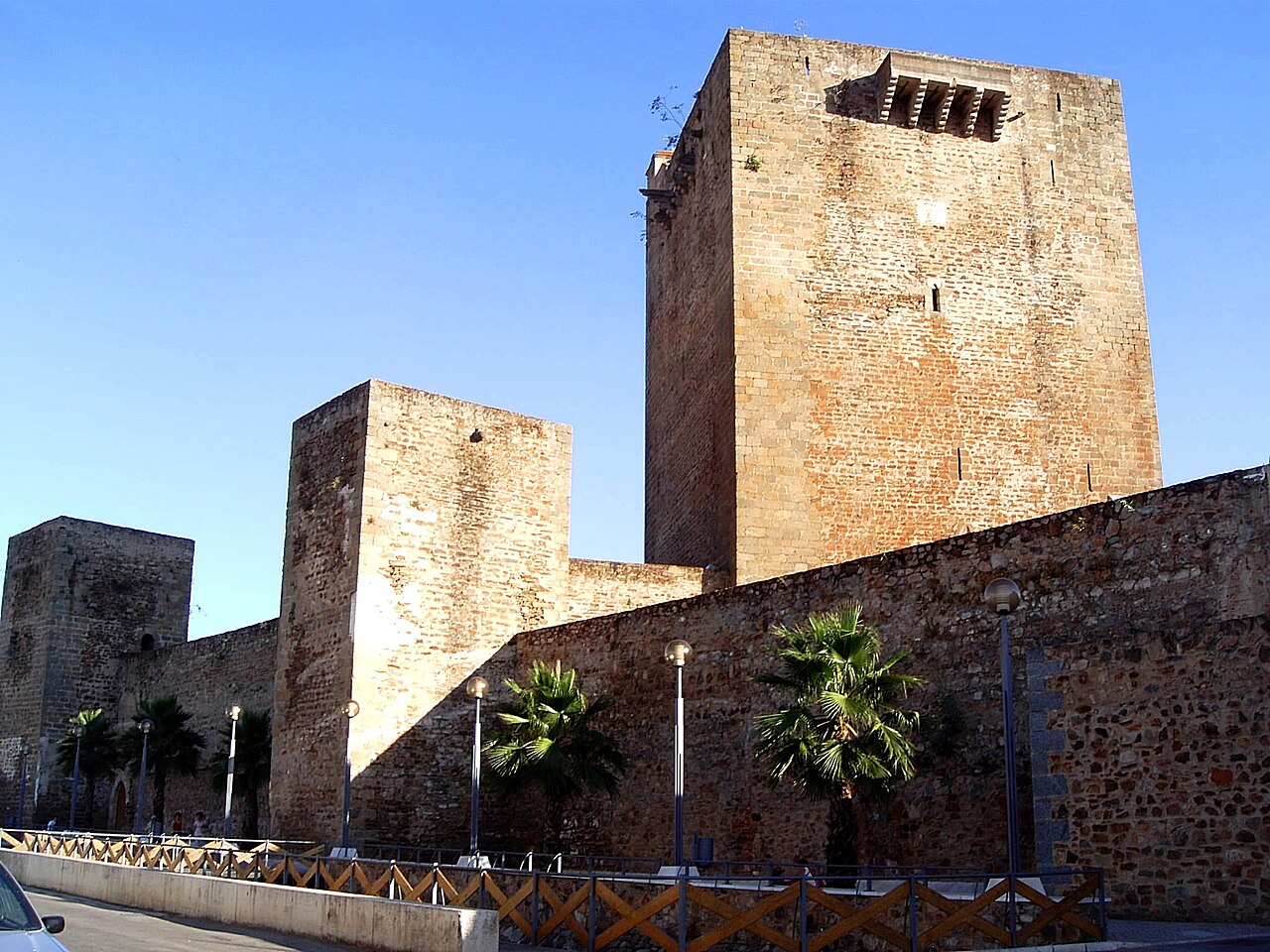
Alconchel Castle
Alconchel Castle stands as a remarkable example of a high medieval hill castle in Spain, perched strategically atop Miraflores hill in the municipality of Alconchel. This fortress is not only significant for its medieval military architecture but also for its deep historical roots that span several ancient civilizations, including the Romans, Visigoths, and Moors. The site’s continuous occupation underscores its longstanding strategic importance in the border region between Spain and Portugal.
The castle’s oldest surviving structures date back to the 12th century, a period when the Christian kingdoms of Portugal and León vied for control of this key frontier. Over subsequent centuries, the fortress underwent numerous modifications to adapt to evolving military technologies, including adaptations for gunpowder artillery in the late 14th and 16th centuries. These changes reflect the castle’s role in the turbulent history of Iberian border conflicts.
Historical background and strategic significance
The site of Alconchel Castle has a rich and complex history that predates its medieval incarnation. Archaeological evidence reveals that Miraflores hill was occupied during the pre-Roman era, with substantial remains from the Roman and Visigothic periods. The presence of Roman tombstones, column fragments, and Visigothic coins attests to the hill’s longstanding importance as a defensive and possibly administrative center.
During the Islamic period in the Iberian Peninsula, a Moorish fortress occupied the site, although no physical remains survive from this era. The toponymy of the area preserves the memory of this Islamic presence, highlighting the castle’s role as a frontier fortification through successive cultural dominions.
The Christian reconquest of the site began in the mid-12th century. In 1145, the fortress briefly came under Portuguese control before being captured by the Kingdom of León. The reconquest led by Alfonso I of Portugal in 1166 solidified the castle’s status as a Christian stronghold. From 1264 to 1312, the castle was entrusted to the Knights Templar, who were granted the fortress by King Fernando III of Castile and León prior to his campaign to conquer Seville. Following the suppression of the Templars, the castle passed to the Order of Alcántara, a military order charged with defending the borderlands.
Architectural evolution and military adaptations
The castle’s architecture reflects its adaptation to changing military needs over several centuries. The original 12th-century fortress was constructed to take advantage of the natural topography of Miraflores hill, with an elongated footprint that follows the hill’s contours. This design allowed for layered defenses that integrated closely with the terrain.
In the 14th century, significant enhancements were made to strengthen the castle’s defenses amid frequent clashes between Spanish and Portuguese forces. The castle’s walls and towers were reinforced, and additional bastions were added to protect vulnerable areas. These fortifications were designed to withstand sieges and assaults typical of the medieval period.
The late 16th century saw further renovations under the direction of Gutierre de Sotomayor, Master of the Order of Alcántara. These works adapted the fortress for the use of artillery and gunpowder weapons, reflecting the evolution of warfare. The modifications included thicker walls and angled bastions better suited to deflect cannon fire, marking a transition from medieval to early modern military architecture.
Key architectural features
The castle’s main entrance is a pointed Gothic gate flanked by two cylindrical towers that rise prominently above the connecting walls. These towers served both defensive and observational roles, providing vantage points for archers and lookouts. The walls surrounding the castle are battlemented (crenellated) and pierced with arrow slits, allowing defenders to shoot while remaining protected.
The corners of the fortress are reinforced by cylindrical bastions, which feature decorative double brick moldings outlining the tops of the battlements and towers. This stylistic detail adds a unique aesthetic dimension to the otherwise utilitarian military structure.
Within the upper enclosure stands a large square keep tower, rising three stories with horizontal cornices separating each level. This keep, once crowned with battlements, is the tallest and most imposing structure of the castle. It contains multiple arrow slits and window-like openings that provided extensive views of the surrounding landscape, crucial for early warning of approaching enemies.
The keep has two entrances: the main doorway framed by a pointed arch typical of Gothic architecture and topped by an alfiz, a Moorish-style rectangular frame that once displayed heraldic symbols of the castle’s owners. A secondary, simpler door on the opposite side likely served for emergency or less formal access.
The castle’s role in border conflicts and noble ownership
Throughout its history, Alconchel Castle was a focal point in the intermittent wars and skirmishes between the kingdoms of Spain and Portugal. Its position near the border made it a valuable military asset, frequently contested and fortified to withstand prolonged sieges.
From the late 17th century through the 19th century, the castle was incorporated into the marquisate of San Juan de Piedras Albas and Bélgida, serving as part of a noble estate. This period marked a transition from purely military use to a more residential and administrative function, although the fortress retained its defensive characteristics.
Archaeological significance and preservation status
Archaeological investigations at Alconchel Castle have uncovered foundations built with large cyclopean masonry blocks, indicating early construction techniques that predate the medieval fortress. These findings contribute to understanding the site's continuous occupation from pre-Roman times through the medieval period.
The recovery of Roman-era tombstones and column fragments at the base of the hill further attest to the site’s importance in antiquity. The presence of Visigothic coins also highlights the castle’s role during the early medieval era.
Today, the castle remains a well-preserved high medieval hill castle, with its defensive walls, towers, and keep largely intact. The integration of Gothic and Moorish architectural elements, combined with adaptations for early modern artillery, make it a valuable cultural and historical monument in the region.
Visiting alconchel castle
Visitors to Alconchel Castle can explore its layered fortifications and appreciate the blend of architectural styles that reflect its diverse history. The castle’s elevated position offers panoramic views of the surrounding landscape, underscoring its strategic significance.
The site’s rich archaeological heritage and well-preserved structures provide valuable insights into the military and cultural history of the Iberian Peninsula. Guided tours and informational signage help visitors understand the castle’s evolution from a Roman and Visigothic stronghold to a medieval fortress adapted for gunpowder warfare.
Frequently asked questions (FAQ)
- How do I get to Alconchel Castle?
- Alconchel Castle is located in the village of Alconchel in Spain, easily accessible by car or public transport. If you're driving, follow the signs to Alconchel, and the castle is situated on a hill overlooking the village, making it a prominent landmark.
- What is the historical significance of Alconchel Castle?
- Alconchel Castle dates back to the 13th century and played a crucial role in the Reconquista, serving as a strategic military fortification. Its historical importance is reflected in its well-preserved architecture, which showcases the blending of Moorish and Christian influences.
- When was Alconchel Castle built?
- The construction of Alconchel Castle began in the 13th century, specifically during the period of the Reconquista when Christian forces were reclaiming land from Muslim rule. Over the centuries, it underwent several modifications, contributing to its unique architectural style.
- Can I visit Alconchel Castle?
- Yes, Alconchel Castle is open to visitors, allowing you to explore its fascinating history and enjoy stunning views of the surrounding landscape. Be sure to check the local tourist information for any guided tours or special events that may be available during your visit.
- Why is Alconchel Castle a popular tourist attraction?
- Alconchel Castle is popular due to its rich history, impressive architecture, and breathtaking views of the countryside. Visitors are drawn to its historical significance and the chance to experience a piece of Spain's medieval past.
- Is it possible to access all areas of Alconchel Castle?
- While many areas of Alconchel Castle are accessible to visitors, some sections may be restricted for safety reasons. It's advisable to follow any posted guidelines and ask staff for information on areas that are open to exploration.
- What are the opening hours for Alconchel Castle?
- Alconchel Castle typically opens to visitors from 10 AM to 6 PM, but hours may vary depending on the season or specific events. It’s best to check the official website or contact local tourism for the most accurate and updated information.
- What are the ticket prices to visit Alconchel Castle?
- The entry fee for Alconchel Castle is generally quite affordable, with discounts often available for students and seniors. Check the local tourism office for current pricing and any promotional offers that may be available during your visit.
- When is the best time to visit Alconchel Castle?
- The best time to visit Alconchel Castle is during the spring and fall when the weather is mild and pleasant for exploring. Additionally, these seasons often have fewer tourists, allowing for a more enjoyable and intimate experience.
- Are there any nearby attractions to visit while in Alconchel?
- Yes, the area around Alconchel offers several attractions, including picturesque villages and natural parks perfect for hiking. Exploring the local culture and cuisine can also enhance your visit, making it a well-rounded experience in this beautiful region of Spain.
Information
Website
Visit websiteSources & official resources
Verify the information above using these authoritative references.
Loading map...
Visitor reviews
No reviews yet. Been here? Write the first review and help other travelers!
Write the first reviewVisited this castle? Share your experience
Your review helps other travelers and adds first-hand knowledge to our encyclopedia.