Alaro Castle
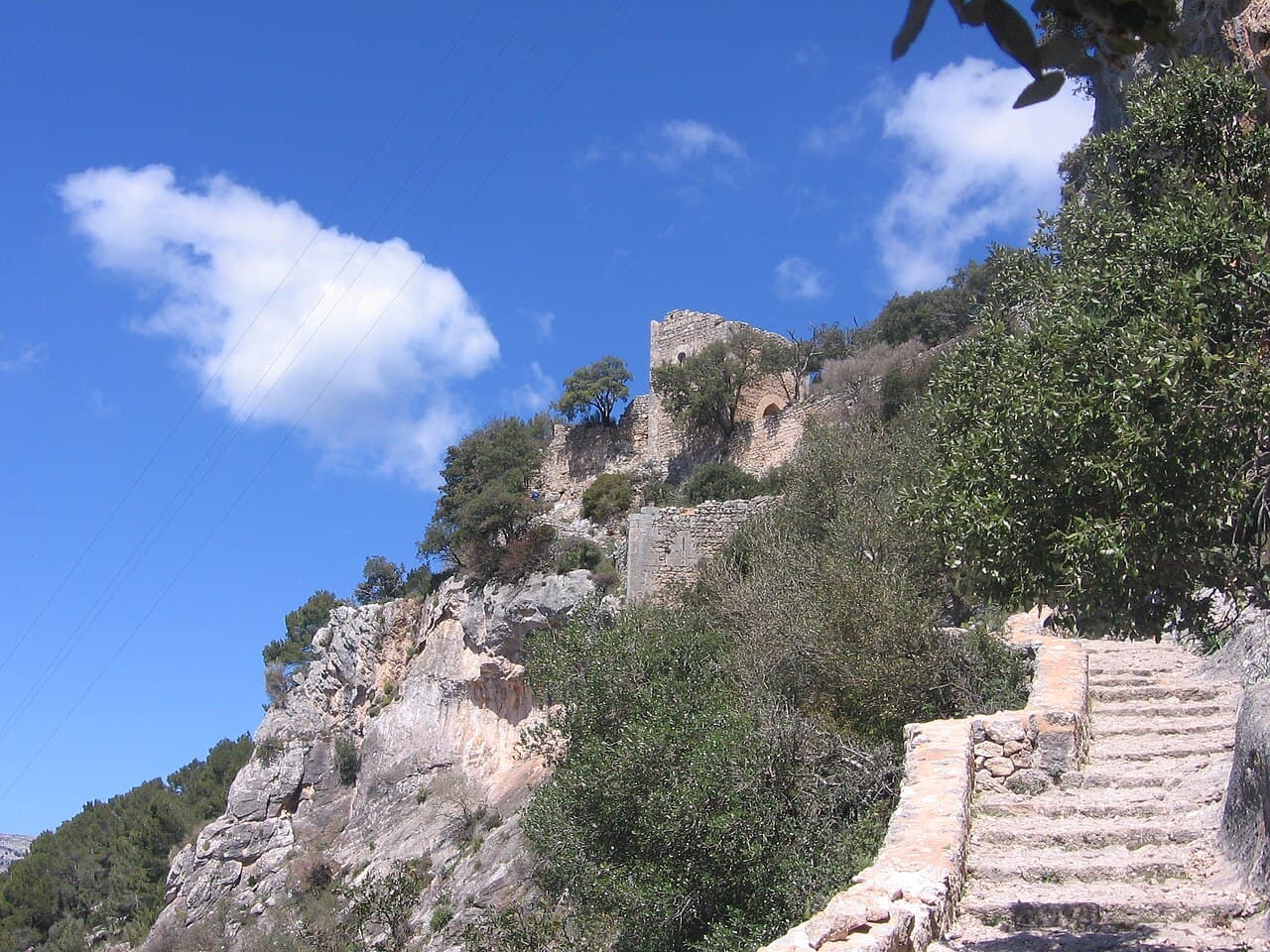
Alaro Castle stands as a remarkable example of a late medieval hill castle perched atop a rocky mountain in the municipality of Alaró, Mallorca, Spain. This fortress commands sweeping views of the Tramuntana mountains, the city of Palma, and the Mediterranean Sea, making it both a strategic military site and a captivating destination for visitors. The castle's origins trace back to the Islamic period, with evidence of earlier human occupation including the Talayotic civilization, Byzantine, and Roman influences, highlighting the site's long-standing cultural and historical significance.
Historical background and significance
The site of Alaro Castle has been fortified since at least 902 AD when it was established by Muslim forces as Hisn Alarun. It played a crucial role during the Islamic conquest of Mallorca, successfully withstanding Saracen sieges for over eight years. After the Christian conquest by King James I of Aragon in 1229, the castle was granted to the County of Urgell and the Infante Pedro I of Urgell. Despite the conquest, Muslim populations remained in the area until at least 1231, using the fortress as a refuge during this transitional period.
One of the castle's most dramatic historical episodes occurred in 1285 during the dynastic conflict between Alfonso III of Aragon and his uncle James II of Mallorca. The castle was defended by local captains Guillem Cabrit and Guillem Bassa, who resisted Alfonso's siege. After the fortress fell, the captains were executed by being burned alive on a spit, an event that cemented their legacy as martyrs and heroes of Mallorcan independence. This episode is commemorated in local legend and art, reflecting the castle's symbolic importance in regional history.
In 1343, the castle was surrendered to the forces of Pedro IV of Aragon, following proclamations that pressured its defenders. Despite this, the fortress continued to serve as a military garrison for several centuries, retaining strategic value until at least 1741. Over time, however, its military importance waned, and by the 14th and 15th centuries, parts of the fortress began to fall into partial ruin.
The site transitioned to religious use starting in 1622 with the construction of a small oratory that later expanded into a chapel and hermitage. This shift illustrates the castle's evolving role from a military bastion to a place of spiritual significance. Today, Alaro Castle is protected as a Bien de Interés Cultural heritage site since 1931, preserving its rich historical layers and architectural remains.
Architectural features and defensive structures
The remains of Castell d’Alaró reveal a complex defensive system adapted to its rugged hilltop location. The castle consists of stone walls arranged around five towers, each serving distinct military functions. The centerpiece is the main keep, known as the Torre del Homenaje or "constipador," which functioned as the lord's residence and last line of defense.
The entrance is fortified by a sophisticated double-gate system. The first gate features an arched portal with a double-leaf wooden door, while the second gate is protected by a stone wall with three narrow arrow slits aimed to repel attackers. This layered defense exemplifies the castle's focus on security and strategic control of access points.
Among the towers, the Torre de Migjorn on the southwest side is notable for its broad defensive walls punctuated with arrow slits, designed to provide archers with optimal fields of fire. Another significant tower is the square-shaped Prisión de los Moros or Torre de sa Cova, which includes arrow slits oriented towards Mecca, a feature reflecting its Islamic origins. This tower is adjacent to a cave historically associated with 17th-century hermits, linking the military architecture to later religious use.
Water management was crucial for the castle's sustainability. Several cisterns or aljibes are found within the complex, some dating back to the Arab period. These cisterns collected and stored rainwater, essential for the fortress's inhabitants during sieges. One cistern is believed to have served as a snow house, preserving ice or snow for use in warmer months. Additional features such as charcoal pits and lime kilns indicate onsite production activities supporting the castle's maintenance and defense.
The hermitage and religious transformation
From the early 17th century, the castle began to assume a religious character with the establishment of a hermitage. Built from local marés stone, the hermitage includes a chapel and sacristy. Its entrance is framed by a Renaissance-style architrave and a porch with a double-pitched Arabic tile roof supported by a semicircular arch and octagonal pilasters. Inside, wooden struts provide structural support for the roof.
The hermitage’s upper façade features a unique limestone sundial oriented southward. This sundial is distinctive for its gnomon aligned with the North Star and the use of Arabic numerals, differing from the more common Roman or Greek styles. Photographs from the early 20th century document this sundial, though its original construction date remains unknown.
Inside the hermitage, a single room with a barrel-vaulted ceiling is adorned with ceramic flooring and walls decorated with vegetal reliefs. The semicircular apse houses a baroque altarpiece featuring an image of the Virgin Mary, flanked by painted portraits of the local captains Guillem Cabrit and Guillem Bassa. These portraits honor their defense of the castle during the 1285 siege and serve as a poignant reminder of the site's layered history.
Visitor experience and access
Today, visitors can reach Alaro Castle via a partially paved and cobbled path ascending the mountain to the summit at approximately 822 to 825 meters elevation. The castle ruins, including its walls, towers, and hermitage, offer panoramic views that extend across the Tramuntana mountain range and the surrounding Mallorcan landscape.
At the site, amenities such as a small hostel and café provide comfort for visitors, making it a popular destination for hikers and history enthusiasts alike. The combination of natural beauty, historical depth, and architectural interest ensures that Alaro Castle remains a cherished cultural landmark in Mallorca.
Frequently asked questions (FAQ)
- How do I get to Alaro Castle?
- Alaro Castle is located in Alaró, Spain, and can be accessed by car or public transportation. The most common route is to drive to the town of Alaró and follow the marked hiking trails that lead to the castle, offering scenic views along the way.
- What is the historical significance of Alaro Castle?
- Alaro Castle dates back to the 10th century and played a crucial role in the defense of Mallorca during the Moorish occupation. It has since become a symbol of the island's rich history and resilience, attracting history enthusiasts from around the world.
- When was Alaro Castle built?
- Construction of Alaro Castle began in the 10th century, with significant renovations occurring in the following centuries. The castle's strategic location was chosen to provide a vantage point for defense against invaders.
- Can I visit Alaro Castle year-round?
- Yes, Alaro Castle is open to visitors throughout the year, although the best time to visit is during the spring and fall when the weather is mild and ideal for hiking. Be sure to check local guidelines for any seasonal closures or special events.
- Why is Alaro Castle a popular tourist attraction?
- Alaro Castle is popular due to its stunning panoramic views of the surrounding landscape and its historical significance. Visitors are drawn to its ancient architecture and the opportunity to explore the ruins while enjoying the natural beauty of Mallorca.
- Is it possible to hike to Alaro Castle?
- Absolutely! Hiking to Alaro Castle is a popular activity, with well-marked trails that vary in difficulty. The hike typically takes around 1-2 hours, depending on your pace, and rewards you with breathtaking views at the top.
- What are the opening hours for Alaro Castle?
- Alaro Castle is generally open to the public from 9 AM to 7 PM during the warmer months and has reduced hours in the winter. It's advisable to check the official website for the most current opening hours before your visit.
- Are there any ticket prices for visiting Alaro Castle?
- There is no entrance fee to visit Alaro Castle, making it an accessible destination for all. However, be prepared for potential parking fees if you choose to drive to the starting point of the hiking trails.
- What are some nearby attractions to Alaro Castle?
- In addition to Alaro Castle, visitors can explore the charming village of Alaró, known for its local markets and traditional Mallorcan architecture. Additionally, nearby hiking trails and the picturesque Serra de Tramuntana mountain range offer various outdoor activities for nature lovers.
Photo gallery

Information
Loading map...
Visitor reviews
No reviews yet. Been here? Write the first review and help other travelers!
Write the first reviewVisited this castle? Share your experience
Your review helps other travelers and adds first-hand knowledge to our encyclopedia.