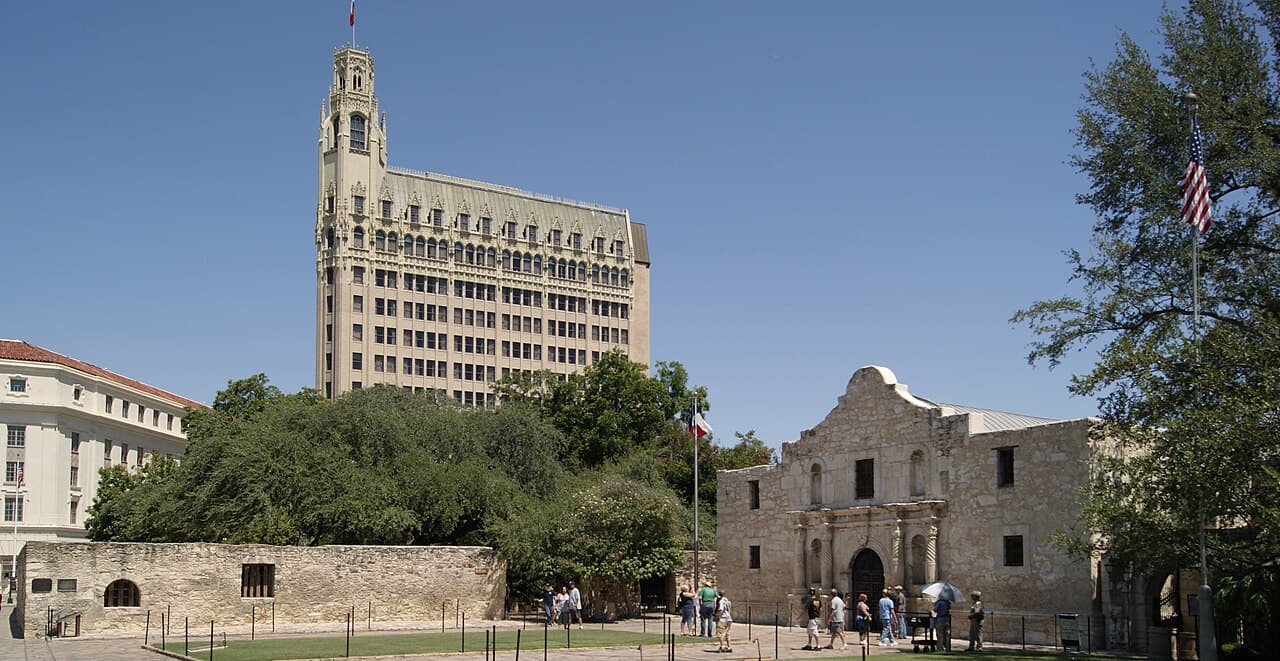
Alamo Mission — United States of America castle

Alamo Mission

The Alamo mission in San Antonio, Texas
San Antonio, Texas, United States of America
Post-Renaissance (17th–18th c.)
Partially Restored

The Alamo mission is a historic Spanish mission and fortress complex located in San Antonio, Texas. Founded in the 18th century by Catholic missionaries, it originally served as a religious outpost aimed at converting local American Indian tribes to Christianity. Known initially as Misión San Antonio de Valero, it became a significant military site and cultural symbol in Texas history, particularly due to its role in the Texas Revolution.

Early history and mission foundation

The Alamo was established in the early 1700s as part of Spain's colonial efforts to expand its influence in the region. The mission's primary purpose was religious conversion and settlement, typical of Spanish missions throughout the Americas. The complex included a church, living quarters, workshops, and agricultural areas. The mission was secularized in 1793, after which it was abandoned as a religious institution.

Transition to military fortress

By 1803, the site was repurposed as a military garrison for the Second Flying Company of San Carlos de Parras, a Spanish military unit. This military presence is believed to have given the mission its enduring name, "Alamo," which means "cottonwood tree" in Spanish. The fortifications were adapted to serve defensive purposes, including the construction of thick adobe walls and bastions suitable for artillery defense.

Architectural features and fortifications

The Alamo's architecture blends elements of Spanish colonial mission style with military fortifications characteristic of the post-Renaissance period. The complex includes a prominent chapel with a distinctive curved facade, defensive walls, and bastioned corners designed to withstand attacks. The use of adobe and limestone was common, providing sturdy yet workable materials for construction. The layout included a courtyard surrounded by defensive walls, with gates controlling access.

The battle of the Alamo and its aftermath

The Alamo is most famous for the Battle of the Alamo in 1836, a pivotal event during the Texas Revolution. A small group of Texian defenders, including notable figures such as James Bowie and Davy Crockett, held the fortress against a much larger Mexican force led by General Antonio López de Santa Anna. After a 13-day siege, the Mexican army overran the mission on March 6, 1836, killing all the Texian defenders. This battle became a symbol of resistance and sacrifice in Texas history.

Following the battle, the Mexican army partially dismantled the fortifications and burned some buildings as they retreated later that year. The site was intermittently used by both Mexican and Texian forces in the following years but gradually fell into disuse.

Post-revolution use and preservation efforts

After Texas joined the United States, the U.S. Army used the Alamo as a quartermaster's depot starting in 1849. The nearby establishment of Fort Sam Houston in 1876 led to the Army abandoning the Alamo. The chapel was sold to the state of Texas and became a site for occasional tours, though no major restoration was undertaken initially. Other buildings on the site were converted for commercial use.

Preservation by the daughters of the republic of Texas

The Daughters of the Republic of Texas (DRT), formed in 1891, played a crucial role in preserving the Alamo. Led by figures such as Adina Emilia De Zavala and Clara Driscoll, they successfully lobbied the Texas legislature in 1905 to purchase the remaining structures and designate the DRT as the site's custodian. Their efforts ensured the Alamo's survival as a historic landmark and museum.

Modern status and world heritage designation

In the 21st century, control of the Alamo transitioned from the DRT to the Texas General Land Office in 2015, reflecting ongoing efforts to manage and preserve the site. The Alamo is part of the Alamo Plaza Historic District and is included in the San Antonio Missions National Historical Park. On July 5, 2015, the Alamo and the other missions in San Antonio were collectively designated a UNESCO World Heritage Site, recognizing their cultural and historical significance.

Visitor experience and significance

Today, the Alamo operates as a museum, attracting visitors from around the world who come to learn about its complex history and architectural heritage. The site includes preserved mission buildings, exhibits on the Texas Revolution, and memorials to those who fought in the Battle of the Alamo. Its legacy as a symbol of courage and resistance continues to resonate in American and Texan identity.

Frequently asked questions (FAQ)

What is the best time to visit the Alamo mission?
The best time to visit the Alamo is during the spring and fall when the weather in San Antonio is mild and comfortable for walking tours. Weekdays tend to be less crowded than weekends, allowing for a more relaxed experience.
How do I get to the Alamo mission in San Antonio?
The Alamo is located in downtown San Antonio and is easily accessible by car, public transit, or on foot from nearby attractions. Parking is available in the vicinity, and several bus routes stop near the Alamo Plaza.
What can I expect to see at the Alamo museum?
Visitors to the Alamo museum can explore the preserved mission chapel, defensive walls, and various exhibits detailing the Texas Revolution and the Battle of the Alamo. Guided tours provide historical context and highlight key figures such as James Bowie and Davy Crockett.
Is the Alamo mission accessible for visitors with disabilities?
The Alamo mission has made efforts to improve accessibility, including ramps and designated pathways for visitors with mobility impairments. However, some historic areas may have limited access due to preservation concerns.
Are there any fees to enter the Alamo?
Admission to the Alamo is free of charge, making it an accessible historic site for all visitors. Donations are accepted to support ongoing preservation and educational programs.

Photo gallery

Alamo Mission
Click to view

Photo by Zygmunt Put Zetpe0202•CC BY-SA 4.0

1 photo • Click any image to view in full screen

Information

Bastioned Fortress

Loading map...

Visitor reviews

No reviews yet. Been here? Write the first review and help other travelers!

Write the first review

Visited this castle? Share your experience

Your review helps other travelers and adds first-hand knowledge to our encyclopedia.

Write a review

(5/5)

0/2000 characters

Your review will be visible after admin approval

Nearby castles

8.7 km

Magic Lantern Castle Museum

San Antonio, United States Minor Outlying Islands

The Magic Lantern Castle Museum in San Antonio offers a unique glimpse into the fascinating world of early projection technology, centered around the magic lantern, the earliest known slide projector. This remarkable device, dating back to the late 1600s, represents a significant milestone in the history of visual entertainment and optical science. The concept of the magic lantern was first rigorously studied and published by Athanasius Kircher, a renowned German Jesuit scholar of geology and medicine, in his seminal work Ars Magna Lucis et Umbrae. Kircher's treatise detailed the principles of the magic lantern, which involved directing a light source through a lens to project images painted on glass slides onto surfaces such as buildings, cloth drapes, or wet screens. For audiences in the 17th century, witnessing images suddenly materialize on a flat surface was nothing short of magical, captivating the imagination and laying the groundwork for modern visual media. The evolution of projection technology and the magic lantern Before the advent of cinema and moving pictures, the magic lantern was the primary means of projecting images to an audience. It remained the dominant projection technology until the late 1890s, when moving images began to emerge. The magic lantern's ability to display painted images on glass slides introduced a new form of storytelling and entertainment, influencing theatrical performances, educational presentations, and even early scientific demonstrations. Construction and mechanism The magic lantern typically consisted of a light source, initially candles or oil lamps, later replaced by more powerful limelight or electric bulbs. The light was focused through a convex lens system, projecting the image from a painted glass slide onto a surface in a darkened room or outdoor setting. The slides often featured hand-painted scenes, illustrations, or even rudimentary animations created by moving parts or multiple slides. Cultural impact and significance The magic lantern captivated audiences across Europe and beyond, becoming a popular form of entertainment in private homes, public lectures, and traveling shows. It played a crucial role in the development of visual culture, inspiring future inventors and filmmakers. The device also contributed to educational methods by enabling visual aids in teaching, particularly in subjects like geography, natural history, and astronomy. The magic lantern castle museum's collection and exhibits The museum houses an extensive collection of magic lanterns, glass slides, and related apparatus, illustrating the technological and artistic evolution of this early projection device. Visitors can explore rare examples of lanterns from different periods, including elaborately decorated models and simpler utilitarian designs. The glass slides on display showcase a variety of subjects, from fairy tales and historical events to scientific diagrams and exotic landscapes. Interactive exhibits allow visitors to experience the magic lantern's projection firsthand, demonstrating how light and optics were harnessed centuries ago to create immersive visual experiences. The museum also provides educational programs and workshops that delve into the history of optics, the science behind projection, and the cultural context of the magic lantern's use. Historical context and legacy The magic lantern represents a crucial link between ancient optical devices and modern cinema technology. Its invention and popularization reflect the human desire to tell stories visually and to share knowledge in engaging ways. The Magic Lantern Castle Museum preserves this heritage, highlighting the ingenuity of early inventors like Athanasius Kircher and the enduring fascination with projected images. Though not a traditional castle in architectural terms, the museum's name evokes the enchanting and mysterious qualities associated with castles, symbolizing a fortress of knowledge and wonder centered on the magic lantern's legacy. It stands as a testament to the intersection of science, art, and entertainment that has shaped visual media history.

Details
122.3 km

Elisabet Ney Museum

Austin, United States of America

The Elisabet Ney Museum in Austin, Texas stands as a unique and evocative castle-like stone structure nestled within the historic Hyde Park National Register Historic Neighborhood. This distinctive building was originally constructed as the personal studio and residence of Elisabet Ney, a renowned German sculptor who immigrated to the United States in the late 19th century. Ney was celebrated for her portrait sculptures of prominent figures, including political leaders and cultural icons of her era. Built in 1893, the structure showcases a blend of artistic vision and architectural individuality, reflecting Ney's European heritage and her artistic identity. The building's stone facade, turret-like features, and overall castle-inspired design distinguish it from typical residential architecture in Austin, giving it a romantic and historic ambiance. This design choice not only served as a functional studio space but also as a symbolic fortress of creativity and artistic independence. Architectural significance and style The Elisabet Ney Museum is notable for its romantic, castle-like architectural style, which is relatively rare in Texas residential areas. The building incorporates stone masonry and turret elements that evoke the feel of a small European tower house. While not a traditional medieval castle, its design draws inspiration from romantic neo-gothic and historicist architectural movements that were popular in the 19th century, particularly among artists and intellectuals who sought to connect their workspaces with a sense of history and grandeur. The interior spaces were designed to accommodate Ney's sculpting work, with ample natural light and open areas for displaying and creating large-scale sculptures. The building's layout includes a main studio room, living quarters, and smaller ancillary rooms, all arranged to support both creative work and daily living. Historical context and elisabet ney's legacy Elisabet Ney (1833–1907) was a pioneering female sculptor who gained international recognition for her skill and artistic vision. After establishing her career in Europe, she moved to Texas in the late 19th century, where she continued her work and became an influential figure in the cultural development of the region. The museum preserves Ney's studio much as it was during her lifetime, offering visitors a glimpse into her working environment and artistic process. Her sculptures include busts of notable figures such as Sam Houston and Stephen F. Austin, key personalities in Texas history. The museum thus serves not only as a tribute to Ney's personal achievements but also as a cultural landmark celebrating Texas heritage. Preservation and public access Since Ney's death in 1907, the property has been carefully preserved and maintained as a monument to her life and work. The building is now operated as a public museum by the City of Austin, offering free admission to visitors interested in art, history, and architecture. The museum hosts exhibitions, educational programs, and cultural events that highlight Ney's contributions to sculpture and the arts in Texas and beyond. Its location in Hyde Park adds to its appeal, as visitors can explore a historic neighborhood known for its early 20th-century residential architecture and cultural significance. Visiting information and nearby attractions The Elisabet Ney Museum is located at 304 E 44th St, Austin, Texas, 78751. It is accessible to the public with no admission fee, encouraging visitors to experience this unique blend of art and architecture. Typical visiting hours are maintained by the City of Austin, and visitors are advised to check the museum's official website for the latest information on hours and special events. Nearby attractions include other historic sites in the Hyde Park neighborhood and the broader cultural offerings of Austin, making the museum a worthwhile stop for those interested in the city's artistic heritage.

Post-Renaissance (17th–18th c.)
Details
132.5 km

Smythwick Castle

Marble Falls, United States of America

Smythwick Castle & Lodge is a distinctive castle-like estate nestled in the heart of the Texas Hill Country, just west of Austin near Marble Falls. This unique property spans over 10 acres of beautifully landscaped grounds featuring waterfalls, ponds, and mature oak trees, creating a serene and picturesque environment. Though not a traditional medieval fortress, Smythwick Castle offers an enchanting old-world ambiance with its stone fireplaces, turrets, brick courtyard, and elegant fountain, making it a sought-after venue for weddings, anniversaries, corporate events, and private celebrations.The estate's architecture evokes the romantic charm of a castle-like lodge, with a grand hall that boasts crystal chandeliers, large stone fireplaces, and expansive picture windows that flood the interior with natural light. The old-world brick courtyard serves as a magical centerpiece for outdoor gatherings, complemented by a romantic gazebo and the presence of peacocks roaming the grounds, adding to the fairytale atmosphere. Guests can enjoy the luxury of five well-appointed bedrooms and relax in amenities such as a hot tub, making it an ideal location for weekend getaways or extended celebrations.Architecture and groundsSmythwick Castle & Lodge is designed to resemble a quaint European castle, blending rustic and elegant elements that harmonize with the natural surroundings. The turrets and stone fireplaces are key architectural features that enhance its castle-like appearance. The estate's layout includes lush gardens, water features like cascading waterfalls and serene ponds, and towering oak trees that provide shade and a sense of timelessness.The brick courtyard with its elegant fountain is a focal point for ceremonies and receptions, offering an intimate yet spacious outdoor venue. The grounds are meticulously maintained to highlight the natural beauty of the Texas Hill Country, with wildflowers blooming in spring and ample space for outdoor activities and photography.Events and accommodationsSmythwick Castle & Lodge specializes in hosting elegant weddings and events, providing a customizable and stress-free experience for brides and event planners. The venue offers comprehensive wedding packages that can include catering and cakes by Bittersweet Cakes & Catering, floral arrangements, officiants, DJs, photographers, hair and makeup services, and vintage or standard china rentals. This all-inclusive approach ensures that every detail is managed professionally, allowing guests to fully enjoy their special day.The intimate setting accommodates up to 10 overnight guests in five luxurious bedrooms, making it perfect for small wedding parties or family gatherings. After celebrations, guests can unwind in the hot tub or enjoy a hearty country breakfast the following morning, enhancing the overall experience.Location and accessibilityLocated at 12615 East FM 1431, Marble Falls, Texas 78654, Smythwick Castle & Lodge is easily accessible from Austin and the surrounding Hill Country region. The venue offers ample parking and is open for events year-round, with springtime being especially popular due to the blooming wildflowers and pleasant weather. The castle's setting amidst natural beauty and rolling hills makes it a favored destination for photographers and couples seeking a romantic backdrop for engagement photos and weddings.Historical and cultural significanceWhile Smythwick Castle & Lodge is a modern construction rather than a historic fortress, it embodies the romantic ideal of a castle in the American landscape. Its design and use as a venue celebrate the cultural fascination with European-style castles and the desire for unique, picturesque event settings. The property contributes to the local tourism and hospitality industry by offering an exclusive venue that combines natural beauty with architectural charm.As of June 2021, Smythwick Castle was sold, and its future use as a lodge and event venue remains unconfirmed, adding a layer of contemporary interest to its story.

Contemporary (20th–21st c.)
Details
