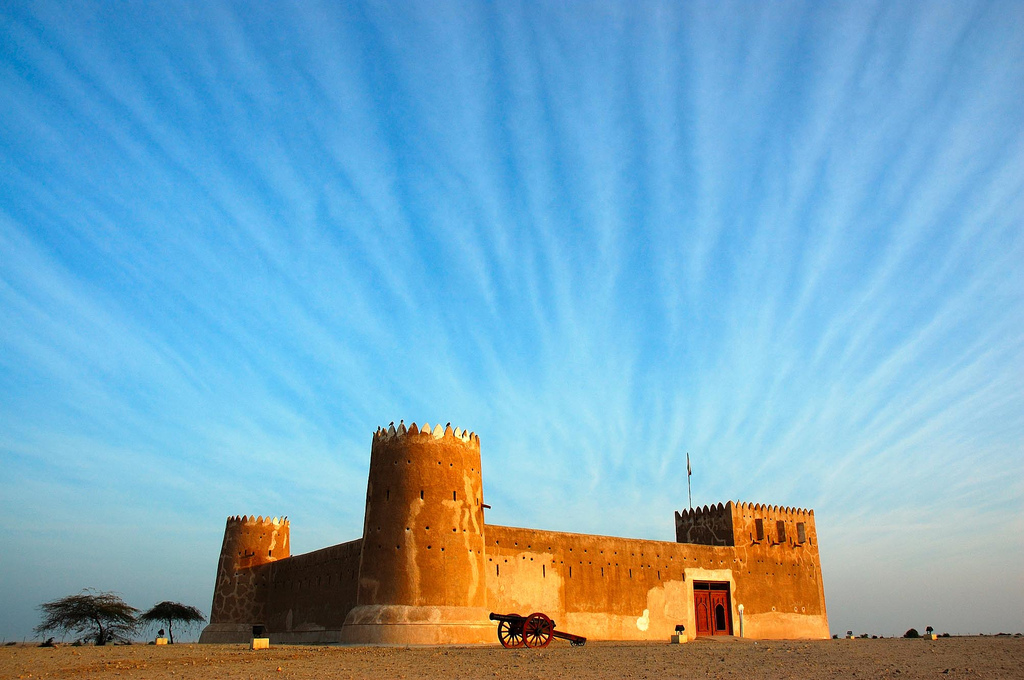
Al Rakayat Fort
Al Rakayat Fort, also known locally as Qal'at al Rakayat, is a notable historic fortress located approximately 9 kilometers south of the town of Al Ruwais in the municipality of Madinat ash Shamal, Qatar. This fort is situated in the desert near a camel ranch, reflecting its traditional setting and strategic importance in the arid landscape of northern Qatar.
The exact date of construction for Al Rakayat Fort remains uncertain, with some sources suggesting origins in the 17th or 18th century, while others lean towards the 19th century. However, the majority of historical assessments place its construction firmly in the 18th century, during the post-Renaissance period. The fort was primarily built to safeguard a local water source, an essential resource in the desert environment, underscoring its strategic military and survival functions.
Architectural features and design
Al Rakayat Fort stands out among Qatari desert forts due to its distinctive architectural layout. It features a square ground plan, a common defensive design, but differs notably by having only one circular tower and three rectangular towers. This combination of tower shapes is unusual compared to other forts in the region, which often have uniform tower designs.
The fort is constructed using irregular coral blocks and adobe, traditional materials well-suited to the desert climate. These materials are coated with a gypsum-based plaster, which helps protect the structure from harsh weather conditions and provides a smooth finish. The walls are thick and robust, designed to withstand attacks and the extreme desert heat.
At the entrance of the fort, there is a small building that historically served as a masjid (mosque). This feature illustrates the integration of religious practices within the fort's daily life and the importance of spiritual needs for its inhabitants or garrison.
Historical significance and context
The fort's primary function was to guard a vital water source, an indispensable asset in Qatar's arid environment. Control of water meant control of survival and local influence, making Al Rakayat Fort a key military and logistical point in the region. Its location near Al Ruwais and proximity to other forts such as Al Thaqab Fort (approximately 3 kilometers to the south) suggests a network of defensive structures designed to secure resources and territory in northern Qatar.
While the fort never played a role in large-scale battles documented in major historical records, its presence reflects the broader strategies of territorial defense and resource protection typical of desert fortifications in the Arabian Peninsula during the post-Renaissance period.
Access and visitor information
Al Rakayat Fort is freely accessible to visitors, offering an opportunity to explore a less frequented but culturally significant site. However, reaching the fort requires careful planning due to its remote desert location. A 4-wheel drive vehicle is recommended to navigate the sandy and rough terrain. Visitors using standard city cars may need to park at the end of a dirt road and proceed on foot for about 1.5 kilometers through the desert.
Visitors should prepare for the harsh desert climate, especially during summer months when temperatures can soar to around 41 degrees Celsius. Carrying sufficient water and sun protection is essential for safety and comfort.
Nearby, Al Thaqab Fort offers another intriguing site with similar access conditions, making a combined visit a rewarding experience for those interested in Qatar's desert heritage and military architecture.
Preservation and current condition
The fort remains in a partially preserved state, retaining much of its original structure and architectural features despite exposure to the desert environment. Its walls, towers, and mosque building still convey the fort's historical function and design. However, the fort has not undergone extensive restoration, which leaves it vulnerable but also authentic as a cultural heritage site.
Efforts to maintain and protect Al Rakayat Fort contribute to preserving Qatar's historical landscape, providing insights into the region's defensive strategies and settlement patterns during the 18th century.
Architectural comparison with other Qatari forts
Compared to other forts in Qatar, which often feature multiple circular towers and elaborate defensive walls, Al Rakayat Fort's unique combination of one circular and three rectangular towers is distinctive. This design likely reflects adaptations to local needs and available materials, as well as the specific defensive requirements of guarding a water source rather than a large settlement.
The use of coral blocks and adobe is typical of coastal and desert fortifications in the region, demonstrating traditional construction techniques that balance durability with resource availability.
Role in local culture and heritage
Al Rakayat Fort holds cultural significance as a symbol of historical survival and resource protection in Qatar's desert areas. It represents the ingenuity of past communities in adapting to harsh environments and securing essential resources through architectural means.
Today, it serves as an educational site for visitors interested in the history of Qatar's desert forts and the broader Arabian Peninsula's military architecture. Its accessibility and proximity to other forts make it a valuable part of the region's cultural tourism offerings.
Frequently asked questions (FAQ)
- How do I get to Al Rakayat Fort?
- Al Rakayat Fort is located about 9 km south of Al Ruwais in Madinat ash Shamal. Access requires a 4-wheel drive vehicle due to desert terrain. Visitors with regular cars should park at the end of the dirt road and walk approximately 1.5 km through the desert.
- What is the historical significance of Al Rakayat Fort?
- The fort was built in the 18th century to protect a vital water source in the desert. It served as a strategic defensive point in northern Qatar during the post-Renaissance period.
- Can I visit Al Rakayat Fort for free?
- Yes, Al Rakayat Fort is freely accessible to visitors without an entrance fee.
- What materials were used to build Al Rakayat Fort?
- The fort is constructed from irregular coral blocks and adobe, covered with a gypsum-based plaster to protect against desert weather.
- Is there a mosque at Al Rakayat Fort?
- Yes, there is a small building near the entrance that was used as a masjid (mosque) within the fort complex.
- What other forts are near Al Rakayat Fort?
- Al Thaqab Fort is located about 3 km south of Al Rakayat Fort and can be visited with similar access arrangements.
Information
Loading map...
Visitor reviews
No reviews yet. Been here? Write the first review and help other travelers!
Write the first reviewVisited this castle? Share your experience
Your review helps other travelers and adds first-hand knowledge to our encyclopedia.