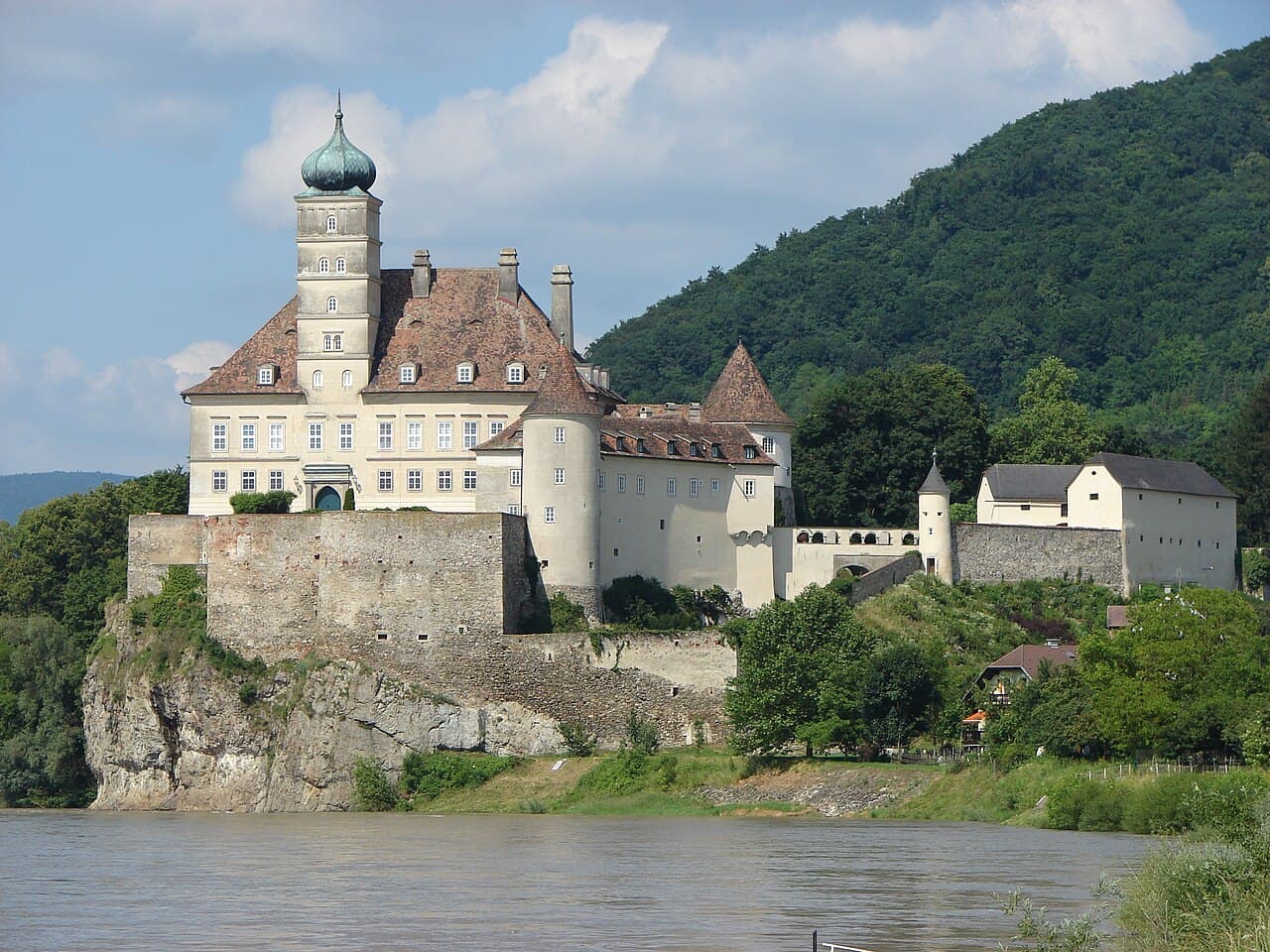
Aggstein Castle
Aggstein Castle is a remarkable high medieval hill castle ruin perched dramatically on a rocky spur above the right bank of the Danube River in the Wachau region of Lower Austria. Constructed in the 12th century, it commands a strategic vantage point approximately 300 metres above the river, stretching about 150 metres in length along an east-west oriented rock formation. This imposing location allowed the castle's medieval occupants to control river traffic and regional trade routes, making it a vital stronghold through centuries of conflict and political change.
Early construction and strategic significance
The origins of Aggstein Castle trace back to the early 12th century, likely established by Manegold III of Acchispach (also known as Aggsbach) from the influential Kuenring family. The castle was built atop a natural rock outcrop featuring two prominent rock structures at its eastern and western ends, known as Bürgel and Stein. Archaeological evidence suggests that the site may have been used even earlier, potentially as a Roman fortress, highlighting the long-standing strategic importance of this location.
From its inception, the castle served as a formidable defensive fortress and a toll station overseeing the Danube's busy shipping lanes. Its elevated position enabled effective surveillance and control, which was crucial during the politically turbulent high medieval period.
The kuenring era and medieval conflicts
The Kuenring family held Aggstein Castle for much of the 12th and 13th centuries. In 1181, the castle came firmly under the Kuenring branch of Aggsbach-Gansbach. The castle's history during this era is marked by episodes of rebellion and siege. Notably, during the Kuenringer revolt against Duke Frederick II in 1230–31, Aggstein was besieged and captured, reflecting the broader noble unrest in Austria at the time.
Later, in 1295–96, the castle was again besieged during another noble uprising led by Leutold I of Kuenring-Dürnstein against Duke Albert I. Despite these sieges, the castle was never taken by direct assault but rather surrendered after prolonged blockades or starvation. The last Kuenring owner, Leutold II, held the castle until 1355, after which it gradually fell into disrepair.
Rebirth under ducal authority and the robber barons
In 1429, Duke Albert V confiscated Aggstein Castle from the Maissau family and entrusted it to his chamberlain, Jörg Scheck von Wald. Scheck von Wald undertook significant rebuilding efforts between 1429 and 1436, transforming the castle into a fortified stronghold with enhanced defenses suitable for the evolving military technology of the time.
Under Scheck von Wald's control, the castle became notorious as a base for robber knights. He exploited his toll rights to attack and plunder passing ships on the Danube, terrorizing river traffic and accumulating wealth through intimidation and ransom. This lawlessness persisted until 1463 when Georg von Stain, another robber knight, besieged and captured the castle, using it as leverage against debts owed by the duke.
The castle changed hands several times thereafter, including a brief tenure by Ulrich Freiherr von Graveneck before surrendering to Duke Frederick III in 1477. The duke then stationed tenants and caretakers to curb the rampant plundering and restore order to the region.
Destruction and artillery modernization
During the first Ottoman siege of Vienna in 1529, Aggstein Castle was burned down by Ottoman forces. This destruction marked a turning point in the castle's military architecture. Subsequent rebuilding efforts incorporated artillery embrasures (gunports) to adapt to the increasing use of firearms and cannon in warfare, reflecting the transition from medieval to early modern fortification techniques.
The castle's defensive upgrades included reinforced walls and strategically placed loopholes for muskets and cannons, enhancing its ability to withstand artillery attacks. These modifications exemplify the broader European trend of adapting medieval castles to the realities of gunpowder warfare in the 16th century.
Renaissance renovations and later decline
In the early 17th century, ownership passed to Anna Freiin von Polheim und Parz, who undertook renovations adding Renaissance-style chancery buildings to the castle complex. These additions introduced architectural elements emphasizing symmetry, proportion, and decorative detail, contrasting with the earlier Gothic and military features.
Despite these improvements, the castle's importance waned over time. After Anna's death, the castle was neglected, and much of its stone and timber was repurposed for nearby monastery construction. The castle gradually fell into ruin, reflecting the broader decline of feudal fortresses in the face of changing political and military landscapes.
Ownership transitions and preservation efforts
Ownership of Aggstein Castle passed through several noble families, including the Starhemberg and Beroldinger families. In 1819, Ludwig Josef Gregor von Starhemberg sold the castle to Count Franz von Beroldingen, who initiated renovations to make parts of the castle habitable again by 1821.
The Beroldinger family maintained the castle until 1930, when it was sold to Count Oswald von Seilern und Aspang. The Seilern-Aspang family has since overseen preservation and restoration efforts, including a major project from 2003 to 2004 that stabilized the ruins, installed modern amenities, and restored key architectural features such as the knights' hall roof and entrance pathways.
Architectural features and notable structures
The castle layout and rock formations
Aggstein Castle is built along a narrow rocky ridge approximately 150 metres long, oriented east to west, with two main rock formations at each end known as Bürgel (east) and Stein (west). Foundations from the original 12th-century construction survive at these points, indicating the castle's initial extent and defensive perimeter.
The women's tower and palas
The castle features the remains of a three-story women's tower called the Frauenturm, which likely served as a private residence or refuge for noblewomen. Adjacent to this is the palas, the main residential building where the lord and his family lived and conducted administrative affairs.
Chapel and religious spaces
A Gothic chapel within the castle complex reflects the religious devotion of its medieval inhabitants. The chapel's architectural details, including pointed arches and ribbed vaulting, exemplify the Gothic style prevalent during the castle's 15th-century reconstruction.
Defensive adaptations for artillery
Following the Ottoman destruction in 1529, the castle was retrofitted with artillery loopholes or Schießscharten to accommodate firearms and cannon. These openings allowed defenders to fire upon attackers while remaining protected behind thick walls.
The rosengärtlein balcony
One of the castle's most distinctive features is the Rosengärtlein, a small rocky balcony projecting from the castle walls. Dating to the 15th-century rebuilding, it is associated with local legends and adds a unique architectural and cultural dimension to the site.
Cultural significance and tourism today
Aggstein Castle is a prominent cultural landmark in Austria's Wachau region, recognized for its rich history and dramatic setting. It attracts visitors interested in medieval architecture, history, and scenic views of the Danube valley.
The castle is partially restored and maintained as a ruin, with visitor facilities including guided tours, exhibitions, and a detailed cardboard model illustrating the castle's idealized original form. The 2003–2004 restoration project enhanced visitor access and safety while preserving the site's historical integrity.
Additionally, Aggstein Castle's image was featured on a 5-Schilling Austrian postage stamp issued in 1973, underscoring its status as an iconic symbol of Austria's historical heritage.
Frequently asked questions (FAQ)
- How do I get to Aggstein Castle?
- Aggstein Castle is located in Schonbuhel-Aggsbach, Austria, and is easily accessible by car. If you are using public transportation, you can take a train to nearby Melk and then catch a local bus or taxi to reach the castle.
- What are the opening hours of Aggstein Castle?
- Aggstein Castle is typically open to visitors from April to October, with varying hours depending on the season. It is advisable to check the official website or contact the castle for the most up-to-date information on opening times before your visit.
- When was Aggstein Castle built?
- Aggstein Castle was originally constructed in the 12th century, making it a significant historical site in Austria. Over the years, it has undergone various renovations and restorations, preserving its architectural heritage.
- Can I take a guided tour of Aggstein Castle?
- Yes, guided tours are available at Aggstein Castle, offering visitors an in-depth look at its history and architecture. These tours often include access to areas of the castle that are not open to the general public.
- Why is Aggstein Castle historically significant?
- Aggstein Castle played a crucial role in the defense of the Danube River valley and served as a residence for noble families, notably the Counts of Formbach. Its strategic position made it a key lookout point during medieval times.
- Is it possible to host events at Aggstein Castle?
- Yes, Aggstein Castle offers options for hosting various events, including weddings and corporate gatherings. The stunning backdrop and historical ambiance make it a unique venue for memorable occasions.
- What is the ticket price for visiting Aggstein Castle?
- The ticket prices for Aggstein Castle vary depending on age and group sizes, with discounts available for children and families. For the most current pricing information, it is recommended to check the castle's official website.
- What is the best time to visit Aggstein Castle?
- The best time to visit Aggstein Castle is during the spring and early autumn months when the weather is mild and the surrounding scenery is at its most beautiful. Additionally, visiting during weekdays can help you avoid larger crowds.
- Are there any nearby attractions to Aggstein Castle?
- Yes, there are several attractions near Aggstein Castle, including the picturesque Wachau Valley, known for its vineyards and charming towns. Visitors can also explore the historic Melk Abbey, which is just a short drive away.
Photo gallery

Information
Website
Visit websiteSources & official resources
Verify the information above using these authoritative references.
Loading map...
Visitor reviews
No reviews yet. Been here? Write the first review and help other travelers!
Write the first reviewVisited this castle? Share your experience
Your review helps other travelers and adds first-hand knowledge to our encyclopedia.


