Aarburg Castle
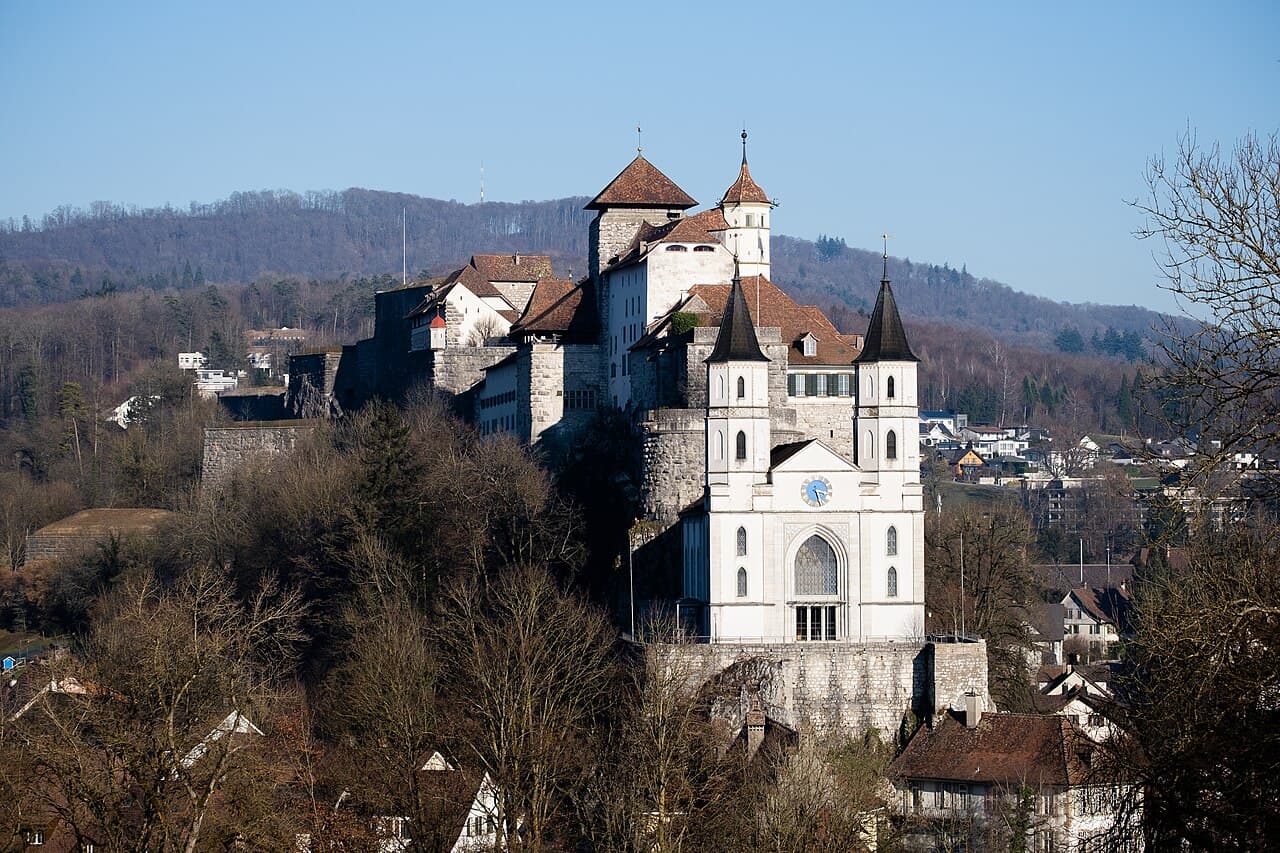
Aarburg Castle stands prominently on a steep, rocky hillside overlooking the town of Aarburg in Switzerland. This historic hill castle was originally constructed in the 12th century and has served multiple roles throughout its long history. Positioned strategically to control a narrow passage along the Aare River, the castle was initially built to oversee and protect an important north-south trade route. Its commanding location and formidable construction reflect its significance as a military stronghold and administrative center during the High Medieval period.
The castle's origins trace back to the early 1100s when it was likely established by the Lords of Büron, although precise documentation is lacking. By the early 13th century, it was under the possession of the Counts of Frohburg, serving as the seat of the Aarburg Vogt, a bailiff responsible for governance, military protection, and justice over the surrounding territory. The Vogtei included the western part of today's District Zofingen but excluded the city itself. Aarburg Castle also hosted the high court, emphasizing its judicial importance in the region.
Medieval origins and early ownership
Throughout the 13th century, Aarburg Castle played a pivotal role in regional administration and defense. In 1299, the Frohburg family sold the castle and its associated Vogtei to the powerful Habsburg dynasty. By around 1330, the castle was inhabited by the von Kriech family, lower nobility serving the Habsburgs, who maintained the castle as a local seat of power. This period was marked by the castle's continued function as a center for governance and military oversight.
Bernese conquest and administration
On 20 April 1415, Aarburg Castle was captured by the town of Bern after a brief siege, marking a significant shift in control. From 1416 onward, the castle became the residence of a Bernese bailiff, who administered the entire Bernese Aargau region from this stronghold. Over time, the bailiwick expanded to include additional territories such as Lenzburg, Schenkenberg, Biberstein, Zofingen, Königsfelden, and Kasteln. The castle thus became a crucial administrative and military hub for Bern's interests in the region.
Architectural evolution and baroque transformation
Under Bernese rule, Aarburg Castle underwent several significant expansions and renovations. The first major rebuilding occurred in 1470 with the reconstruction of the palace (Palas). Further modifications took place in 1534-1535, and most notably between 1621 and 1627, followed by an extensive transformation from 1659 to 1673. These efforts culminated in the creation of a large baroque fortress designed to protect the Protestant cities of Bern and Zurich and to secure the narrowest point of Bernese territory against potential attacks from Catholic neighbors.
Fortifications and military features
The castle's core consists of a 13th-century keep and an adjoining palace, both constructed primarily from limestone. The keep features massive walls between 3 and 3.5 meters thick, with the lowest floor carved directly from the bedrock, demonstrating advanced medieval engineering. In 1557, a distinctive tent-shaped roof was added to the tower, replacing the original upper floor, which had been removed and replaced with a barrel vault topped by battlements.
Access to the fortress is secured by a complex defensive system including a ravelin (a triangular fortification), a vaulted stairway cut into the rock, and three portcullises—heavy iron grates that could be lowered to block entry. Beyond the main gate lies the neck ditch, a courtyard that separates the medieval castle from later fortress additions, enhancing its defensive capabilities.
Interior and auxiliary structures
The palace measures approximately 21 meters long by 9 meters wide, with walls up to two meters thick on the lower floors and thinner walls above. The third floor was converted into a representative hall, featuring two surviving round-arched windows made of tuff stone on the southwest side of the attic. The castle chapel, located north of the neck ditch, retains much of its original Baroque Protestant character, including a pulpit dated 1668 and choir stalls from the same period.
The fortress also includes a deep well shaft more than two meters wide and 45 meters deep, expanding into a cavernous chamber at its base, essential for sustaining the garrison during sieges. The eastern section housed the execution site used for court proceedings and capital punishment under Bernese and later Aargau authority, with the last execution recorded in 1863.
Later history and modern uses
From 1666, Aarburg Castle was continuously garrisoned, with the Governor also serving as military commander. Part of the fortress functioned as a prison, notably holding political prisoners such as Jacques-Barthélemy Micheli du Crest, who was incarcerated there from 1749 to 1766. The castle fell without resistance to the French army on 10 March 1798 during the French invasion of Switzerland.
Following the establishment of the Canton of Aargau in 1804, the castle became state property. Initially, it served as an arsenal and barracks, then as a prison from 1826 until 1864. After a period of neglect and partial abandonment, the cantonal parliament decided in 1891 to repurpose Aarburg Castle as an institution for juvenile offenders, opening in 1893 as Switzerland's first compulsory education institution for young criminals.
Throughout the 20th century, the castle underwent several renovations to accommodate its new role. Between 1946 and 1959, and again from 1982 to 1988, extensive rehabilitation and reconstruction efforts were undertaken. The institution's name evolved from the Education Home in 1972 to the Youth Home in 1989, reflecting a shift towards rehabilitation and education rather than punishment. Today, Aarburg Castle continues to function as a juvenile rehabilitation center, housing young men aged 14 to 22.
Architectural adaptations for modern use
While preserving its historic character, the castle has seen modifications such as the replacement of the southern cell block in 1954-1955 with a building for educational staff, designed to harmonize with the historic structures. The main tower, palace, and barracks have also been adapted internally to meet contemporary institutional needs without compromising the castle's architectural integrity.
Cultural and heritage significance
Aarburg Castle is classified as a Swiss heritage site of national significance, recognized for its exceptional architectural features and historical importance. It stands as a testament to medieval fortification techniques, baroque military architecture, and the evolving role of castles from feudal strongholds to modern institutional facilities.
Visitors to Aarburg can appreciate the castle's imposing presence above the Aare River, its well-preserved defensive structures, and its layered history spanning from the High Medieval period through the Baroque era to contemporary times. The castle's continuous adaptation over centuries highlights the dynamic nature of Swiss cultural heritage and the importance of preserving such monuments for future generations.
Frequently asked questions (FAQ)
- How do I visit Aarburg Castle?
- Aarburg Castle is located on a steep hillside above Aarburg town and can be visited by appointment or during special open days. Visitors should check local schedules as it functions primarily as a youth rehabilitation center.
- What is the historical significance of Aarburg Castle?
- Aarburg Castle has served as a medieval fortress, administrative center, Bernese stronghold, prison, and currently as a juvenile rehabilitation institution, reflecting its evolving role in Swiss history.
- When was Aarburg Castle built?
- The castle was likely constructed in the 12th century, with the earliest records dating back to the early 13th century under the Counts of Frohburg.
- Can I see the baroque architecture at Aarburg Castle?
- Yes, the castle features extensive baroque military architecture from renovations between the 17th century, including fortified walls, bastions, and a chapel with period furnishings.
- Is Aarburg Castle accessible to visitors with mobility challenges?
- Due to its hillside location and historic structure, accessibility is limited. Visitors with mobility challenges should inquire in advance about accommodations.
Photo gallery

Information
Sources & official resources
Verify the information above using these authoritative references.
Loading map...
Visitor reviews
No reviews yet. Been here? Write the first review and help other travelers!
Write the first reviewVisited this castle? Share your experience
Your review helps other travelers and adds first-hand knowledge to our encyclopedia.