
Zamość Fortress
Zamość Fortress (Polish: Twierdza Zamość) is a prominent example of a Renaissance bastioned fortress located in southeastern Poland. Constructed between 1579 and 1618, it was commissioned by Jan Zamoyski, a notable Chancellor and Hetman of the Polish–Lithuanian Commonwealth. The fortress was built simultaneously with the city of Zamość, designed as a fortified urban center blending military functionality with urban planning principles of the Renaissance period.
Historical context and strategic significance
The fortress was conceived during a time when the Polish–Lithuanian Commonwealth faced threats from multiple fronts, including the Ottoman Empire, Cossack uprisings, and Swedish invasions. Its location in southeastern Poland was strategically chosen to protect the Commonwealth's southeastern borders and to serve as a military stronghold controlling key trade and communication routes.
During its active military use, Zamość Fortress became one of the largest and most resilient fortifications in the Commonwealth. Its robust construction allowed it to withstand numerous sieges and attacks by various forces, including the Cossacks during the Khmelnytsky Uprising and the Swedish armies during the Deluge in the mid-17th century.
Architectural design and features
The fortress exemplifies the bastioned fortress style, which was a cutting-edge military architectural design of the Renaissance era. This style features angular bastions projecting outward from the main walls, allowing defenders to cover adjacent walls with overlapping fields of fire. Such design minimized blind spots and improved defensive capabilities against artillery and infantry assaults.
Zamość Fortress was constructed with a complex system of ramparts, moats, and bastions, integrated with the urban layout of the city. The fortress walls were thick and sloped, designed to absorb and deflect cannon fire. The bastions were positioned to cover all approaches, creating a formidable defensive perimeter.
Within the fortress walls, the city of Zamość was planned with a regular grid pattern, reflecting Renaissance urban planning ideals. The integration of military and civilian architecture made Zamość a unique example of a fortified Renaissance city.
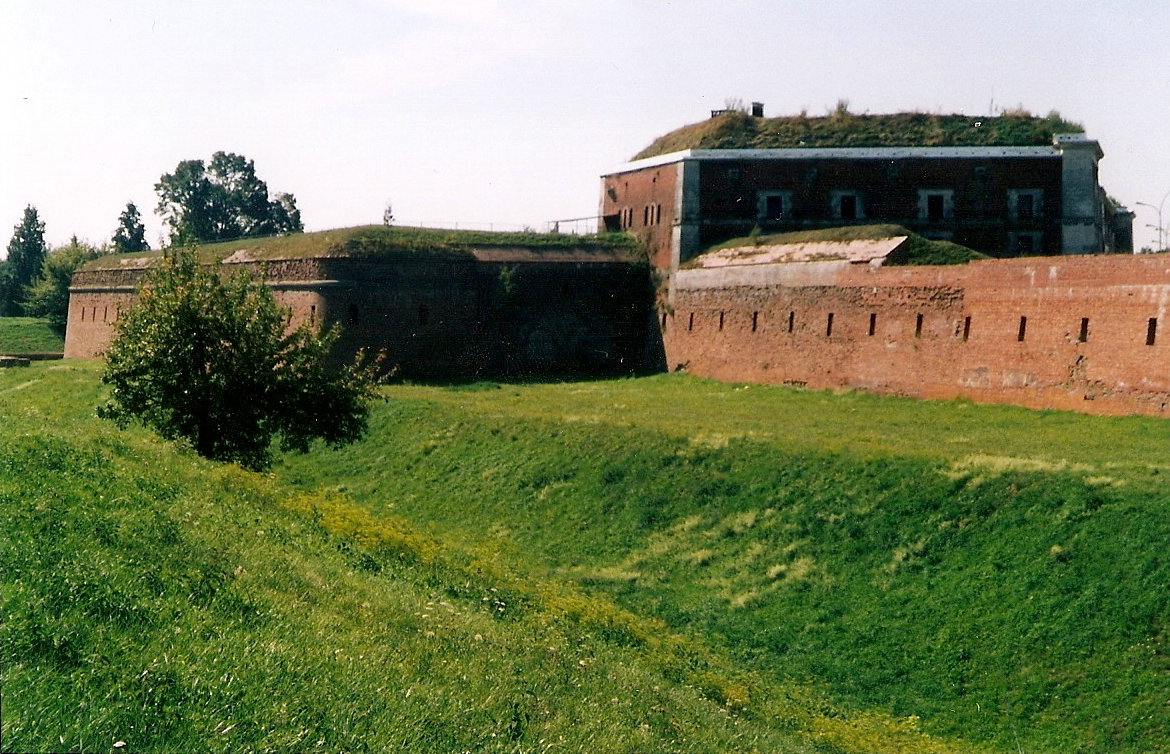
Photo by Gladius87 • CC BY 2.5
Military engagements and sieges
Throughout its history, Zamość Fortress endured six significant sieges, demonstrating its military importance and resilience. The first siege occurred in 1648 during the Khmelnytsky Uprising, when Cossack forces attempted to capture the stronghold but were repelled.
Subsequent sieges included attacks by the Swedish army in 1656 and again in 1703 during the Great Northern War. In 1809, the fortress was besieged and captured by the army of the Duchy of Warsaw from Austrian forces, reflecting the shifting political landscape of the Napoleonic era.
The longest siege took place in 1813, when Polish forces defended the fortress against the Russians for eight months, highlighting its strategic value during the Napoleonic Wars. The final siege occurred during the November Uprising of 1831, when Zamość was the last Polish defensive position to fall to Russian control.
Decline and preservation
By the mid-19th century, advances in military technology and changes in warfare rendered traditional bastioned fortresses like Zamość obsolete. Consequently, the fortress was officially decommissioned and dismantled in 1866. Although much of the fortress was taken down, significant fragments of the walls and bastions remain, preserving the historical and architectural legacy of the site.
Today, Zamość Fortress is recognized as an important cultural and historical monument. Its remains offer valuable insights into Renaissance military architecture and the turbulent history of the Polish–Lithuanian Commonwealth. The fortress, together with the city of Zamość, which retains its original Renaissance urban plan, is a subject of study for historians and architects alike.
Architectural and cultural significance
Zamość Fortress stands as a prime example of the integration of military and urban planning during the Renaissance. Its design reflects the adaptation of Italian fortification principles to the Polish context, showcasing the influence of Renaissance military engineering across Europe.
The fortress's survival through multiple sieges and its role in significant historical conflicts underscore its importance in Polish history. It also represents the ambitions of Jan Zamoyski, who sought to create a stronghold that could serve both defensive and administrative functions.
Preservation efforts focus on maintaining the remaining structures and promoting public awareness of the fortress's heritage. The site attracts visitors interested in military history, Renaissance architecture, and Polish cultural heritage.
Frequently asked questions (FAQ)
- When was Zamość Fortress built and who initiated its construction?
- Zamość Fortress was built between 1579 and 1618, initiated by Chancellor and Hetman Jan Zamoyski to protect the southeastern borders of the Polish–Lithuanian Commonwealth.
- What architectural style characterizes Zamość Fortress?
- The fortress is a classic example of a Renaissance bastioned fortress, featuring angular bastions and thick sloped walls designed to withstand artillery attacks.
- How many sieges did Zamość Fortress endure?
- Zamość Fortress endured six major sieges, including attacks during the Khmelnytsky Uprising, the Swedish Deluge, and the November Uprising.
- Is Zamość Fortress open to visitors?
- Yes, parts of the fortress remain preserved and accessible to visitors, with the site managed by the local municipality.
- Why was Zamość Fortress dismantled?
- The fortress was dismantled in 1866 due to advances in military technology that made traditional bastioned fortresses obsolete.
Photo gallery

Information
Current owner
Municipality
Loading map...
Visitor reviews
No reviews yet. Be the first to share your experience!