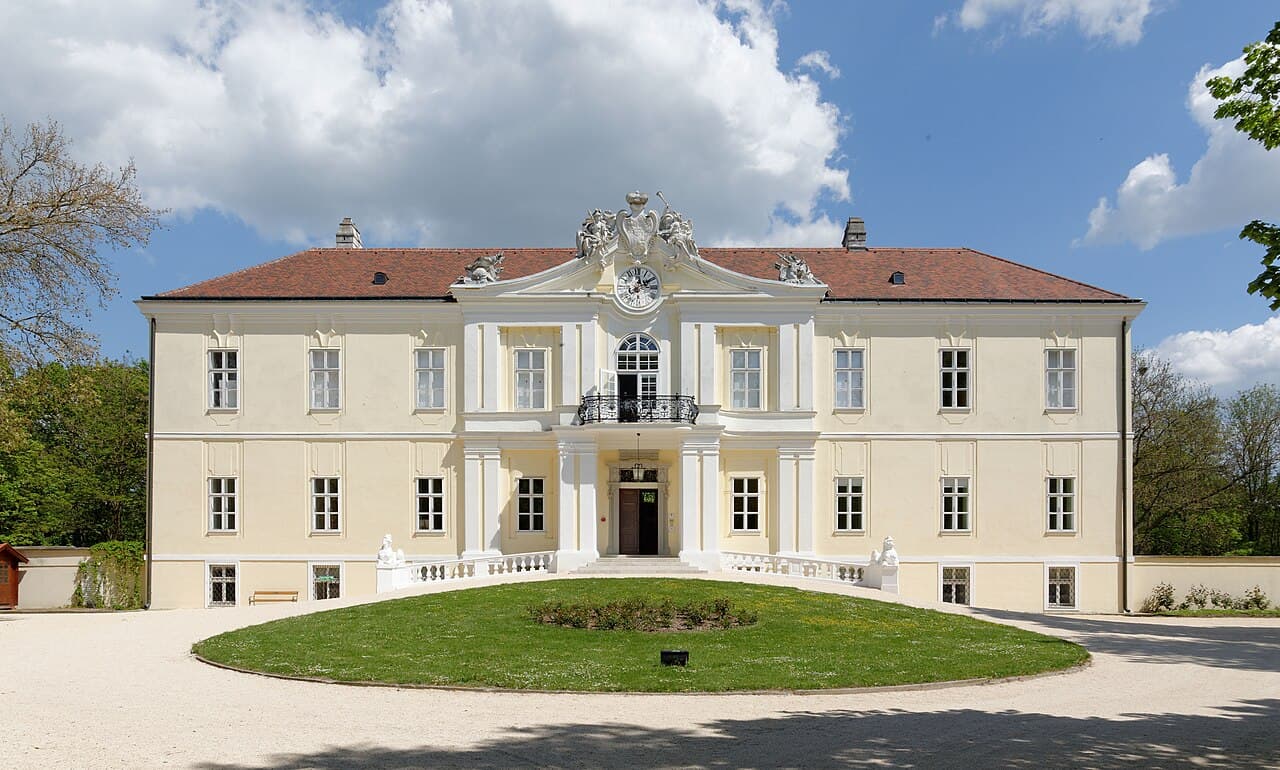
Wilfersdorf Castle — Austria castle

Wilfersdorf Castle

Wilfersdorf Castle in Austria's Weinviertel region
Wilfersdorf, Austria
Renaissance (15th–17th c.)
Well Preserved

Wilfersdorf Castle is a notable Renaissance hill castle situated in the Weinviertel wine district of Austria, specifically in the town of Wilfersdorf within the Mistelbach district. This castle has been a significant seat of the Liechtenstein family since 1436, marking it as one of the enduring family estates in the region. Its long-standing ownership by the Liechtensteins highlights its importance as a cultural and historical landmark in Lower Austria.

Historical significance and lineage

The castle's origins trace back to the 16th century, placing its construction firmly in the Renaissance period. Over the centuries, Wilfersdorf Castle has served primarily as a summer residence and a hunting seat for the reigning princes of the Liechtenstein family. This tradition reflects the castle's role not only as a defensive structure but also as a symbol of aristocratic leisure and estate management.

Its continuous possession by the Liechtensteins since the early 15th century underscores the family's deep-rooted connection to the area and their influence in the region's social and economic development. The castle estate has been central to the family's agricultural activities, especially viticulture, which remains a key aspect of its identity.

Architectural features and style

Wilfersdorf Castle exemplifies Renaissance architectural style, characterized by its harmonious proportions and classical elements that were typical of the period. Although specific architectural details of the castle's layout and fortifications are less documented, its classification as a hill castle indicates its strategic placement on elevated terrain, offering natural defensive advantages and commanding views of the surrounding vineyards and landscape.

The castle complex includes residential buildings, service wings, and cellars, all integrated into the estate's functioning as a princely seat and agricultural center. The architecture reflects a blend of practical estate management needs with the aesthetic aspirations of Renaissance nobility.

Viticulture and cultural role

One of the most distinguished aspects of Wilfersdorf Castle is its princely cellars, renowned for wine production. The estate encompasses approximately 38.5 hectares (95 acres) of vineyards, making it a significant player in the region's wine industry. The vineyards produce a well-known white wine, which contributes to the cultural and economic vitality of the estate.

Today, the castle serves multiple functions beyond its historical residential role. It houses a cultural and exhibition centre, which hosts various events, exhibitions, and cultural activities, thereby maintaining the castle's relevance in contemporary times. Additionally, it accommodates the property management offices for the princely estates in the Weinviertel, ensuring ongoing stewardship of the land and heritage.

Location and surroundings

Wilfersdorf Castle's location in the Weinviertel situates it in one of Austria's prominent wine-producing regions. The castle's elevated position as a hill castle provides panoramic views of the extensive vineyards that characterize the landscape. This setting underscores the castle's dual role as both a defensive structure and a center of agricultural production.

The surrounding town of Wilfersdorf and the wider Mistelbach district offer a rich cultural context, with the castle being a focal point of local heritage. Visitors to the region can explore the castle's historical architecture, enjoy wine tastings, and participate in cultural events hosted within the castle grounds.

Preservation and current status

Wilfersdorf Castle is currently well preserved, maintaining much of its historical integrity and architectural character. The estate's continuous use and management by the Liechtenstein family have contributed to its upkeep and conservation. Modern adaptations for cultural and administrative purposes have been integrated sensitively to preserve the castle's Renaissance charm.

The castle is accessible to visitors interested in its history, architecture, and viticulture. Its role as a cultural venue enhances public engagement while respecting the site's heritage and private ownership.

Frequently asked questions (FAQ)

How do I get to Wilfersdorf Castle?
Wilfersdorf Castle is located in the quaint village of Wilfersdorf, Austria, easily accessible by car and public transport. If you're traveling by train, the nearest station is in the town of Laa an der Thaya, from where you can take a taxi or local bus to reach the castle.
What is the historical significance of Wilfersdorf Castle?
Wilfersdorf Castle has a rich history dating back to the 13th century, serving as a noble residence and a strategic fortification. The castle has witnessed various historical events and has been owned by several prominent families, making it an important landmark in Austrian heritage.
When was Wilfersdorf Castle built?
The construction of Wilfersdorf Castle began in the early 13th century, with significant expansions and renovations occurring over the centuries. Its architectural evolution reflects the changing styles and needs of its inhabitants throughout history.
Can I visit Wilfersdorf Castle?
Yes, visitors are welcome to explore Wilfersdorf Castle, which offers guided tours that delve into its intriguing history and architecture. Be sure to check the official website for any special events or exhibitions that may be taking place during your visit.
Why is Wilfersdorf Castle an important architectural site?
Wilfersdorf Castle showcases a blend of architectural styles, including medieval and Renaissance elements, reflecting the evolution of design over centuries. Its well-preserved structures and surrounding landscape provide a glimpse into the past and are a treat for history and architecture enthusiasts.
Is it possible to host events at Wilfersdorf Castle?
Yes, Wilfersdorf Castle offers facilities for various events, including weddings, corporate meetings, and private gatherings. The picturesque setting and historical ambiance make it a unique venue, and interested parties should contact the castle management for more information on availability and services.
What are the opening hours for Wilfersdorf Castle?
Wilfersdorf Castle typically opens to visitors from April to October, with specific hours varying by season. It is advisable to check the castle's official website for the most current opening hours and any seasonal closures.
What are the ticket prices for visiting Wilfersdorf Castle?
Ticket prices for Wilfersdorf Castle are generally affordable, with discounts available for children, students, and seniors. For the most accurate pricing information, it is best to visit the official website or contact the castle directly before your visit.
When is the best time to visit Wilfersdorf Castle?
The best time to visit Wilfersdorf Castle is during the spring and early autumn months when the weather is pleasant and the surrounding gardens are in full bloom. Additionally, during these times, you can enjoy various events and activities organized by the castle.
What nearby attractions should I visit while at Wilfersdorf Castle?
While visiting Wilfersdorf Castle, consider exploring the charming village of Wilfersdorf and the nearby towns of Laa an der Thaya and Mistelbach. These areas offer beautiful landscapes, local shops, and cultural sites that complement your castle experience.

Photo gallery

Wilfersdorf Castle
Click to view

Photo by Robert Heilinger•CC BY-SA 3.0

1 photo • Click any image to view in full screen

Information

Hill Castle

Current owner

Liechtenstein family

Loading map...

Visitor reviews

No reviews yet. Been here? Write the first review and help other travelers!

Write the first review

Visited this castle? Share your experience

Your review helps other travelers and adds first-hand knowledge to our encyclopedia.

Write a review

(5/5)

0/2000 characters

Your review will be visible after admin approval

Nearby castles

15.1 km

Hanslburg Castle

Some 150 meters north of the L3082 road between Loosdorf and Frättingsdorf, Austria

Hanslburg Castle, located some 150 meters north of the L3082 road between Loosdorf and Frättingsdorf in Lower Austria, is a unique example of a romantic folly constructed in the early 19th century. Despite its appearance as a traditional medieval fortress, Hanslburg is not a genuine castle but rather an ornamental ruin built in 1800 to evoke the charm and mystery of the past. The site of Hanslburg Castle holds a deeper historical significance, as it stands on the remains of an older motte-and-bailey castle. This earlier fortification was characterized by three concentric earthen walls, remnants of which still survive today. This original castle is believed to have been a predecessor to the nearby Loosdorf Castle, linking Hanslburg to the region's medieval defensive network. The origins of Hanslburg Castle as a romantic folly The current structure was commissioned by Johann I Joseph, Prince of Liechtenstein, a notable figure of the time, who sought to create a picturesque setting for leisure rather than defense. The folly was intended as a hunting and picnic pavilion, blending natural beauty with architectural fantasy. Upon completion, the castle was gifted to the prince's wife and named Hanslburg on Saint John's Eve, a name that reflects the romantic and personal nature of the project rather than any historical lineage. Architectural features and design elements Hanslburg Castle's design mimics the appearance of a medieval ruin, featuring elements such as battlemented walls and towers that create the illusion of a fortress in decay. However, these features were deliberately constructed to enhance the aesthetic rather than serve any military function. The castle's earthen walls and stonework are arranged to evoke a sense of antiquity and romantic nostalgia, typical of the early 19th-century Romantic movement in architecture and landscape design. The folly’s location amidst wooded terrain adds to its picturesque quality, making it a favored spot for visitors seeking a tranquil retreat and a glimpse into the era's fascination with medievalism and nature. Historical context and cultural significance Hanslburg Castle reflects the Romantic era's interest in medieval history and the sublime, where ruins were celebrated as symbols of the passage of time and the beauty of decay. Unlike true castles built for defense or residence, Hanslburg was conceived as a decorative element within the landscape, embodying the ideals of romanticism and aristocratic leisure. Its construction during the Modern period (circa 1800) places it in a broader European trend of creating artificial ruins and follies, which were popular among the nobility for enhancing their estates and gardens. Current condition and visitor experience Today, Hanslburg Castle remains a romantic ruin freely accessible to the public. Visitors can reach it via a short walk along a footpath through the surrounding woods, making it an appealing destination for hikers and history enthusiasts alike. Despite its artificial origins, the site offers an authentic atmosphere of medieval charm and natural beauty. While the castle no longer serves any defensive or residential purpose, its preservation as a folly allows visitors to appreciate the historical layering of the site—from its medieval roots to its 19th-century reinvention.

Modern (19th–20th c.)
Details
15.3 km

Hagenberg Castle

Fallbach, Austria

Hagenberg Castle, located in Fallbach, Austria, is a notable example of architectural evolution from the high medieval period through the Renaissance and Baroque eras. Originally referenced in 1264 as castrum Hackenberg, the castle's earliest mention highlights its role as a site for document sealing, indicating its administrative importance in the 13th century. The castle's medieval foundations underpin the structure that would later be transformed significantly over the centuries. Historical ownership and transformations The castle changed hands several times, reflecting the shifting political and social landscape of the region. After the extinction of the original Hackenberger family line, ownership passed to Alber Stuchs von Trautmannsdorf in 1382. The most substantial early transformation occurred under Christoph Kuenritz, who purchased the castle in 1543 and converted it into a Renaissance residence. This period introduced the castle's characteristic geometric proportions and layout, marking a departure from purely defensive medieval architecture toward a more refined, residential style. During the Thirty Years' War in 1620, Hagenberg Castle was plundered, leaving it in a state of devastation. It remained so until Sigmund Friedrich von Sinzendorf acquired the property in 1650. His nephew, Theodor Reichsgraf von Sinzendorf, spearheaded a comprehensive remodeling between 1677 and 1679, transforming the castle into a Baroque palace. This renovation introduced cosmological mysticism into the design, evident in the precise alignment of the four wings with the cardinal directions, enclosing a rectangular courtyard. The Baroque period also brought rich decorative elements, including colorful ceiling frescoes and elaborate stucco work, particularly preserved in the southern wings. Following the death of Prosper von Sinzendorf in 1822, the castle passed to the Reuß-Köstritz princes. Unfortunately, under their stewardship, the castle gradually fell into disrepair. After World War II, in 1945, the castle came under Soviet administration as German property but was returned to the Reuß family in 1955. From 1959 onwards, the castle became a hub for artists, notably members of the Vienna Group such as Friedensreich Hundertwasser. Later owners included Captain Josef Steiger in 1974 and Horst Wächter, Hundertwasser's former assistant, in 1986. The Osmann family took over in 2020, with Wächter continuing historical research on the site. Architectural features and layout The castle's four-story structure exemplifies Renaissance geometry and proportions while retaining its medieval foundations. The four wings of the castle are oriented precisely to the cardinal directions, forming a rectangular courtyard at the center. This courtyard contains an octagonal fountain and leads to a remarkable sala terrena, a three-bay shell grotto richly decorated with statues, frescoes, shells, and stucco. This space extends into the garden, creating a seamless transition between the interior and exterior. Access to the castle is through a short alley on the northeast side, crossing a stone bridge that leads into a frescoed entrance hall. The southern wings are notable for their preservation of colorful ceiling frescoes and stucco decorations, which reflect the Baroque renovation's artistic ambitions. Historically, the castle was surrounded by a moat, with the original access extending over it to a landscaped area featuring a Baroque-era artificial lake. This integration of water features and garden design is typical of Baroque palatial architecture, emphasizing harmony between built and natural environments. Cultural significance and current use Today, Hagenberg Castle serves as a cultural venue under the stewardship of the Initiative Hagenberg association. It hosts various cultural events, fostering a connection between the castle's rich history and contemporary artistic expression. The castle's layered architectural history, from its medieval origins through Renaissance and Baroque transformations, offers visitors a tangible experience of Austria's architectural and cultural heritage. The castle's association with prominent historical figures and artists, including the Vienna Group and Friedensreich Hundertwasser, adds to its cultural cachet. This blending of historical architecture with modern artistic influence makes Hagenberg Castle a unique site for both historical study and cultural engagement.

High Medieval (11th–13th c.)
Details
15.3 km

Staatz Castle

Staatz, Austria

Staatz Castle, also known as Burgruine Staatz, is a striking medieval hill fortress located in the village of Staatz within the province of Lower Austria. Perched atop a prominent limestone cliff called Staatzer Klippe, the castle commands expansive views over the surrounding countryside, a strategic advantage that shaped its historical significance. The castle's origins date back to at least the early 12th century, with the first known noble associated with the site mentioned in 1072 and further records by 1130 indicating the presence of the Reginger family, ministeriales serving the Babenberg Dukes of Austria. Early history and strategic importance The castle's location on a steep limestone outcrop rising approximately 100 meters above the surrounding lowlands made it a formidable defensive position. It was likely constructed before 1130, serving as a stronghold for local nobility who were vassals of the Babenberg dynasty. The Lords of Staatz, first documented in the early 12th century, were prominent feudal lords until their line probably died out in the first half of the 13th century. Staatz Castle played a pivotal role in regional conflicts, notably in 1246 when a battle took place on the plains below between Frederick II, Duke of Austria, and Ulrich III, Duke of Carinthia. Following his defeat, Ulrich was imprisoned within the castle, highlighting its function as a military stronghold and prison. The castle also suffered partial destruction in 1260 during an attack by the counts of Hardegg, reflecting the turbulent political rivalries of the period. Ownership changes and architectural development In the latter half of the 13th century, the castle was granted as a fief by Ottokar II of Bohemia to Otto von Maissau. Under the Maissau family, Staatz Castle and the adjacent settlement flourished, with contemporary documents recognizing the surrounding community as a town. The castle's heyday occurred during this period, marked by architectural enhancements and increased regional importance. However, the Maissau family's fortunes changed in the early 15th century. After an unsuccessful rebellion against Albert II of Germany in 1430, they were dispossessed of the castle. It was then pledged to Niklas Truchseß von Drasenhofen in 1431. The castle endured a siege by Hussite forces in 1439, which was unsuccessful, demonstrating its resilience and defensive capabilities. Later, the castle came under the ownership of the Barons of Roggendorf in the first half of the 16th century. In 1551, Ferdinand I, Holy Roman Emperor, granted the castle to the Barons of Breuner, who undertook significant enlargements and renovations, adapting the fortress to the evolving needs of the era. Siege and decline during the thirty years' war Despite its reputation for impregnability, Staatz Castle was captured in April 1645 during the Thirty Years' War by Swedish troops led by General Lennart Torstensson. The siege, directed by Colonel Jordan, involved heavy artillery bombardment that inflicted severe damage on the castle's stone structures. The bombardment caused a fire that further devastated the fortress. Following its capture, the Swedes occupied the castle for about a year, during which they deliberately demolished significant portions of the structure to prevent its future military use. After their departure, the castle was left in ruins and was subsequently abandoned. Over time, the medieval fortress served as a convenient quarry for local building materials. In response to the castle's destruction, a new residential manor was constructed at the base of the hill, marking a shift from fortified medieval architecture to more comfortable post-medieval estate living. Unfortunately, this manor house was destroyed by fire in 1945 and later demolished, leaving only a few ancillary buildings from the estate. Architectural features and surviving remains The ruins of Staatz Castle still retain several notable architectural elements that reflect its medieval origins and turbulent history. Among these are the original first gate, which provided access to the fortified complex, and parts of the palas, or main residential building. The palas includes remnants of a Romanesque coupled window, characterized by two adjacent openings separated by a slender column, a distinctive feature of medieval architecture. At the summit of the limestone cliff stands the bergfried, a tall defensive tower that served as a lookout and last refuge during sieges. The stone blocks of the bergfried bear visible damage from artillery fire, including marks left by the 1645 Swedish siege. These scars offer a tangible connection to the castle's dramatic military history. Below the castle ruins lies a natural rock amphitheater carved into the limestone, which has been adapted for cultural uses such as summer musical performances. The broader estate includes surviving structures from the post-medieval period, such as a granary now converted into a music hall, a rock cellar hewn into the cliff, and two residential buildings. These elements illustrate the site's evolution from a medieval fortress to a noble estate. Cultural significance and visitor experience Today, Staatz Castle is freely accessible to the public, offering visitors a glimpse into Austria's medieval past through its well-preserved ruins and dramatic setting. The castle's location on a hilltop provides spectacular panoramic views of the surrounding landscape, making it a popular destination for history enthusiasts, hikers, and cultural tourists. The site also serves as a venue for cultural events, leveraging its unique rock amphitheater and historic atmosphere. Its combination of natural beauty, architectural heritage, and layered history makes Staatz Castle a significant landmark within Lower Austria's rich tapestry of medieval castles. Visitors can explore the castle ruins, including the bergfried and palas remains, and enjoy the scenic vistas. The castle's history of sieges, noble ownership, and architectural evolution offers a compelling narrative that enriches the visitor experience.

High Medieval (11th–13th c.)
Details

