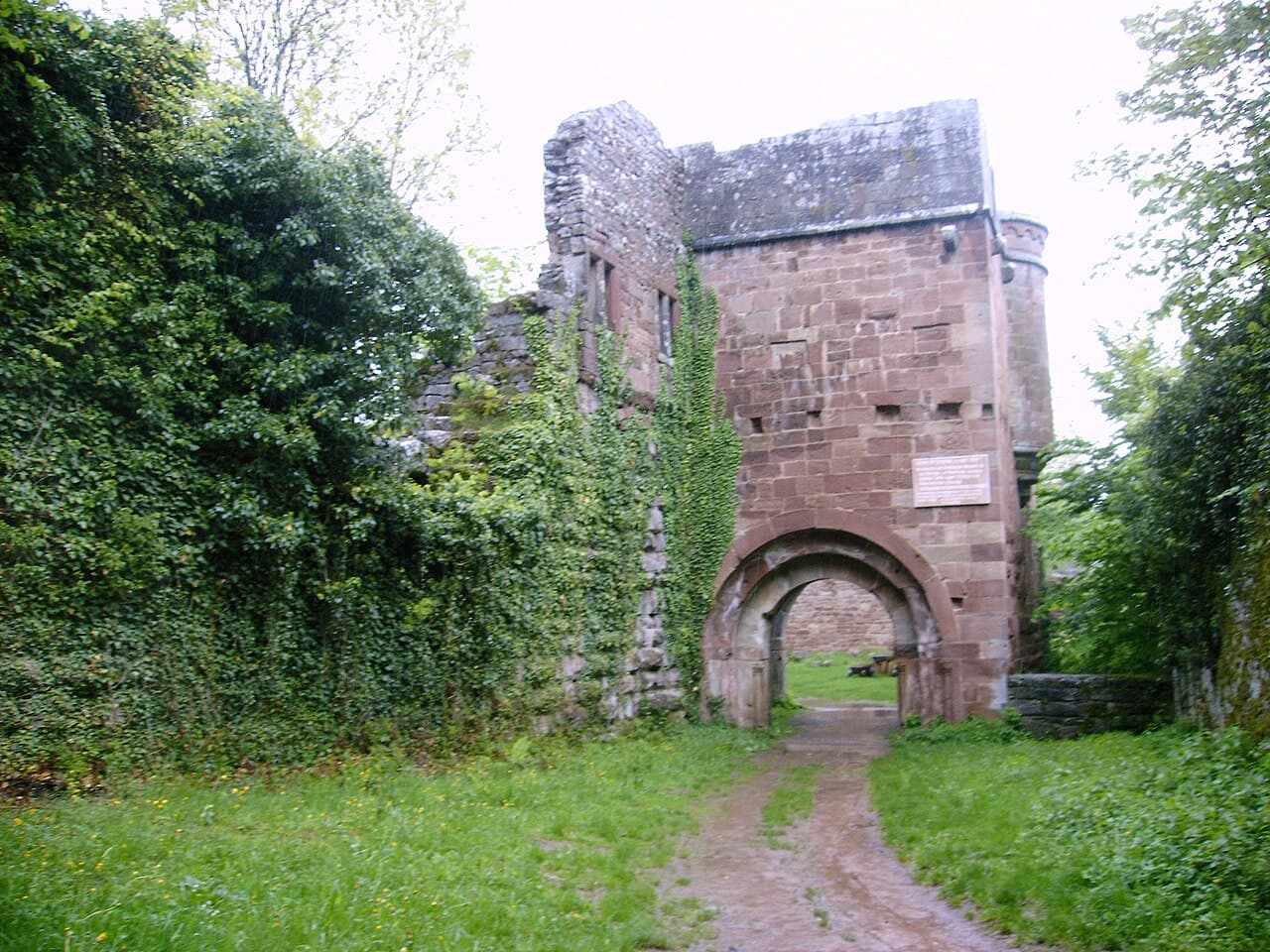
Wildenberg Castle
The ruins of Wildenberg Castle stand prominently on the Schlossberg hill spur near Kirchzell, Germany. This high medieval hill castle was constructed between 1180 and 1200 by the lords of Dürn, who were notable vassals of the Hohenstaufen emperors and served as Schutzvögte (protectors) of Amorbach Abbey. The castle's strategic position on a northeast-projecting spur provided natural defense and commanding views of the surrounding landscape, typical of medieval fortifications designed for both residence and military control.
While some historical sources suggest the gate tower was added around 1216 by Conrad I of Dürn, this likely represents a significant expansion rather than initial construction. The castle's core structures, including the roughly rectangular inner ward measuring approximately 80 meters in length, largely date from the original Hohenstaufen period and have remained remarkably intact despite centuries of ruin.
Historical significance and ownership
The lords of Dürn were influential members of the imperial retinue, and their association with Amorbach Abbey underscores the castle's role as a regional power center. Financial difficulties in the late 13th century forced the family to sell parts of the castle to the Archbishopric of Mainz in 1271 and 1272. By 1292, the entire Barony of Walldürn, including Wildenberg, came under Mainz's control.
The castle was administered by various officials appointed by Mainz, including vogts and burgraves, with notable figures such as Conrad Rüdt of Collenberg serving in the early 14th century. In 1337, Archbishop Henry temporarily transferred the castle to the cathedral canons, reflecting ecclesiastical politics of the period. Later, the castle was enfeoffed to local nobles like Eberhard of Rosenberg and subsequently redeemed by Conrad Rüdt, who expanded his influence by acquiring offices in Walldürn and Buchen.
The castle sustained damage during a significant earthquake in 1356, centered near Basel. Despite this, it remained an important administrative seat for Mainz into the 16th century.
Architectural features and expansions
Wildenberg Castle exemplifies Hohenstaufen military architecture with its diagonally oriented bergfried positioned on the uphill side, designed for observation and defense. The gate tower on the southern side features a distinctive stepped portal, above which sits a castle chapel with an apsidal bay window, integrating religious functions within the fortification.
The palas, or main residential hall, faces downhill and is notable for its large window arcades on the upper floor. These arches bear artistic similarities to those of the imperial palace at Gelnhausen and the Château de Guirbaden in Alsace, highlighting the castle's architectural significance. The palas also contains large fireplaces, which some scholars associate with descriptions of the Grail castle in Wolfram von Eschenbach's medieval epic Parzival, thought to have been composed at Wildenberg around 1205.
Between 1400 and 1511, the castle underwent late medieval expansions, including the construction of a western tower and a barrier wall dividing the courtyard. The castle chapel was also renovated during this period, reflecting ongoing investment in both defensive and residential functions.
Mason's marks and craftsmanship
The castle walls exhibit a rich collection of at least 50 distinct mason's marks, symbols left by stonemasons who worked on the construction. These marks are found at other regional sites such as Stolzeneck Castle on the Neckar River and the palace at Gelnhausen, indicating a network of skilled craftsmen operating across the Rhine-Main-Neckar region.
The felsenburg rock castle
Just above Wildenberg lies the Felsenburg or "Rock Castle," a cave hewn from natural rock with a rectangular stone entrance portal. The interior floor was leveled with stone slabs to create a platform. While its exact function remains unproven, it is hypothesized to have served as an outer ward protecting the ridge approach to the main castle.
Destruction and later history
Wildenberg's active role ended during the German Peasants' War when peasants led by the knight Götz von Berlichingen attacked and razed the castle on 4 May 1525. The castle was never rebuilt and fell into ruin.
In the 19th century, parts of the ruins were repurposed to create artificial ruins in Eulbach Park. The castle's ownership changed hands due to secularization and territorial shifts: seized briefly by the Principality of Leiningen in 1803, mediatised by the Grand Duchy of Baden in 1806, then incorporated into the Grand Duchy of Hesse-Darmstadt by 1810, and finally transferred to the Kingdom of Bavaria in 1816.
Today, Wildenberg Castle is a popular destination for hikers and history enthusiasts. Occasional cultural events are held among the ruins, which remain a testament to Hohenstaufen architecture and medieval noble life in southern Germany.
Preservation and significance
Despite its ruinous state, Wildenberg Castle is regarded as one of the best-preserved Hohenstaufen castles in southern Germany. The survival of its original layout, including the inner ward, bergfried, gate tower, chapel, and palas, provides valuable insights into medieval castle architecture and the lifestyle of the regional nobility.
The castle's integration of defensive, residential, and religious structures exemplifies the multifunctional nature of medieval fortifications. Its rich assemblage of mason's marks further highlights the craftsmanship and regional connections among builders of the period.
Wildenberg's literary association with Wolfram von Eschenbach's Parzival adds cultural depth to its historical significance, linking the site to one of the most important works of medieval German literature.
Visitors to the site can explore the atmospheric ruins, including the bergfried and chapel, while enjoying panoramic views from the Schlossberg hill. The nearby Felsenburg rock castle adds an intriguing element to the castle complex, inviting further exploration of the medieval landscape.
Frequently asked questions (FAQ)
- How do I get to Wildenberg Castle?
- Wildenberg Castle is located near Kirchzell in Germany. It is accessible by hiking trails from nearby towns such as Amorbach, making it a popular destination for outdoor enthusiasts.
- What is the historical significance of Wildenberg Castle?
- Wildenberg Castle was built in the late 12th century by the lords of Dürn and served as a regional administrative center under the Archbishopric of Mainz. It is also linked to the medieval epic Parzival by Wolfram von Eschenbach.
- Can I visit the interior of Wildenberg Castle?
- As a ruin, Wildenberg Castle's interior is accessible to visitors, but there are no modern facilities. Visitors should be prepared for uneven terrain and wear appropriate footwear.
- When was Wildenberg Castle destroyed?
- The castle was destroyed during the German Peasants' War on 4 May 1525 by peasants led by knight Götz von Berlichingen and has remained a ruin since.
- Are there any special events held at Wildenberg Castle?
- Occasionally, cultural events and historical reenactments are held at the castle ruins, offering visitors a chance to experience medieval history in an atmospheric setting.
Photo gallery

Information
Loading map...
Visitor reviews
No reviews yet. Been here? Write the first review and help other travelers!
Write the first reviewVisited this castle? Share your experience
Your review helps other travelers and adds first-hand knowledge to our encyclopedia.



