
Wąbrzeźno
Wąbrzeźno Castle stands as a significant example of a high medieval hill castle in northern Poland, with origins dating back to the mid-13th century. Located on a strategically formed peninsula between Lake Zamkowe and Lake Frydek, the site initially hosted a defensive stronghold in the early medieval period. This early fortification, comprising a fortified settlement with an adjacent suburb, was later seized by the Teutonic Knights, who utilized it as a military outpost before transferring ownership to the Chełmno bishops in 1246. The castle's rich history intertwines with the regional conflicts and shifting political control of the area, reflecting the turbulent medieval landscape of Prussia and Poland.
Early defensive site and teutonic origins
Before the construction of the stone castle, the location functioned as a fortified settlement, or gród, protected naturally by the surrounding lakes. This early medieval stronghold was an important defensive position in the region. After the Teutonic Order's arrival, they established a guard post here, capitalizing on the site's strategic advantages. The transfer of the land to the Chełmno bishops in 1246 marked a pivotal moment, as the bishops soon planned to develop a more permanent and formidable stone fortress.
Construction of the stone castle under bishop herman von prizna
In 1303, Bishop Herman von Prizna initiated the construction of a brick castle on the artificially elevated tip of the peninsula on Lake Zamkowe. The building phase extended until 1321, resulting in a complex defensive ensemble comprising the main castle and an outer bailey. The castle itself was designed on a square plan approximately 60 meters per side. It featured two-storey residential wings enclosing the inner courtyard on three sides, with the eastern side closed off by a defensive wall. A prominent feature was the octagonal tower projecting from the eastern wall, positioned to defend the adjacent gate.
The southern wing was the most architecturally significant, housing the refectory and a chapel. Surrounding the courtyard were arcaded galleries or cloisters; those along the southern wing were built of brick, while the others were wooden. This mixture of materials reflected both defensive and residential functions within the castle.
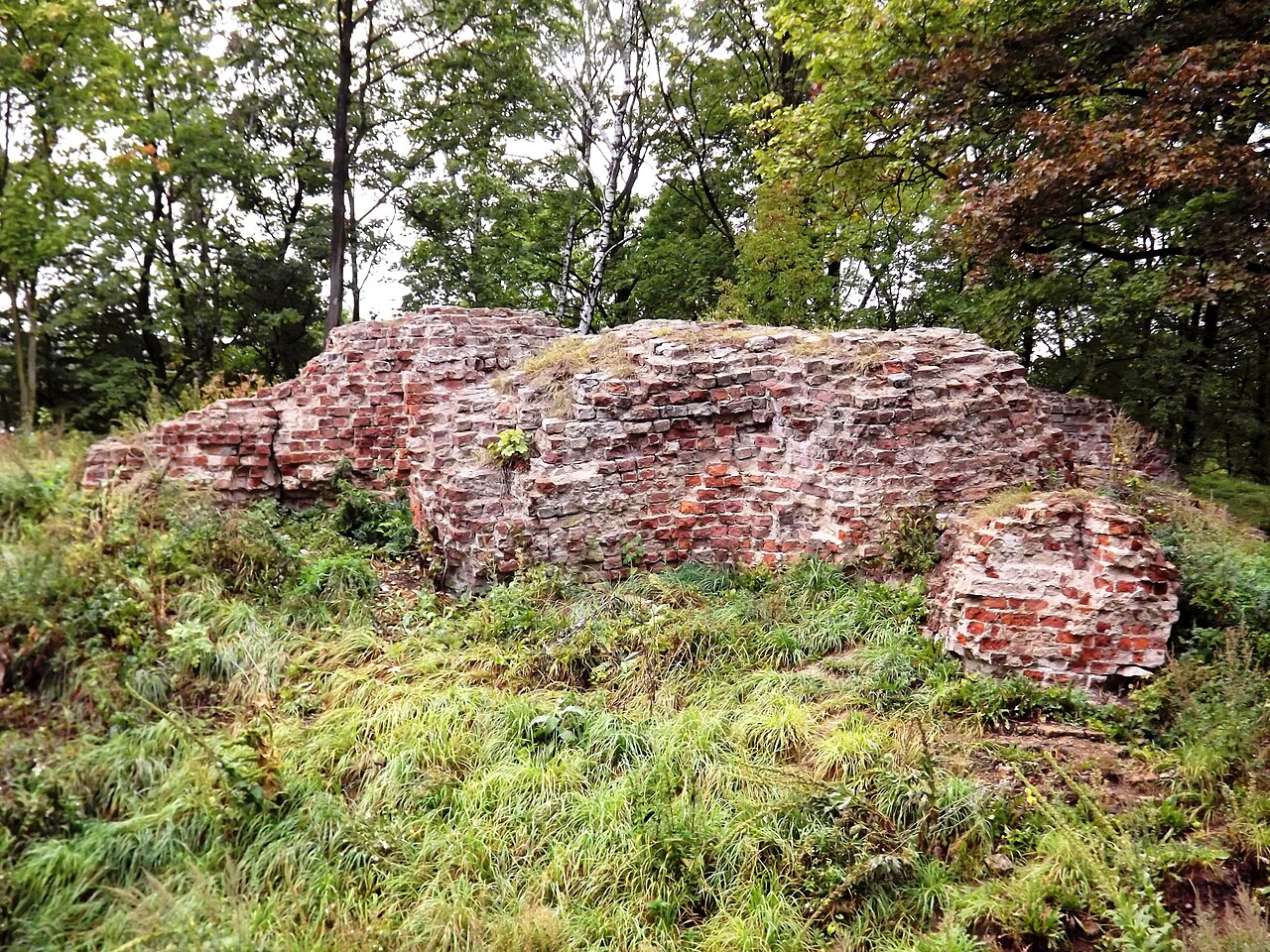
Photo by Loker71 • CC BY-SA 3.0 pl
Defensive features and outer bailey fortifications
Access to the castle was controlled by a drawbridge spanning a broad dry moat, which separated the main castle from the outer bailey. The outer bailey was trapezoidal in shape and enclosed by its own defensive wall reinforced with bastions. Entrance to the bailey also featured a drawbridge over a moat, guarded by a gate complex and two square corner towers. This layered defense system underscored the castle's role as a fortified episcopal residence and military stronghold.
Historical conflicts and damage
Throughout its history, Wąbrzeźno Castle witnessed several military engagements. In 1454, during the Thirteen Years' War, Polish forces captured the castle. A decade later, it was seized by Bernard Szumborski, commanding mercenary troops for the Teutonic Knights. The castle suffered significant damage when the bishop's residence was burned. Following the Second Peace of Toruń in 1466, the region, including Wąbrzeźno, became part of Poland, but the castle remained under the bishops' control. They undertook repairs and reconstruction, completing restoration efforts by around 1499.
Further modifications occurred between 1611 and 1613 under Bishop Maciej Konopacki, who remodeled the castle in the Gothic style. However, the castle sustained damage again during the Polish-Swedish wars. It was notably damaged in 1626 during the first conflict and then severely damaged and burned during the later Swedish invasion known as the Deluge. The defenders' refusal to surrender led to a prolonged artillery bombardment, resulting in the castle's destruction and abandonment.
Decline and modern legacy
In 1792, Prussian King Frederick II ordered the castle's complete demolition. The bricks were repurposed for local agricultural buildings, accelerating the site's decay. By the late 19th century, the castle was reduced to ruins, with the area known only as "Góra Zamkowa" (Castle Hill). In 1920, the Polish authorities purchased the site intending to create a public park. Today, the location serves as a popular urban park, where visitors can explore the ruins of the octagonal tower, remnants of the defensive walls, and clearly visible outlines of the moats.
Architectural significance and heritage value
Wąbrzeźno Castle is a valuable example of a medieval episcopal fortress that combines residential and military architecture. Its brick construction on a raised peninsula demonstrates strategic use of natural geography for defense. The castle's layout, with its square plan, residential wings, and distinctive octagonal tower, reflects typical Gothic castle architecture of the region. Despite its ruined state, the site offers important insights into the medieval history of the Chełmno Land and the interplay between the Teutonic Order and Polish authorities.
Visitor experience today
Visitors to the site can enjoy a walk through the castle park and observe the surviving architectural fragments. The visible ruins include the base of the octagonal tower, sections of the defensive walls, and the outlines of the moat system. Informational plaques provide historical context, making it an educational destination for those interested in medieval fortifications and Polish history.
Preservation challenges
The castle remains in a ruined condition, with ongoing challenges related to conservation and protection of the remaining structures. Efforts focus on stabilizing the ruins and maintaining the site as a cultural heritage landmark accessible to the public.
Frequently asked questions (FAQ)
- How do I get to Wąbrzeźno Castle?
- Wąbrzeźno Castle is located in the town of Wąbrzeźno in the Kuyavian-Pomeranian Voivodeship of Poland. It is accessible by local roads and is within walking distance from the town center.
- What is the historical significance of Wąbrzeźno Castle?
- Wąbrzeźno Castle was a medieval episcopal fortress built in the early 14th century. It played a key role in regional conflicts between the Teutonic Order and Poland, serving as a bishop's residence and military stronghold.
- Can I visit the ruins of Wąbrzeźno Castle?
- Yes, the castle ruins are open to the public as part of a city park. Visitors can explore the remains of the octagonal tower, defensive walls, and moat outlines.
- When was Wąbrzeźno Castle built?
- The stone castle construction began in 1303 under Bishop Herman von Prizna and was completed around 1321, replacing an earlier fortified settlement.
- Why is the octagonal tower important?
- The octagonal tower was a key defensive feature guarding the eastern gate of the castle. Its unique shape and strategic position highlight medieval military architecture.
- Is Wąbrzeźno Castle wheelchair accessible?
- As the site consists mainly of ruins in a park setting, accessibility may be limited. Visitors with mobility concerns should inquire locally about access options.
Photo gallery

Information
Current owner
Municipality
Loading map...
Visitor reviews
No reviews yet. Be the first to share your experience!