
Valère Castle
Valère Castle is a remarkable historic site perched atop a steep, rocky hill overlooking the old town of Sion, Switzerland. This hill castle is renowned for its unique combination of religious, military, and cultural significance, anchored by a well-preserved Romanesque basilica that dates back to the 11th and 12th centuries. The castle's hill has been a focal point of human activity since prehistoric times, with archaeological finds revealing Neolithic artifacts such as pottery shards and bracelet fragments dating to around 5000 BCE. Although the site likely served strategic or religious purposes during the Roman era, no surviving architectural remains from that period have been confirmed.
Early history and construction
The first documented mention of a Christian church at Valère dates to the year 1049. Construction of the stone basilica began between approximately 1100 and 1130, reflecting the Romanesque architectural style prevalent in medieval Europe. The basilica was built with a three-nave layout and later evolved into a cruciform plan during the 12th and 13th centuries. This development included the addition of defensive features such as fortified walls topped with battlements, underscoring the site's dual function as both a religious sanctuary and a fortified refuge.
Religious and political significance
Valère Castle served as the home of the cathedral chapter of Sion, a powerful ecclesiastical institution that wielded both spiritual and temporal authority. From the late 10th century onward, the Prince-Bishops of Sion governed the region from this site, making it a center of regional governance and religious influence. The castle's fortified church symbolized this blend of sacred and secular power, standing as a bastion of the Prince-Bishops' dominion.
Architectural features and artistic treasures
The castle's centerpiece is the three-nave Romanesque basilica with a cruciform ground plan inspired by the design of Lausanne Cathedral. The basilica includes a prominent northern tower rising above the adjacent north chapel, with polygonal window vaults adorning the semicircular apse at the eastern end. The fortified stone walls surrounding the church, complete with battlements, give it the appearance of a fortress designed for defense against potential attacks.
Interior decorations and sculptures
Inside the basilica, visitors can admire a Gothic marble statue of the Madonna and Child placed above the main altar, dating from the 15th century. The choir walls are richly decorated with vibrant murals depicting apostles, prophets, and saints associated with local religious traditions. These artworks, created around 1435, contribute to the basilica's spiritual ambiance and highlight the artistic heritage of the region.
The historic pipe organ
One of Valère's most extraordinary features is its pipe organ, constructed between 1430 and 1435. It is among the oldest playable organs in the world and is located on the west wall of the basilica. The organ has a keyboard spanning four octaves with 45 keys, a one-octave pedalboard, and eight stops controlling different sound registers. Architecturally, the pipes are arranged to resemble a church façade with two towers and a triangular roof. Some of the original wooden pipes from the 14th century survive, and the organ underwent expansions in 1687 and restorations in the 20th century, including significant work in 1954 and 2004. Its tuning is approximately 450 Hz, slightly higher than modern pitch standards, which makes it unique but less compatible with contemporary instruments.
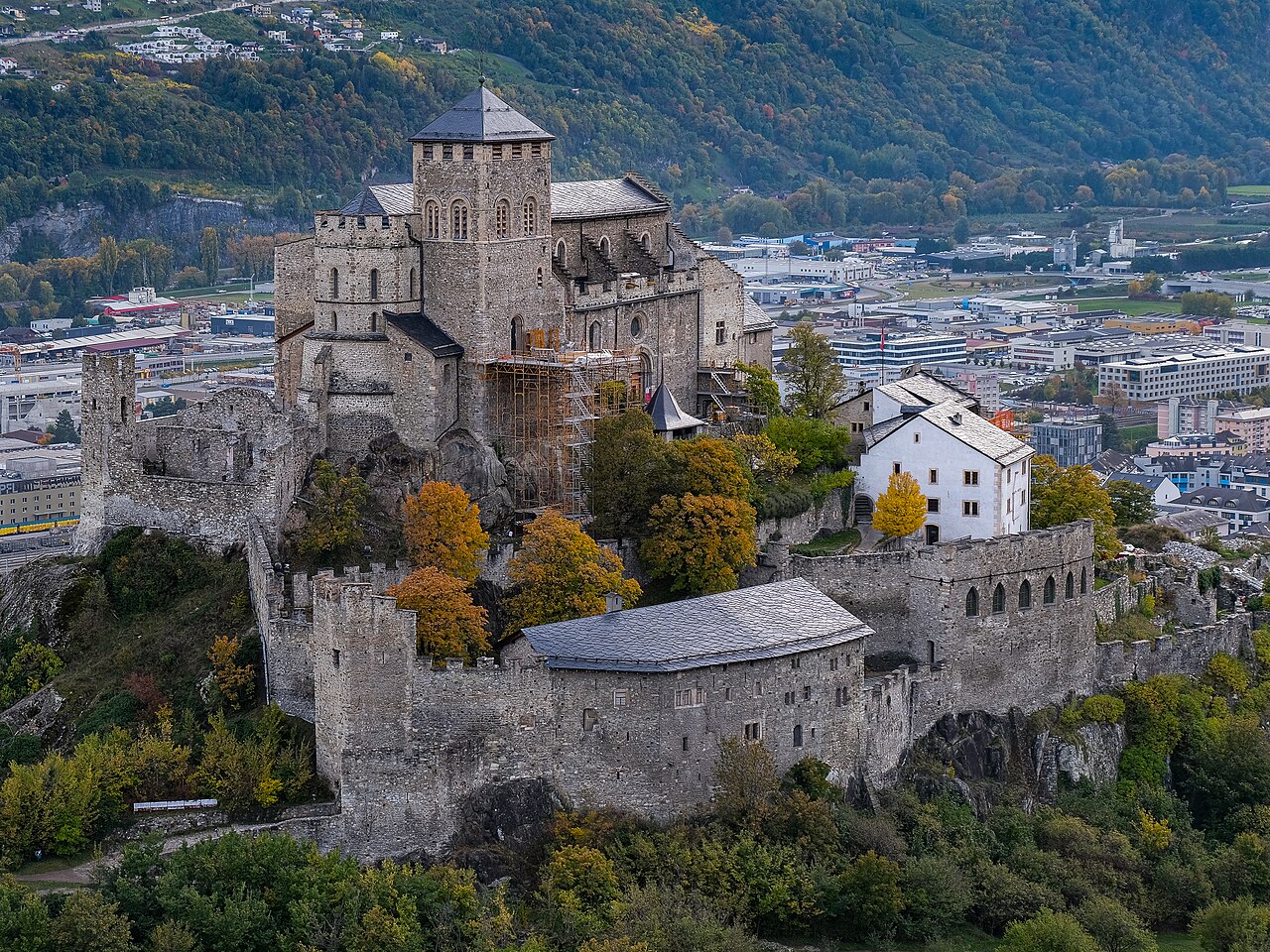
Photo by Christian David • CC BY-SA 4.0
Later history and preservation efforts
Valère Castle's importance declined after the French Revolutionary Wars in 1798, when French troops invaded the region. Religious activities shifted primarily to the nearby Notre-Dame de Sion, leading to reduced maintenance of the site. Despite this, the castle was never completely abandoned, retaining its cultural and historical significance.
Modern restoration and museum use
Restoration efforts began in 1987, supported by the canton of Valais, focusing on preserving the basilica's stained glass windows and painted panels created by the artist Peter Maggenberg in the early 15th century. Specialists from the Basel Art Museum carried out the restoration, which was completed by 2016. During a visit in 1987, Pope John Paul II elevated the church to the status of a minor basilica, recognizing its religious and cultural importance.
The former chapter house, located north of the basilica and dating from around 1300, now houses the Valais History Museum. This museum showcases exhibits related to the region's history and the castle's role within it. Renovation work on the museum began in 2008 to improve visitor facilities and preserve the historic structures.
Natural and cultural heritage significance
The hill on which Valère Castle stands is protected not only for its architectural and historical value but also for its natural environment. The area supports numerous rare plant and animal species, contributing to its designation as a site of national heritage importance since 1977. A marked visitor route guides guests through the castle grounds and the former chapter house, offering an immersive experience of the site's multifaceted heritage.
Valère Castle remains a striking example of medieval Romanesque architecture combined with fortified ecclesiastical design. Its rich history, artistic treasures, and remarkable preservation make it a significant cultural landmark in Switzerland and a popular destination for visitors interested in medieval history, architecture, and sacred art.
Frequently asked questions (FAQ)
- How do I get to Valère Castle in Sion?
- Valère Castle is located on a hill in the old town of Sion, Switzerland. It is accessible by foot via marked paths from the town center, and nearby parking is available for visitors arriving by car.
- What is the historical significance of Valère Castle?
- Valère Castle served as the seat of the Prince-Bishops of Sion, combining religious and temporal power. Its fortified Romanesque basilica and medieval structures reflect its role as a spiritual and political center from the 11th century onward.
- Can I visit the Valais History Museum at Valère Castle?
- Yes, the former chapter house north of the basilica houses the Valais History Museum, which features exhibits on regional history and the castle's cultural heritage. The museum is open during the castle's visiting hours.
- What are the visiting hours and ticket prices for Valère Castle?
- The castle is open daily from 10:00 to 17:00. Tickets cost €8 for adults, €5 for children, and admission is free for visitors under 18 years old.
- Is Valère Castle accessible for visitors with limited mobility?
- Due to its hilltop location and historic structures, accessibility may be limited for visitors with reduced mobility. Some paths are steep and uneven, so visitors should plan accordingly.
Photo gallery

Information
Opening hours
10:00-17:00, daily
Ticket prices
€8 adult, €5 child, free under 18
Current owner
State museum
Website
Visit websiteLoading map...
Visitor reviews
No reviews yet. Be the first to share your experience!