
Udórz
Udórz Castle stands as a compelling relic of late medieval military architecture in Poland. Perched atop a prominent hill known locally as Zamczysko, the castle's ruins emerge from dense forest, marking the site of a former knightly fortress with significant historical and strategic value. Constructed probably in the second half of the 14th century, the castle was built on the foundations of an earlier defensive settlement, highlighting the site's enduring importance in regional defense.
Historical context and strategic significance
The castle's establishment is closely linked to the reign of King Casimir III the Great of Poland, who ruled from 1333 to 1370. During his reign, there was a concerted effort to fortify the kingdom's borders, particularly the frontier with the Kingdom of Bohemia (modern-day Czech Republic). Udórz Castle likely functioned as part of a broader system of fortifications designed to secure this politically sensitive boundary. Its location atop a hill provided a vantage point for surveillance and defense against potential incursions.
Architectural design and fortifications
The castle was constructed on a polygonal plan, skillfully adapting to the natural topography to maximize defensive capabilities. This irregular shape was typical of hill castles that needed to conform to the contours of their elevated sites. The main stone structure was complemented by an extensive outer defense system consisting of wooden-earth ramparts, which enclosed the castle complex and enhanced its ability to withstand sieges.
Structural remnants and layout
Today, the site preserves fragments of the original stone walls, which provide valuable insights into the castle's construction techniques and defensive strategies. Archaeological investigations have revealed that the castle may never have been fully completed or underwent significant reconstruction phases that were left unfinished. This hypothesis is supported by the poor condition of the surviving masonry and the scarcity of historical records documenting the castle's active use.
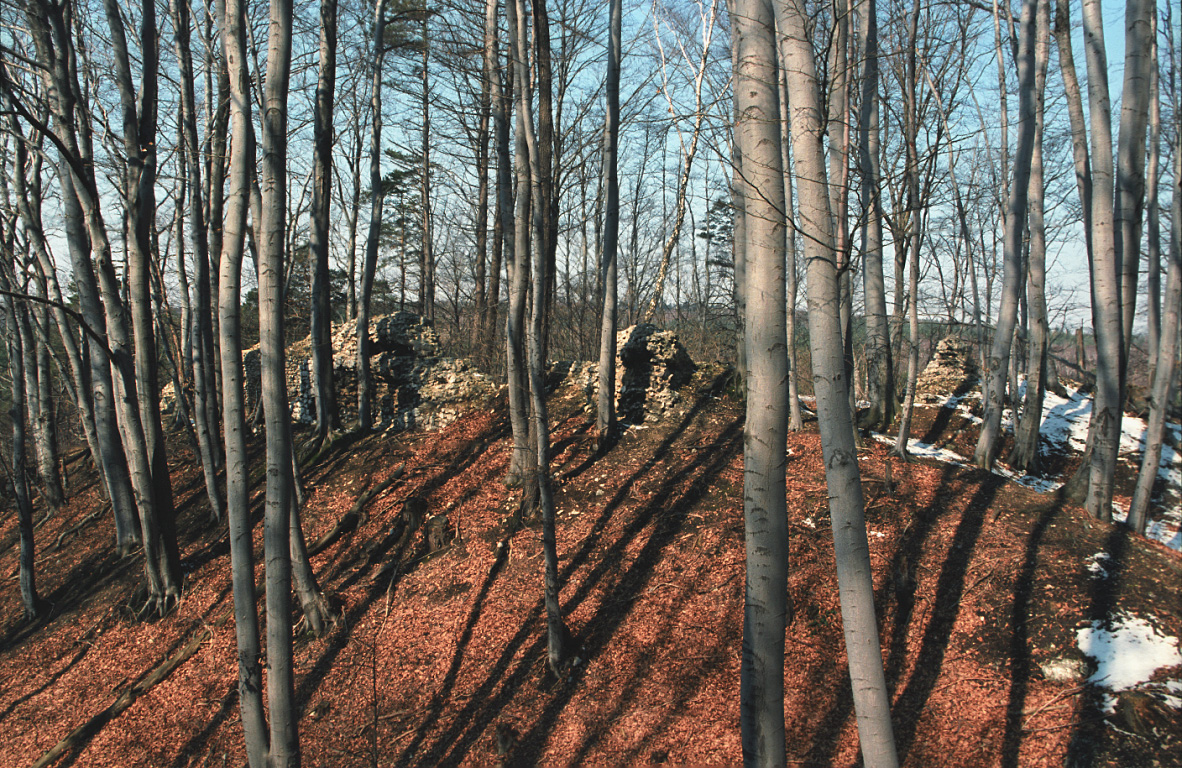
Photo by Jerzy Strzelecki • CC BY-SA 3.0
Ownership and historical transitions
In the late 16th century, specifically after 1581, the castle passed into the hands of Andrzej Koryciński, following its ownership by Mikołaj Długosz. This transfer reflects the typical pattern of noble estate management and inheritance during the period, although by this time the castle's military importance had diminished, contributing to its decline and eventual ruin.
Archaeological research and preservation status
Extensive archaeological studies have been conducted at the Udórz site, shedding light on its historical phases and architectural development. These investigations have been crucial in understanding the castle's incomplete construction and its role within the medieval defensive network. Despite the castle's ruinous state, it remains an important cultural heritage site, illustrating the challenges of border defense in medieval Poland.
Current condition and visitor experience
As ruins, the castle offers a tangible connection to Poland's medieval past. Visitors to the site can explore the surviving walls and imagine the fortress's original scale and function. The natural setting atop the hill adds to the site's atmospheric appeal, making it a point of interest for history enthusiasts and hikers alike.
Architectural significance within the region
Udórz Castle exemplifies the characteristics of a hill castle from the late medieval period in Central Europe. Its adaptation to the terrain, combined with the use of both stone and earthworks, reflects common defensive strategies of the time. The castle's polygonal layout is particularly notable for its integration with the landscape, a feature that enhanced its defensive posture.
Comparison with contemporary castles
While many castles from this era have been extensively restored or rebuilt, Udórz remains largely in ruins, offering a more authentic glimpse into the challenges of medieval construction and maintenance. Its incomplete state sets it apart from other well-preserved fortresses, underscoring the variability of castle development in response to political and economic factors.
Legacy and cultural importance
Though no longer functioning as a fortress, Udórz Castle continues to hold cultural and historical significance. It stands as a symbol of the medieval Polish kingdom's efforts to secure its borders and maintain sovereignty. The castle's ruins contribute to the local identity and serve as a reminder of the region's turbulent past.
In summary, Udórz Castle is a valuable heritage site that encapsulates the architectural ingenuity and strategic imperatives of 14th-century Poland. Its ruins invite further study and preservation efforts to ensure that this medieval landmark remains accessible and informative for future generations.
Frequently asked questions (FAQ)
- When was Udórz Castle built and what was its primary purpose?
- Udórz Castle was likely constructed in the second half of the 14th century during the reign of King Casimir III the Great. Its primary purpose was to serve as a defensive stronghold on the Polish-Czech border.
- What remains of Udórz Castle can visitors see today?
- Visitors can see fragments of the original stone walls and the layout of the polygonal castle structure. The ruins provide insight into medieval defensive architecture despite the castle never being fully completed.
- Is Udórz Castle accessible to the public and what should visitors expect?
- Udórz Castle ruins are accessible to visitors who can explore the site and enjoy the natural hilltop setting. As it is a ruin, facilities may be limited, and visitors should be prepared for uneven terrain.
- Why is Udórz Castle historically significant?
- The castle is historically significant as part of the border defense system during the late medieval period under King Casimir III the Great, reflecting the political and military strategies of the time.
- Are there any ongoing preservation efforts for Udórz Castle?
- Archaeological studies have been conducted to better understand the castle's history and structure, but the site remains in ruins. Preservation efforts focus on maintaining the site as a cultural heritage landmark.
Photo gallery

Information
Loading map...
Visitor reviews
No reviews yet. Be the first to share your experience!