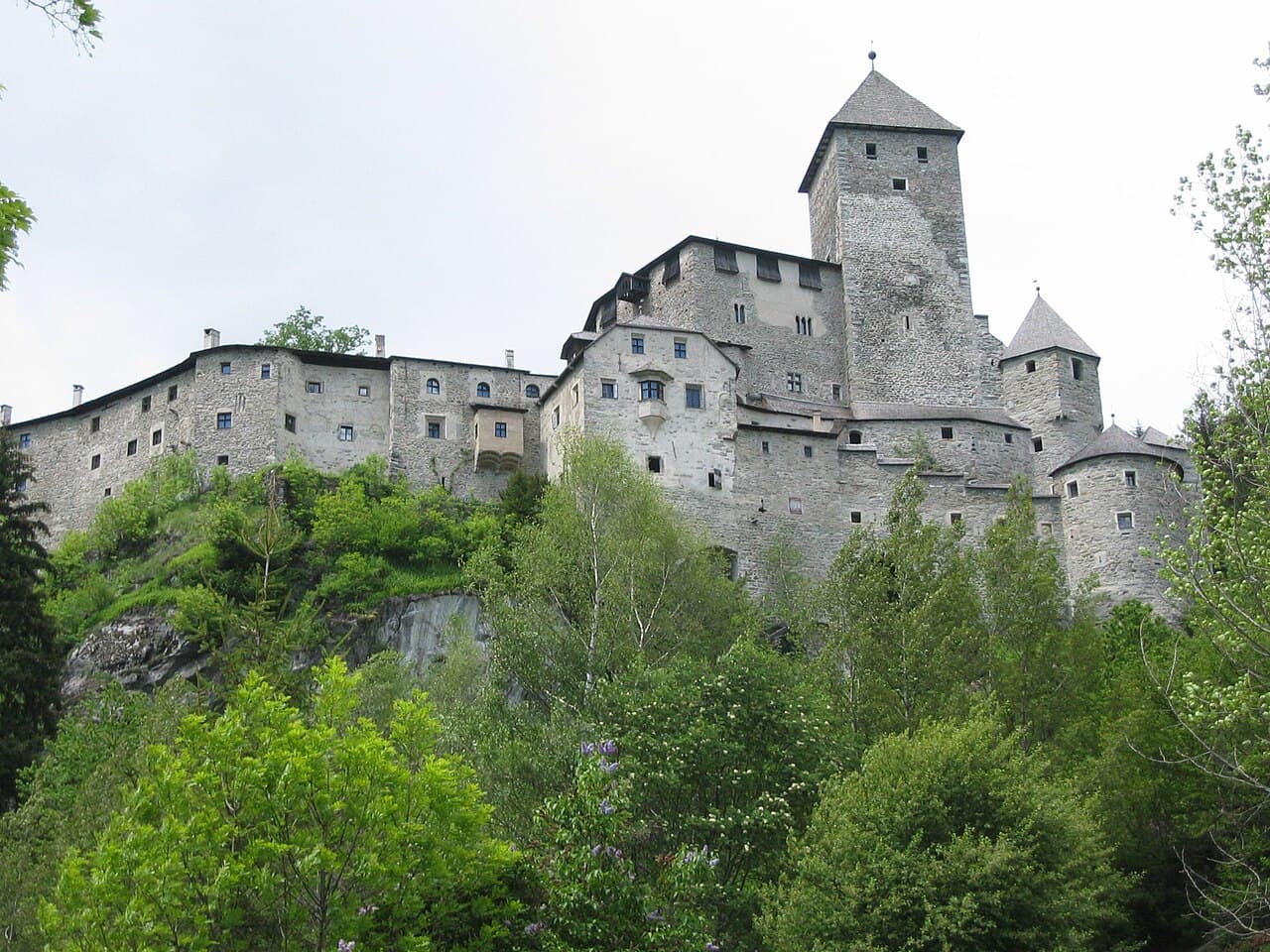
Tures Castle
Taufers Castle (also known as Castel Tures) is a remarkable example of a high medieval hill castle located in Campo Tures, within the Trentino-Alto Adige region of northern Italy. Perched on a natural rocky ridge overlooking the Tauferer Valley, this fortress commands strategic views over the surrounding mountainous landscape. The castle's origins date back to the early 13th century, with the first documented mention of the noble family of Taufers appearing in 1136. The castle was constructed to serve as a fortified residence for the feudal lords who controlled the Aurino valley and nearby territories.
Historical significance and ownership
The castle's history is closely intertwined with the noble family of Taufers, who established their lordship in the region by the early 12th century. The initial construction phase took place in the 1220s, culminating in a large stately home featuring a keep or bergfried, a dungeon or residential tower, and a palatial building. This layout was designed to maximize defense and residential comfort, with the keep positioned towards the more vulnerable mountainous side and the palace on the western side, naturally protected by the terrain.
Ownership of the castle shifted through the centuries. In the 15th century, it came under the control of the von Fieger family, vassals to the Austrian dukes, who undertook significant fortification enhancements. Later, in 1456, Duke Sigismund of Austria sold the castle to the bishops of the Bolzano and Brixen dioceses. Under ecclesiastical ownership, the complex was expanded with additional residential and service buildings, and its defensive structures were further strengthened with multiple towers, gates, and drawbridges.
Following the 17th century, the castle gradually fell into disrepair, with many parts deteriorating due to neglect. In the early 20th century, Ludwig Lobmeyr, a prominent figure associated with the J. & L. Lobmeyr company, purchased and initiated restoration efforts to preserve the castle's architectural heritage. Since 1977, the South Tyrolean Castle Institute has managed the site, continuing extensive restoration and conservation work to maintain its historical integrity and public accessibility.
Architectural features and layout
Taufers Castle is characterized by its adaptation to the natural topography, with an oval ground plan that follows the contours of the rocky outcrop it occupies at nearly 1,000 meters above sea level. The castle's construction primarily uses rubble stone masonry laid in a distinctive opus spicatum (herringbone) pattern, contributing to the robustness of its defensive walls.
The northern section features the prominent bergfried, a tall defensive tower serving as the castle's main stronghold. Adjacent to it stands the Breiter Turm, a residential tower that also formed part of the northern defenses. The western side houses the palas, a grand hall later converted into a granary and currently used for cultural events. The southern area contains another palace-like building, while the eastern side includes the main entrance and former stable buildings.
The castle also contains a smithy and a rock-cut cistern for water storage, underscoring its self-sufficiency. The complex originally featured a sophisticated gate system with multiple defensive towers and drawbridges designed to control access and enhance security. While many of these structures survive only as foundations or fragments, a reconstructed outer access bridge over a neck ditch was completed in 2012 to illustrate the castle's medieval defensive mechanisms.
Interior and notable rooms
Inside, Taufers Castle boasts 64 rooms, with approximately 24 accessible and panelled for visitors. Key interior spaces include a chapel adorned with frescoes attributed to the school of Friedrich Pacher, a renowned Tyrolean painter. The chapel also displays a replica Romanesque crucifix at its altar. The owner's chambers feature elaborate canopy beds indicative of noble status.
Other significant rooms include a large library equipped with a tiled rider stove, an armory housing medieval weaponry, a courtroom for administering justice, and a prison with a torture chamber, reflecting the castle's role as a seat of power and law. The Knight's Hall contains portraits of Tyrolean noble descendants who studied under Beatrix von Fieger in the mid-16th century.
Restoration and current status
The bergfried underwent significant reconstruction between 1969 and 1972, ensuring its preservation as a defining feature of the castle's silhouette. The South Tyrolean Castle Institute has overseen ongoing restoration efforts since acquiring the property, maintaining the castle in a well-preserved state. Visitors can explore much of the castle's interior, experiencing its historical ambiance through original furnishings, old tiled stoves, pine panelling, and frescoes.
Taufers Castle serves not only as a historical monument but also as a cultural venue. It hosts various events, exhibitions, and educational programs aimed at engaging both tourists and local residents. The castle's integration with the dramatic alpine scenery enhances its appeal, making it a significant heritage site in the region.
Visitor information and cultural significance
Taufers Castle stands as a testament to medieval architecture and feudal history in the South Tyrol area. Its preservation allows insight into the lifestyle, defense strategies, and artistic achievements of the region's noble families over several centuries. The castle's combination of military, residential, and ecclesiastical features offers a comprehensive view of its multifaceted role through history.
Frequently asked questions (FAQ)
- How do I get to Tures Castle?
- Tures Castle is located in Campo Tures, Italy, and can be easily reached by car or public transport. If you are driving, follow the signs to Campo Tures, and there is parking available nearby. For public transport, check local bus schedules that connect to the town.
- What is the historical significance of Tures Castle?
- Tures Castle dates back to the 13th century and served as a noble residence and a strategic fortification. It has a rich history tied to the local nobility and played a vital role in the region's defense. The castle's well-preserved architecture offers a glimpse into the medieval period of South Tyrol.
- When was Tures Castle built?
- Construction of Tures Castle began in the early 13th century, with various expansions and renovations occurring over the centuries. Its architectural style reflects the evolution of design from the medieval era to the Renaissance. The castle stands today as a testament to its long and storied past.
- Can I take guided tours of Tures Castle?
- Yes, guided tours are available, providing visitors with in-depth knowledge of the castle's history and architecture. These tours often include access to areas that may not be open to the general public. It's recommended to check the castle's official website for tour schedules and availability.
- Why is Tures Castle a popular tourist destination?
- Tures Castle is renowned for its stunning architecture, beautiful gardens, and breathtaking views of the surrounding mountains. Its historical significance and well-preserved interiors attract history enthusiasts and travelers alike. Additionally, the picturesque setting makes it a perfect spot for photography.
- Is it possible to host events at Tures Castle?
- Yes, Tures Castle can be rented for private events such as weddings and corporate gatherings. The castle offers a unique and enchanting atmosphere, making it a memorable location for special occasions. Interested parties should contact the castle management for more information on event hosting and availability.
- What are the opening hours for Tures Castle?
- Tures Castle is typically open to visitors from April to October, but specific hours may vary. It's advisable to check the official website or contact the castle directly for the most current opening hours and any seasonal changes. Planning your visit during these months ensures you can fully experience the castle.
- What are the ticket prices for visiting Tures Castle?
- Ticket prices for Tures Castle are generally affordable, with discounts available for students and groups. Children under a certain age may enter for free or at a reduced rate. For the most accurate information regarding ticket prices, it's best to consult the castle's official site before your visit.
- What are some nearby attractions to Tures Castle?
- Nearby attractions include the beautiful Ahrntal Valley and the charming town of Campo Tures itself, known for its local shops and restaurants. Additionally, the surrounding mountains offer numerous hiking and outdoor activities. Combining a visit to the castle with these nearby sites makes for a delightful day out.

Information
Website
Visit websiteSources & official resources
Verify the information above using these authoritative references.
Loading map...
Visitor reviews
No reviews yet. Been here? Write the first review and help other travelers!
Write the first reviewVisited this castle? Share your experience
Your review helps other travelers and adds first-hand knowledge to our encyclopedia.



