
Tschanüff Castle
Tschanüff Castle, located in the former municipality of Ramosch (now part of Valsot) in the Canton of Graubünden, Switzerland, is a significant medieval fortress with origins dating back to the 12th century. Known historically as Ramosch or Remüs Castle until the 16th century, it played a crucial role in controlling trade and taxation in the Lower Engadine region. Today, the castle remains a striking example of high medieval fortification architecture, though it stands in ruins due to centuries of conflict and natural disasters.
The castle's oldest surviving structure is the main tower, originally constructed as a bergfried—a defensive tower designed for military purposes without permanent habitation. This tower was built by the Lords of Ramosch in the 12th century and served as the core defensive element of the complex. In the 13th century, a ring wall was added to enclose the castle, expanding its defensive capabilities and marking its evolution into a larger fortified residence.
Historical development and ownership disputes
On 12 March 1256, Count Meinhard of Tyrol granted the knight Nannes of Ramosch the right to build a castle at Ramosch. Since a fortification already existed, this permission likely authorized the expansion of the original tower into a more extensive castle complex. This expansion allowed the Ramosch family to exert control over the vital trade routes and tax collection throughout the Lower Engadine valley.
By 1317, the fief was divided between Nannes and his brother Johannes, which eventually led to internal conflicts between their successors, Conrad and Schweiker. Their disputes escalated until 1365 when Duke Leopold of Austria intervened to mediate. The agreement imposed strict conditions, including accepting the Dukes of Austria as overlords and keeping the castle accessible to them. Despite this, the quarrel continued, culminating in Schweiker murdering Conrad in 1367 and fleeing the castle.
Following these events, the Duke rewarded Ulrich of Matsch with ownership of Tschanüff Castle in 1369 for his military services. However, the Bishop of Chur also claimed the castle, concerned about Austrian influence in the region. In 1394, Bishop Hartmann compelled the Matsch family to relinquish the castle. The following year, the Matsch family briefly recaptured and plundered it but withdrew upon the Bishop's military response.
The conflict was resolved in 1421 with a peace treaty that transferred the castle to the Bishopric, compensating the Matsch family with 2500 marks. Subsequently, the Bishops of Chur appointed vogts (administrators) to govern the valley from the castle for several centuries, reinforcing its role as a regional administrative center.
Sieges, destruction, and rebuilding
The castle endured multiple military conflicts, including an attack by the League of God's House in 1468 during a dispute with the Bishop. It may have also been besieged during the Hennenkreig in 1475. In the Swabian War of 1499, the Bishop's own troops burned Tschanüff to prevent its capture by Imperial forces.
In 1565, rebels opposing the Bishop attacked and burned the outer ward. The residents of the Lower Engadine were held responsible for the damage and ordered to finance the castle's reconstruction. The castle’s name changed from Ramosch or Remüs to Tschanüff in the 16th century, derived from the Romansh term "Casa nova" meaning "New House," to distinguish it from nearby Serviezel Castle.
During the Bündner Wirren in 1622, troops from Glarus captured and burned the castle. It was quickly repaired and continued to serve as the residence of the Bishop’s appointed representative for the next century and a half. However, by 1780, part of the castle was destroyed by a landslide, leading to its abandonment.
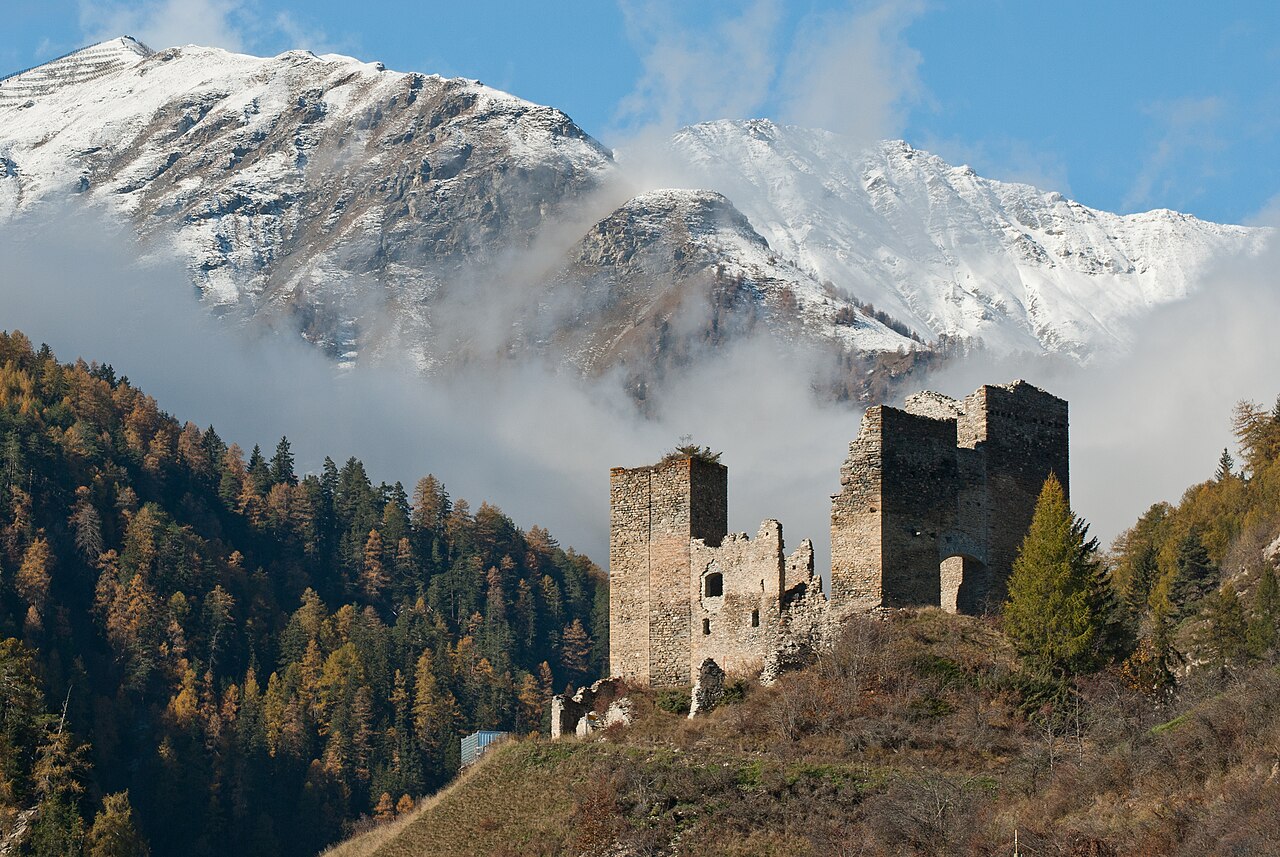
Photo by Hermann Hammer (User:Haneburger) • CC0
Architectural features and layout
The castle complex consists of a main castle with its bergfried tower, residential buildings, and secondary structures surrounded by a ring wall. A southern outer ward is enclosed by an additional ring wall of varying thickness. The two sections are connected by a gateway that leads through a vaulted passage into the main courtyard.
Archaeological evidence shows multiple construction phases. The oldest part of the ring wall on the southeast may predate 1200, while the main tower likely dates from the late 12th or early 13th century. The bergfried still stands with five floors and features a high entrance on the fourth floor facing south, typical of defensive towers designed to be difficult to access.
South of the tower is a building accessible via the high entrance, with holes for wooden beams suggesting multiple floors. The southern residential tract, built in the 15th century, is a four-story structure divided by cross walls. Its lower floors have barrel vaults, some of which have partially collapsed. The third floor housed a hall with a wooden ceiling, topped by a crenelated fighting platform. Rooms were accessible from the courtyard side.
To the north of this wing, only remnants of a more recent building remain. The south wing includes an older shield wall approximately 3 meters thick, likely reinforced during the firearm era to twice that thickness, forming a massive tower-like block without interior divisions.
West of the main tower, a two-story building from around 1500 may have served as a kitchen or smithy on the lower floor with living quarters above. Traces of sgraffito decoration remain on the exterior plaster. Window openings in the western enclosure wall suggest the castle once extended further west, but those parts collapsed in landslides.
Cultural significance and preservation
Tschanüff Castle is recognized as a Swiss heritage site of national significance. Despite its ruined condition, it offers valuable insight into medieval castle architecture and the turbulent history of the Engadine region. The castle's multiple layers of construction and destruction reflect the shifting political and military landscape of medieval Switzerland.
Today, the site attracts historians, archaeologists, and visitors interested in medieval fortifications and Swiss heritage. Its location in the scenic Lower Engadine valley adds to its appeal, providing a tangible connection to the region's past.
Frequently asked questions (FAQ)
- How do I get to Tschanüff Castle?
- Tschanüff Castle is located in Valsot, Switzerland, and can be accessed by car or public transport. The nearest major city is St. Moritz, from where you can take a bus to Valsot. Once in Valsot, follow the signs leading to the castle, which is situated on a scenic hillside.
- What is the historical significance of Tschanüff Castle?
- Tschanüff Castle dates back to the 13th century and is a remarkable example of medieval architecture in the region. It served as a strategic fortification during the feudal era and played a vital role in the local power dynamics. The castle is an important cultural heritage site that attracts history enthusiasts and tourists alike.
- When was Tschanüff Castle built?
- Tschanüff Castle was constructed in the early 1200s, with its architecture showcasing elements typical of that period. Over the centuries, it has undergone several renovations, preserving its historical integrity while adapting to modern standards. This rich history makes it a fascinating destination for visitors interested in Swiss heritage.
- Is it possible to visit Tschanüff Castle year-round?
- Yes, Tschanüff Castle is open to visitors throughout the year, but it is advisable to check specific opening hours before planning your visit. The castle may have limited access during winter months due to weather conditions. Guided tours are typically available, offering insights into the castle's history and architecture.
- Can I take guided tours of Tschanüff Castle?
- Yes, guided tours of Tschanüff Castle are available, providing an excellent opportunity to learn about its rich history and architectural features. Tours are conducted in multiple languages, making it accessible for international visitors. It is recommended to book in advance, especially during peak tourist seasons.
- What are the ticket prices for Tschanüff Castle?
- Ticket prices for Tschanüff Castle are generally affordable, with discounts available for students and seniors. Children under a certain age may enter for free, making it a great family-friendly attraction. Be sure to check the official website for the most current pricing information before your visit.
- What are the opening hours for Tschanüff Castle?
- Tschanüff Castle typically opens at 10 AM and closes at 5 PM, but these hours may vary seasonally. It is advisable to visit their official website for any updates on opening times, especially around holidays. Early arrival is recommended to enjoy the full experience without the crowds.
- When is the best time to visit Tschanüff Castle?
- The best time to visit Tschanüff Castle is during the spring and early fall when the weather is mild, and the surrounding landscape is picturesque. Summer also attracts many visitors, so plan for potential crowds during peak tourist season. Each season offers a unique perspective of the castle and its surroundings.
- Are there any nearby attractions to visit along with Tschanüff Castle?
- Yes, several attractions are located near Tschanüff Castle, including beautiful hiking trails and the charming village of Valsot. The stunning landscapes of the Swiss Alps provide ample opportunities for outdoor activities. Additionally, nearby towns offer cultural experiences and local cuisine, making it easy to spend a full day exploring the area.
Photo gallery

Information
Loading map...
Visitor reviews
No reviews yet. Be the first to share your experience!