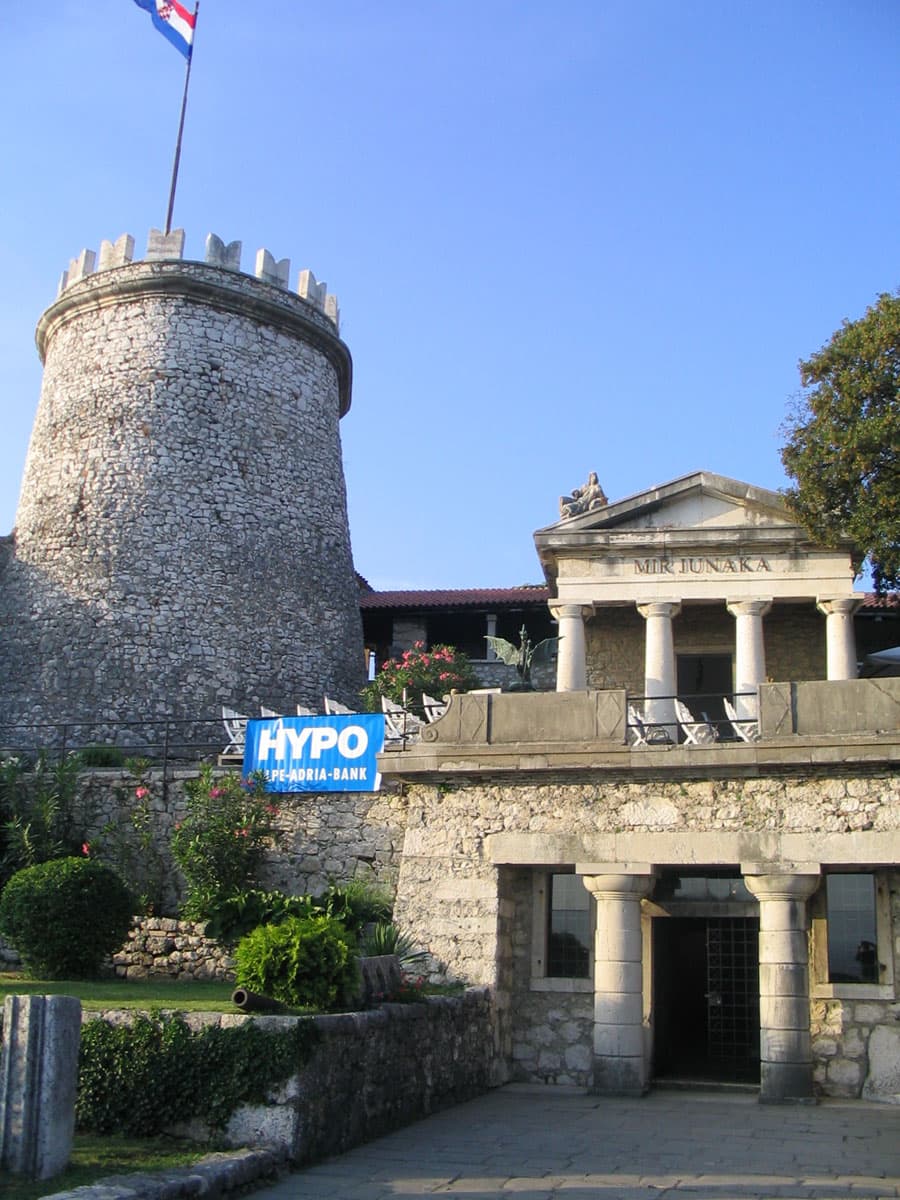
Trsat Castle
Trsat Castle stands prominently on a 138-meter hill above the city of Rijeka in Primorje-Gorski Kotar County, Croatia. This high medieval fortress offers spectacular views over the Rječina River valley, the docks, the Adriatic Sea, and the distant island of Krk. Its strategic location has made it a significant defensive and administrative site since ancient times, evolving from an Illyrian hill-fort to a medieval stronghold and later a noble residence.
Ancient origins and early history
The site of Trsat Castle is believed to have been occupied since antiquity, originally hosting an Illyrian hill-fort known as Darsata by the Japodian tribe. This was succeeded by a Roman fortification named Tarsatica, which guarded vital roads linking the Roman city of Aquileia with Pannonia and the coastal town of Senia (modern Senj). The commanding position overlooking the Rječina River gorge made it a key military and trade vantage point throughout the classical era.
Medieval construction and the frankopan legacy
The present castle structure was built in the 13th century by the Frankopan family, one of Croatia's most powerful noble lineages. They constructed the fortress to secure their holdings in the Vinodol region and to control the important trade routes and surrounding territory. The castle first appears in historical records in 1288 as a parish center, highlighting its dual military and administrative functions.
Throughout the high medieval period, Trsat Castle served as a stronghold against external threats and a symbol of Frankopan authority. It remained under their ownership until 1670, during which it played an important role in regional defense and governance.
Conflicts and historical significance
One of the most notable events in the castle's history occurred in June 1509 during the Austro-Venetian wars. Croatian Ban Andrew Bot of Bajna led forces to recapture Trsat Castle from the Venetians, a victory that forced the Venetian withdrawal from Rijeka and restored Habsburg control under Maximilian of Habsburg. This campaign is historically significant as it marks the only documented connection between Rijeka and Venice or Italy from the 7th century onward.
In the 17th century, the castle's military importance declined due to reduced threats from Venice and the Ottoman Empire. The decline accelerated after a damaging earthquake in 1750, which left parts of the fortress in disrepair.
19th-century restoration and the nugent era
During the Napoleonic Wars, the castle briefly came under British influence when Captain Hoste governed Rijeka (then called Fiume) in 1811. In 1826, the castle was granted to Field-Marshal Laval Nugent von Westmeath, an Irish-born Austrian commander who was ennobled and made the castle his residence.
Nugent undertook extensive restorations, transforming Trsat Castle with Neo-Gothic architectural elements and a romanticized style favored in the 19th century. He commissioned the construction of a mausoleum within the castle grounds, designed as a Doric temple adorned with the Nugent family coat of arms. The entrance is guarded by two bronze dragons, created by the renowned sculptor Anton Dominik von Fernkorn in 1864, adding unique artistic character to the site.
Under Nugent's patronage, the castle housed collections of artworks and furniture including pieces by Italian Renaissance masters such as Titian, Tintoretto, and Andrea Schiavone. Though these collections were later dispersed, they reflect the castle's cultural prominence during this period.
Architectural features and current state
Trsat Castle is classified as a hill castle, characterized by its elevated position and defensive ramparts. The complex includes two distinct towers—one circular and one oval—reflecting its medieval military origins. The castle's walls, bastions, and ramparts provide commanding views and strategic defense points.
The courtyard has been adapted over time for various uses, including cultural events such as concerts, theatre performances, and fashion shows during the summer months. A former dungeon beneath the castle is occasionally used for exhibitions, linking the site's historical past with contemporary cultural activities.
The Nugent mausoleum remains a highlight, with its classical Doric columns and symbolic bronze dragons. The castle also features a café-bar open until midnight in summer, offering visitors a scenic spot to enjoy panoramic views of Rijeka and the Adriatic coast.
Despite periods of decay, especially after the 18th-century earthquake, the castle is partially preserved and benefits from ongoing maintenance. Its layered history is visible in the blend of medieval fortifications and 19th-century romantic restorations, making it a unique cultural landmark.
Cultural and historical importance
Trsat Castle is not only a military and architectural monument but also a symbol of regional identity and heritage. It is linked to notable historical figures such as the Frankopan family, Ban Andrew Bot of Bajna, and Field-Marshal Laval Nugent. The castle's connection to religious history is underscored by the burial of Croatian noble Vuk Krsto Frankopan in a church associated with the site.
Today, Trsat Castle attracts numerous tourists, drawn by its rich history, stunning views, and cultural events. Its transformation into a restaurant and event venue allows visitors to experience the castle's ambiance while enjoying modern amenities.
Visiting trsat castle
Visitors can explore the castle grounds, including the ramparts, towers, and courtyard. The open-air café-bar provides a relaxing atmosphere with spectacular vistas. Seasonal cultural programs enhance the visitor experience, especially during summer months when concerts and performances are held.
The castle's location above Rijeka makes it accessible by foot or car, and its historical significance offers educational opportunities for those interested in Croatian medieval and Habsburg-era history.
Frequently asked questions (FAQ)
- How do I get to Trsat Castle from Rijeka city center?
- Trsat Castle is accessible by a short drive or a scenic 20-minute walk uphill from Rijeka city center. Public transportation options and parking are available near the castle entrance.
- What are the opening hours for visiting Trsat Castle?
- The castle is generally open to visitors during daylight hours, with extended hours in summer for cultural events. It's best to check locally for seasonal variations and special event schedules.
- Is there an entrance fee to visit Trsat Castle?
- Entrance to the castle grounds is typically free, but some special exhibitions or events may require a ticket. The on-site café and restaurant operate independently.
- What architectural styles are visible at Trsat Castle?
- Visitors can observe a blend of high medieval fortification architecture and 19th-century Neo-Gothic restorations, including the distinctive Doric mausoleum and decorative bronze dragons.
- Can I attend cultural events at Trsat Castle?
- Yes, during the summer months, the castle hosts concerts, theatre performances, and fashion shows, providing a vibrant cultural experience amidst historic surroundings.
- Is Trsat Castle suitable for families and children?
- The castle offers open spaces and educational exhibits suitable for families. However, some areas like the dungeon may have limited accessibility, so supervision is recommended.
Photo gallery

Information
Sources & official resources
Verify the information above using these authoritative references.
Loading map...
Visitor reviews
No reviews yet. Been here? Write the first review and help other travelers!
Write the first reviewVisited this castle? Share your experience
Your review helps other travelers and adds first-hand knowledge to our encyclopedia.



