
Toruń Fortress
Toruń Fortress (Polish: Twierdza Toruń, German: Festung Thorn) is a significant 19th-century bastioned fortress located in Toruń, Poland. It ranks among the largest fortress complexes in Central and Eastern Europe. Constructed between 1872 and 1894 during the Modern period, the fortress was built by the Kingdom of Prussia when Toruń was part of the Prussian Partition of Poland. The fortress was strategically designed to protect the eastern borders of Prussia against the Russian Empire.
Historical context and construction
The construction of Toruń Fortress was part of a broader Prussian military strategy in the late 19th century, aiming to strengthen border defenses following the unification of Germany in 1871. The fortress complex consisted of a chain of forts encircling the city of Toruń, supplemented by numerous smaller fortifications and defensive works. These fortifications incorporated the bastioned fortress design, a style characterized by angular bastions projecting outward to cover adjacent walls with defensive fire, which was a common feature in European military architecture of the period.
Design and architectural features
The fortress was designed with modern military engineering principles of the late 19th century, including thick masonry walls, earthworks, and moats to absorb artillery fire. The bastions allowed for overlapping fields of fire, improving defensive capabilities against infantry and artillery attacks. The fortress also included ravelins, casemates, and underground tunnels to facilitate troop movements and protect soldiers from bombardment.
Military role and significance
Despite its extensive fortifications and strategic importance, Toruń Fortress did not see significant combat during the First World War. The fortress's role was primarily deterrent, and it remained largely unchallenged during the conflict. In the interwar period, the fortress's military relevance declined as advances in artillery and warfare tactics rendered such static defenses less effective.
World War II and later history
During the Second World War, when Poland was occupied by Nazi Germany, the fortress complex was repurposed by the German military. It housed a prison for Poles and the Stalag XX-A prisoner-of-war camp, which detained Polish, British, French, Australian, and Soviet prisoners of war. The fortress was also a site of atrocities, including the Intelligenzaktion, a campaign of mass executions targeting the Polish intelligentsia and leadership classes.
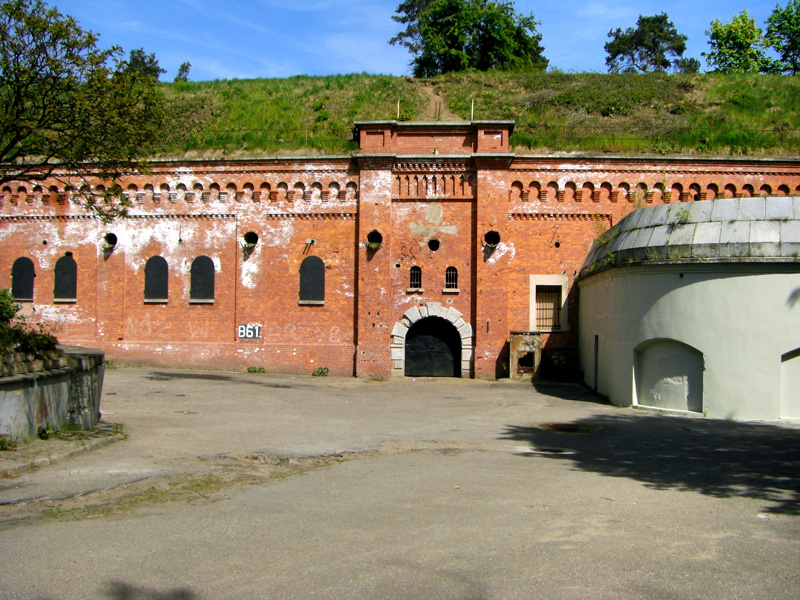
Photo by Michał Madajewski • CC BY-SA 3.0
Preservation and current status
Today, Toruń Fortress remains a prominent historical landmark in Toruń. While some parts of the fortress have been preserved or restored, others are in varying states of decay. The complex offers insight into 19th-century military architecture and the turbulent history of the region. It serves as a cultural and educational site, attracting visitors interested in military history and architecture.
Architectural legacy
The fortress exemplifies the bastioned fortress style adapted to the demands of modern artillery warfare of its time. Its extensive network of forts and defensive structures demonstrates the scale and ambition of Prussian military engineering in the late 1800s. The site contributes to understanding the evolution of fortress design and the geopolitical tensions in Central Europe during the Modern period.
Frequently asked questions (FAQ)
- What is the historical significance of Toruń Fortress?
- Toruń Fortress is one of the largest 19th-century bastioned fortresses in Central and Eastern Europe, built by Prussia to defend its eastern border. It also served as a prison and POW camp during World War II.
- Can I visit Toruń Fortress today?
- Yes, parts of Toruń Fortress are accessible to visitors. It is a historical landmark offering insights into 19th-century military architecture and regional history.
- When was Toruń Fortress built?
- The fortress was constructed between 1872 and 1894 during the Modern period by the Kingdom of Prussia.
- What architectural style characterizes Toruń Fortress?
- Toruń Fortress is designed in the bastioned fortress style, featuring angular bastions, thick walls, earthworks, and defensive moats typical of 19th-century military engineering.
- What role did Toruń Fortress play in World War I?
- Despite its size and defenses, Toruń Fortress did not see significant combat during World War I and mainly served as a deterrent.
- What happened at Toruń Fortress during World War II?
- During World War II, the fortress was used by Nazi Germany as a prison for Poles and a POW camp, and was the site of German massacres during the Intelligenzaktion.
Photo gallery

Information
Loading map...
Visitor reviews
No reviews yet. Be the first to share your experience!