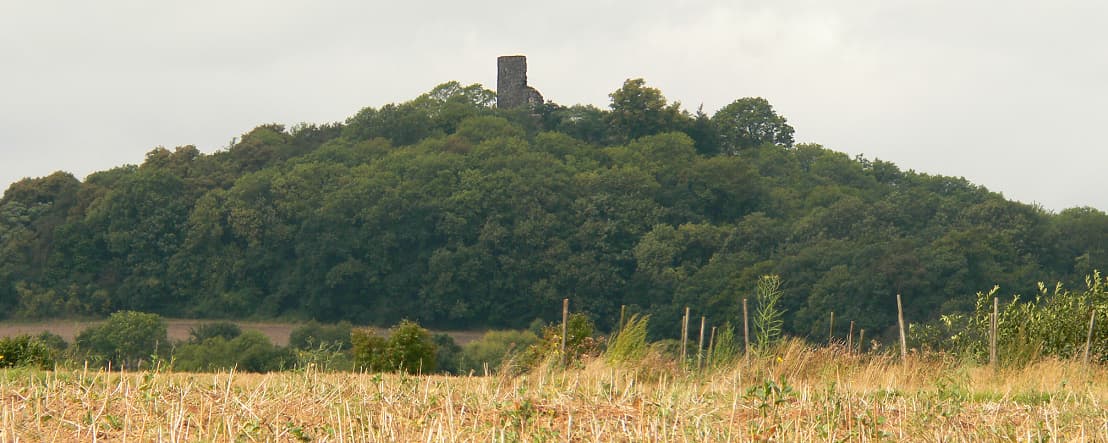
Tomburg Castle
Tomburg Castle stands as a significant historical monument near Rheinbach, Germany, embodying a rich legacy that spans over a millennium. Constructed around the year 900 AD, this hill castle was originally established by local rulers as a strategic fortified stronghold atop the volcanic Tomberg hill. The site itself holds a deeper antiquity, with archaeological evidence revealing that the Romans utilized this basalt dome for military purposes during the 4th century. This early occupation highlights the site's long-standing strategic importance in the region.
By the turn of the first millennium, Tomburg Castle had risen in prominence as the residence of Count Palatine Ezzo and his wife Mathilda, sister of Emperor Otto III. This noble family played a pivotal role in the political landscape of the Holy Roman Empire. Their daughter, Richeza, became the Queen of Poland, while their son Otto inherited the Palatinate and served as Duke of Swabia until his death at Tomburg in 1047. This association firmly places the castle within the sphere of imperial influence and power during the High Medieval period.
Historical significance and ownership transitions
In the mid-11th century, control of Tomburg Castle transitioned to the Archbishopric of Cologne, a shift confirmed by Pope Leo IX in 1052. This transfer included not only the castle but also the associated church, underscoring the intertwined nature of secular and ecclesiastical power. From 1090 onward, the castle was held by the Counts of Cleves as vassals under the archbishops, marking a period of feudal stewardship that lasted until the 13th century.
The Lords of Müllenark acquired the castle in the 13th century, adopting the name "von Tomburg" and securing the office of burgrave in 1253. This title reflected their authority as castle governors and local lords, responsible for the administration and defense of the fortress. Over the following centuries, the castle's military role diminished, particularly in the 14th century as the advent of gunpowder artillery revolutionized siege warfare and rendered many traditional hilltop fortifications vulnerable.
Siege and destruction in the 15th century
The castle's decline culminated in a violent conflict in the early 15th century. After the death of a prominent family member around 1420, Tomburg Castle became embroiled in inheritance disputes involving Frederick of Tomburg and Duke Gerhard VII of Jülich. These tensions led to a decisive siege on September 7, 1473, when Duke Gerhard VII's forces attacked the fortress. The siege notably employed artillery bombardment, which inflicted severe damage and resulted in the castle's near-total destruction.
Following the siege, Tomburg Castle was abandoned and never restored as a military stronghold. The ruins gradually suffered further degradation as local inhabitants quarried basalt from the volcanic hill, diminishing the site's structural remains.
Architectural features and archaeological remains
The castle ruins occupy the summit of the Tomberg hill, a basalt dome formed by volcanic activity during the Tertiary period. The hill rises approximately 310 meters above sea level and features an elliptical volcanic vent about 175 meters across. Despite centuries of quarrying, roughly 70 percent of the original volcanic hill remains intact, preserving the natural foundation upon which the castle was built.
Among the most prominent surviving structures is the bergfried, the main tower of the castle. Although its upper sections have collapsed, the lower portion remains standing and has been secured to prevent further damage. This tower would have served as a crucial lookout and final defensive refuge within the castle complex.
Another significant archaeological feature is the , excavated in 1883 by a local heritage society. This well descends approximately 46 meters into the basalt hill, demonstrating the advanced engineering techniques employed to ensure a reliable water supply for the castle's inhabitants. Its preservation offers valuable insight into the daily life and logistical challenges faced by medieval occupants.
Excavations have also uncovered stone cannonballs, tangible evidence of the castle's involvement in military conflicts and the artillery siege that led to its downfall. These artifacts corroborate historical accounts of the fortress's destruction in the 15th century.
Conservation and cultural legacy
Today, Tomburg Castle's ruins and the surrounding hill are protected within a designated nature reserve. This status safeguards both the archaeological remains and the ecological environment, including an adjacent meadow that forms part of the European Natura 2000 conservation network. This dual protection underscores the site's importance as a cultural and natural heritage asset.
The castle has also inspired artistic representation, notably a 1920s painting by Fritz von Wille, which captures the dramatic basalt hill and the decayed structures. Aerial photographs from 2015 further document the site's condition and landscape context, supporting ongoing preservation efforts.
Tomburg Castle remains a compelling testament to the region's medieval history, architectural evolution, and the shifting tides of political power within the Holy Roman Empire. Its ruins invite exploration and study, offering a tangible connection to a turbulent past marked by noble ambition, military innovation, and enduring cultural significance.
Frequently asked questions (FAQ)
- How do I get to Tomburg Castle near Rheinbach?
- Tomburg Castle is located near Rheinbach in Germany. Visitors can reach the site by car or local public transportation, followed by a short hike up the Tomberg hill to the castle ruins.
- What is the historical significance of Tomburg Castle?
- Tomburg Castle was a prominent hilltop fortress built around 900 AD, associated with notable figures such as Count Palatine Ezzo and Emperor Otto III's family. It played a role in regional power dynamics during the Holy Roman Empire.
- Can I visit the ruins of Tomburg Castle?
- Yes, the ruins of Tomburg Castle are accessible to the public. The site is part of a nature reserve, offering visitors both historical exploration and natural scenery.
- When was Tomburg Castle destroyed?
- Tomburg Castle was besieged and severely damaged by artillery on September 7, 1473, leading to its abandonment and ruin.
- What remains of Tomburg Castle today?
- Today, visitors can see the remains of the bergfried tower, the deep castle well, and scattered ruins on the basalt hill. Archaeological finds like stone cannonballs also highlight its military past.
Photo gallery

Photo by Axel Hindemith•Public domain
Information
Website
Visit websiteSources & official resources
Verify the information above using these authoritative references.
Loading map...
Visitor reviews
No reviews yet. Been here? Write the first review and help other travelers!
Write the first reviewVisited this castle? Share your experience
Your review helps other travelers and adds first-hand knowledge to our encyclopedia.



