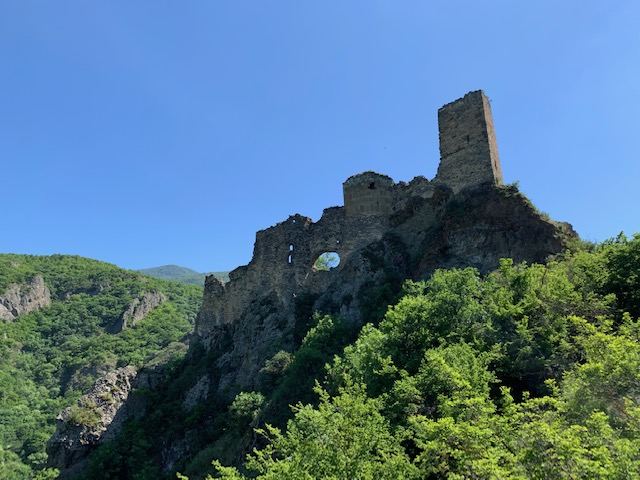
Toidziant Tower

Toidziant Tower in Zemo Chocheti, Georgia
Zemo Chocheti, Shida Kartli, Georgia
Post-Renaissance (17th–18th c.)
Ruins

Toidziant Tower is a historic tower ruin located in the village of Zemo (Upper) Chocheti, within the Kaspi municipality of the Shida Kartli region in Georgia. This structure represents a typical example of regional defensive architecture from the 18th century, reflecting the post-medieval period's local construction styles.

Architectural characteristics and structure

The tower has a square ground plan, a common design choice for watchtowers and defensive structures in the Georgian highlands during the post-Renaissance period. The walls taper upwards, which not only adds structural stability but also enhances the tower’s defensive capabilities. This tapering is a distinctive feature that helps distribute the weight and resist external forces such as sieges or natural erosion.

Although the tower is currently in a ruined state, its remaining masonry provides insight into the construction techniques used at the time. The use of local stone and traditional mortar reflects the practical and resourceful building practices of the region. The tower's height, while difficult to ascertain precisely due to its ruinous condition, suggests it was intended for surveillance and communication across the surrounding landscape.

Historical context and significance

While detailed historical records about Toidziant Tower are scarce, its location in Shida Kartli situates it within a region historically significant for its strategic importance in Georgian history. The area served as a crossroads for various military campaigns and local conflicts, especially during the turbulent centuries following the medieval period.

Towers like Toidziant were often constructed as part of a network of fortifications designed to protect villages and trade routes from raids. Their roles included early warning, defense, and as symbols of local authority. The 17th and 18th centuries in Georgia were marked by frequent incursions and shifting allegiances, making such structures vital for community security.

Current condition and accessibility

Today, Toidziant Tower remains a ruined tower and is situated on private land, which limits public access. The ruin’s preservation state reflects the challenges of maintaining smaller, less prominent historical sites in rural areas. Visitors interested in Georgian medieval and post-medieval architecture may find the tower an intriguing example of local defensive construction, although physical access is restricted.

Efforts to document and conserve such towers are important for preserving Georgia’s cultural heritage, especially as many similar structures face threats from neglect and natural decay.

Regional architectural heritage

The Shida Kartli region is home to numerous historical fortifications, castles, and towers that collectively illustrate the evolution of Georgian military architecture. Toidziant Tower contributes to this heritage as part of the broader landscape of defensive buildings that supported the local communities through centuries of conflict and change.

Its simple yet effective design reflects the practical needs of rural populations during the post-Renaissance period and offers valuable insight into the architectural and historical fabric of the region.

Frequently asked questions (FAQ)

How do I get to Toidziant Tower?
Toidziant Tower is located in Zemo Chocheti, Georgia, and can be reached by car or public transportation from nearby cities. The nearest major town is Kutaisi, which is approximately 50 kilometers away. Local guides and taxi services are also available to assist visitors in reaching the tower.
What is the historical significance of Toidziant Tower?
Toidziant Tower dates back to the medieval period and served as a defensive structure for the region. It is a key example of Georgian architecture and provides insight into the historical military strategies of the time. The tower is also associated with local legends and has become a symbol of heritage for the community.
When was Toidziant Tower built?
The exact date of construction for Toidziant Tower is not definitively known, but it is believed to have been built in the 12th century. This period was significant for the development of fortifications in Georgia, as various kingdoms sought to protect their territories from invasions. The architectural style reflects the medieval influences prevalent during that era.
Can I enter Toidziant Tower?
Yes, visitors are allowed to enter Toidziant Tower, but access may be subject to certain restrictions for preservation purposes. It is advisable to check in advance regarding guided tours or special events that may be taking place. Local guides can provide valuable insights during your visit.
Why is Toidziant Tower popular among tourists?
Toidziant Tower is popular among tourists because of its stunning architecture and rich history, offering a glimpse into Georgia's past. The picturesque setting provides excellent photo opportunities, and the surrounding landscape is ideal for hiking and exploration. Its cultural significance also attracts history enthusiasts and travelers seeking unique experiences.
Is it possible to visit Toidziant Tower year-round?
Yes, Toidziant Tower can be visited year-round, but the best time to explore is during the spring and fall when the weather is mild. Summer can be quite warm, while winter may bring snow, making access more challenging. Always check local weather conditions before planning your visit.
What are the ticket prices for Toidziant Tower?
As of now, the ticket prices for Toidziant Tower are quite affordable, typically ranging from a few lari for adults and discounted rates for students and seniors. Group rates may also be available for larger parties. It is recommended to confirm the current pricing and any potential changes before your visit.
What are the opening hours for Toidziant Tower?
Toidziant Tower generally opens from 10 AM to 6 PM, but these hours may vary depending on the season or special events. It is advisable to check with local tourism offices or the official website for the most up-to-date information. Planning your visit during these hours will ensure you have ample time to explore the site.
Are there any nearby attractions to visit along with Toidziant Tower?
Yes, there are several attractions near Toidziant Tower, including beautiful hiking trails and other historical sites that showcase Georgia's rich culture. Visitors can also explore local villages and enjoy traditional Georgian cuisine in nearby restaurants. These additional experiences enhance the overall visit to the area.

Information

Tower House

Loading map...

Visitor reviews

No reviews yet. Been here? Write the first review and help other travelers!

Write the first review

Visited this castle? Share your experience

Your review helps other travelers and adds first-hand knowledge to our encyclopedia.

Write a review

(5/5)

0/2000 characters

Your review will be visible after admin approval

Nearby castles

3.1 km

Akhaltsikhe Castle

Akhaltsikhe, Georgia

Akhaltsikhe Castle is a historic fortress located on a steep hill in the village of Akhaltsikhe, within the Kaspi municipality of the Shida Kartli region in Georgia. This castle, though less documented than its namesake in the Samtskhe–Javakheti region, offers a glimpse into the medieval defensive architecture typical of the area. Its elevated position provided strategic advantages for surveillance and defense. Architectural features and layout The castle has a rectangular ground plan, a common design for fortifications aiming to maximize internal space while maintaining strong defensive walls. Notably, there are remains of four circular corner towers which would have served as vantage points for archers and lookouts, enhancing the castle's defensive capabilities. Additionally, a larger circular tower is situated centrally along the west wall; this tower likely functioned as the keep or main stronghold, providing a final refuge during sieges. The castle's walls and towers are constructed from local stone, typical of Georgian medieval fortifications, designed to withstand assaults and the test of time. Although now in ruins, the structural remnants convey the original scale and defensive intent of the fortress. Historical context and usage While detailed historical records about Akhaltsikhe Castle in Shida Kartli are scarce, its architectural features suggest construction during the medieval period, likely between the 12th and 15th centuries, a time when regional lords fortified their domains against rival factions and invading forces. The castle's location on a hill aligns with typical medieval military strategy, prioritizing elevation for defense and control of surrounding territory. Over time, the castle fell into disuse and ruin. The hill and castle grounds were repurposed as a village graveyard. This transformation is evident in the presence of numerous stone coffin-like gravestones scattered within the castle walls, blending the site's martial past with its role in local cultural and religious practices. Current condition and accessibility Today, Akhaltsikhe Castle stands as a ruined fortress with visible remnants of its towers and walls. The site is freely accessible to visitors, offering a quiet and evocative atmosphere. The combination of the castle ruins and the graveyard creates a unique historical landscape that reflects both the defensive and communal aspects of the location. Visitors can explore the remains of the towers and walls while observing the traditional gravestones, which provide insight into the local customs and the site's ongoing significance to the village community. Significance and visitor information Although not as famous as other Georgian castles, Akhaltsikhe Castle in Shida Kartli holds value as a cultural and historical landmark. It illustrates the typical features of a hill castle in Georgia and offers a tangible connection to the region's medieval past. The site's integration with the village graveyard adds a layer of anthropological interest, highlighting how historic sites can evolve in function over centuries. Visitors interested in medieval Georgian architecture and local history will find the site rewarding, especially given its peaceful setting and the opportunity to see authentic stonework and defensive structures.

High Medieval (11th–13th c.)
Details
5.6 km
Drisi Javakhaant Castle — Georgia castle

Drisi Javakhaant Castle

, Georgia

The Drisi Javakhaant castle (Georgian: დრისის ჯავახაანთ ციხე, romanized: drisis javakhaant tsikhe), also known as Javakhaant castle, is a notable hill castle situated in the Kaspi Municipality of Georgia. Perched on a prominent rock formation on the left bank of the Tedzami River, it lies approximately 400 meters west of the village of Chqopiani. This strategic location provided natural defensive advantages, making it a significant stronghold in the region. Architectural composition and layout The fortress complex is composed of several key elements that reflect the multifunctional nature of medieval Georgian fortifications. It includes a main castle structure, encompassing defensive walls, a church, a tower, and a palace. The castle is built directly atop the rock, integrating the natural terrain into its defensive design, a common feature in hill castles that maximizes visibility and protection. The defensive walls encircle the castle, forming a barrier against invaders. The presence of a tower within the complex suggests a lookout or strongpoint for surveillance and defense. The church within the walls indicates the spiritual and communal importance of the site, serving both the castle inhabitants and possibly the surrounding population. The palace area within the fortress likely functioned as the residential quarters for the ruling elite or local nobility, highlighting the castle's role not only as a military installation but also as a center of governance and administration. Historical significance and status Recognized for its cultural and historical value, the Drisi Javakhaant castle was designated a Monument of National Importance by a presidential decree in 2006. This status underscores the castle's importance in Georgia's national heritage and its preservation as a site of archaeological and architectural interest. The castle's exact construction date is not definitively documented, but its architectural features and location suggest it was established during the medieval period, serving as a defensive and administrative center in the region. Strategic location and defensive features The castle's placement on a rocky hill overlooking the Tedzami River provided natural defenses against attacks. The elevation allowed defenders to monitor the surrounding landscape and control movement along the river valley, a critical factor in medieval military strategy. The integration of the castle's walls with the rock base enhanced its fortification, making direct assaults difficult. The tower's vantage point would have been essential for early warning and coordination during sieges or conflicts. Architectural style and construction techniques While specific stylistic details are limited, the castle's construction reflects typical medieval Georgian military architecture, which often combined robust stone masonry with the natural terrain. The use of local stone materials and the adaptation to the rocky site demonstrate practical engineering approaches of the time. The church within the castle likely features traditional Georgian ecclesiastical architectural elements, such as a cross-dome plan and stone carvings, common in medieval Georgian religious buildings. Current condition and accessibility The Drisi Javakhaant castle remains a partially preserved site, with some structures intact enough to convey its historical form. Its designation as a Monument of National Importance has helped protect it from further deterioration. Located near the village of Chqopiani, the castle is accessible to visitors interested in Georgian history and medieval architecture, although facilities and detailed visitor information may be limited due to its remote location.

Details
6.2 km

Drisi Castle

Chkopiani, Georgia

Drisi Castle is a medieval fortress located on a rocky mountain west of the village of Chkopiani, within the Kaspi municipality of the Shida Kartli region in Georgia. Perched above the Tedzami River gorge, the castle occupies a strategic position that commands views over the surrounding landscape. Its irregular ground plan closely follows the natural contours of the rocky peak on which it is built, a common feature of mountain castles designed to maximize natural defenses. Historical context and ownership While detailed records about Drisi Castle are scarce, it is known to have belonged to the Javakhishvili family during the Middle Ages. This noble Georgian family played a significant role in the region's history, and their possession of the castle underscores its importance as a feudal stronghold. Some historians speculate that Drisi Castle may be identified with the Cchireti Castle, reputed to have served as the summer residence of Luarsab II of Kartli, a prominent 17th-century Georgian monarch. However, this identification remains tentative due to limited documentary evidence. Architectural features and layout The castle's architecture is typical of mountain fortresses from the medieval period in Georgia. Its irregular plan is dictated by the rocky terrain, with fortification walls adapting to the natural rock formations. This integration of architecture with the landscape provided enhanced defensive capabilities, making direct assaults difficult. The castle likely included defensive towers, curtain walls, and a gatehouse, though much of the structure today is in ruins and detailed architectural elements are not well documented. Location and natural defenses Built on a steep rocky peak, Drisi Castle leverages the natural topography for defense. The elevation above the Tedzami River gorge created a formidable barrier against invaders. The rugged terrain surrounding the castle would have limited access points, forcing any approaching force to navigate narrow paths and steep climbs, which would have been easily defended by the castle’s garrison. Access and current condition Currently, Drisi Castle is accessible to visitors, though reaching it requires a moderate hike. There is reportedly a path leading to the castle from the east, but it can be difficult to locate and navigate safely without local guidance. Visitors often approach from the nearest road, which involves about a 20-minute hike through uneven terrain. Due to its ruined state, care is advised when exploring the site. Visitor experience and views Despite the challenges in accessing the castle, visitors are rewarded with spectacular views of the Tedzami River gorge and the surrounding Shida Kartli region. The castle’s elevated position offers panoramic vistas that highlight its strategic importance in controlling the valley below. The site remains a point of interest for history enthusiasts and hikers exploring the Georgian countryside. Significance and preservation Drisi Castle represents an example of Georgian medieval military architecture adapted to mountainous terrain. Although much of its history and detailed structure remain obscure, it reflects the feudal era’s defensive strategies and noble residence patterns. Preservation efforts are minimal, and the castle exists primarily as ruins, yet it holds cultural and historical value within the region. Potential for archaeological study The limited documentation and physical remains suggest that further archaeological investigation could yield valuable insights into the castle’s construction phases, usage, and historical context. Such studies would contribute to a deeper understanding of medieval fortifications in Georgia and the role of the Javakhishvili family in regional politics.

Late Medieval (14th–15th c.)
Details