
Tidö Castle
Tidö Castle, located near Västerås in Västmanland, Sweden, is one of the country's best preserved examples of a Renaissance noble residence exhibiting strong influences from the Dutch Renaissance and early Baroque architectural styles. The castle's history spans several centuries, beginning with a medieval stone house established in the late 15th century and evolving into the grand 17th-century palace seen today.
Medieval origins and early history
The site of Tidö Castle was originally occupied by a fortified stone house known as Oldenburg, constructed by the Gren family in the late 1400s. This medieval structure was a square fortress crowned with a stair tower and surrounded by defensive moats, typical of noble estates of the period. The castle's early ownership included prominent Scandinavian noble families such as the Gren, Leijonhufvud, Tott, and Bååt lineages. In 1537, the estate was sold to Queen consort Margaret Leijonhufvud, wife of King Gustav Vasa, who later exchanged it for Ekolsund Castle in 1540, passing Tidö to the Tott family.
Transformation into a renaissance palace
Between 1625 and 1645, the medieval fortress was replaced by the present castle under the direction of Lord High Chancellor Axel Oxenstierna and his wife Anna Åkesdotter Bååt. This extensive rebuilding transformed Tidö into a grand noble residence reflecting the late Renaissance and early Baroque styles popular in Europe at the time. The design incorporated a rectangular courtyard layout with a two-story main building on the north side and three linked two-story wings on the east, west, and south sides. The entrance is through a vaulted gateway in the south wing.
The architectural design involved notable figures such as Simon de la Vallée and Nicodemus Tessin the Elder, who contributed to the castle's stylistic features and decorative elements. The castle's exterior is distinguished by sandstone portals carved around 1640 by stonemason Heinrich Blume, featuring Doric half-columns and double coats of arms representing the Oxenstierna and Bååt families. The southern wing's façade also includes small curved turrets inspired by South German architecture, a rare motif in Sweden.
Architectural details and interior features
Tidö Castle's roofing was originally a high hipped saddle roof but was replaced in the early 18th century with a manor-style roof. Despite this change, several 17th-century copper water spouts shaped like dolphins, crafted by Peter Mitter, remain on the roofs of the wings.
The castle interior preserves many original elements, including the Knight's Hall with 17th-century intarsia wood doors featuring intricate inlaid patterns, deep window niches with stone benches, and a limestone floor. The hall also contains a richly decorated open fireplace bearing the family coats of arms dated 1652.
Other notable rooms include the Yellow Salon, furnished in the 18th-century Gustavian style with a ceiling painting of Aurora by Carl Gustaf Wetterstrand. The Gallery displays 17th-century portraits of Swedish military leaders, baroque crystal chandeliers, and 18th-century column stoves. The Blue Dining Room combines 18th-century décor with a 17th-century Delft tulip vase centerpiece.
Approximately forty elaborately decorated wooden doors in Renaissance style survive throughout the castle, crafted by German artisans with rich mosaic woodwork. Original ceiling beams bear Renaissance motifs, underscoring Tidö's status as one of Sweden's most intact Renaissance noble residences, comparable to other Oxenstierna family estates such as Rosersberg, Sturefors, Sätuna, and Tyresö castles.
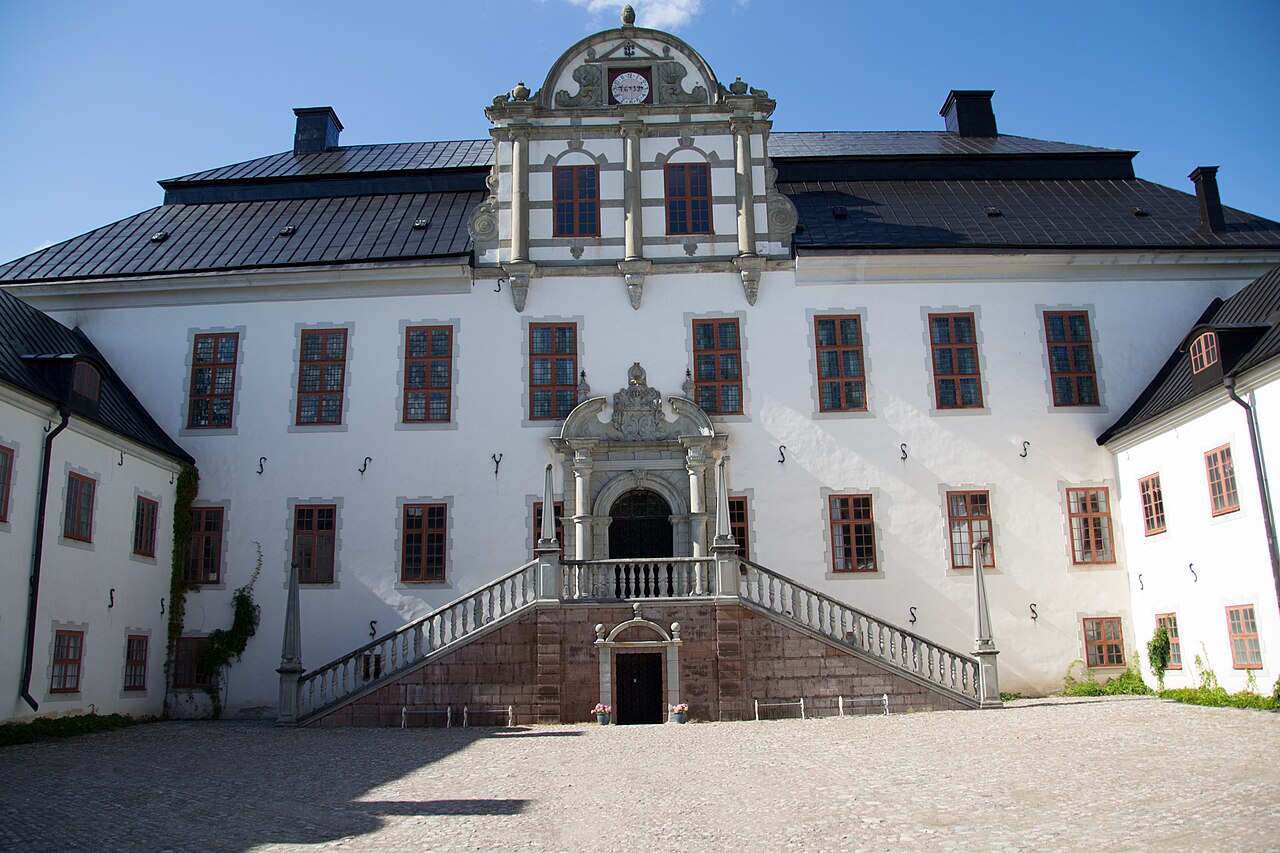
Photo by Alpstedt • CC BY-SA 3.0
Later history and cultural significance
After remaining in the Oxenstierna family for around two centuries, Tidö Castle was purchased in 1889 by the von Schinkel family, who continue to own it. In 1974, Carl-David von Schinkel established a toy museum within the castle, which later merged with another collection and relocated to Stockholm in 2017.
More recently, Tidö Castle gained political prominence as the site of negotiations following the 2022 Swedish general election. Leaders of four right-wing parties met at Tidö to form the Tidö Agreement, a coalition deal that led to the establishment of a center-right government in Sweden.
Remains of the medieval fortress
Several hundred meters from the current castle stand the remains of the original medieval stone house. Once a fortified square stone building with a stair tower and surrounded by moats, it was repurposed by the mid-17th century into a brewhouse and maltings. These ruins provide a tangible link to Tidö's medieval origins and the evolution of noble estates in Sweden.
Visiting tidö castle today
Tidö Castle remains a well-preserved example of 17th-century Swedish noble architecture, offering visitors a glimpse into the Renaissance and early Baroque period aristocratic life. The castle's vaulted entrance, courtyard, and richly decorated interiors showcase the craftsmanship and stylistic influences of the era. While the original toy museum has relocated, the castle and its grounds continue to attract visitors interested in history, architecture, and Swedish cultural heritage.
Frequently asked questions (FAQ)
- How do I visit Tidö Castle and what are the opening hours?
- Tidö Castle is open to visitors during the warmer months, typically from late spring to early autumn. It is best to check the official website or local tourist information for exact opening hours and guided tour availability.
- What architectural styles are represented at Tidö Castle?
- Tidö Castle primarily features late Renaissance and early Baroque architectural styles, with Dutch Renaissance influences. The castle's design includes elements by architects Simon de la Vallée and Nicodemus Tessin the Elder.
- Can I see the medieval ruins near Tidö Castle?
- Yes, visitors can view the remains of the original medieval stone house, known as Oldenburg, located a few hundred meters from the present castle. These ruins offer insight into the estate's medieval origins.
- What is the historical significance of Tidö Castle?
- Tidö Castle has been a noble residence since the 15th century, rebuilt in the 17th century by Axel Oxenstierna. It also played a role in modern Swedish politics as the site of the Tidö Agreement in 2022.
- Is there a museum inside Tidö Castle?
- Tidö Castle housed a toy museum established in 1974 by Carl-David von Schinkel, but the collection moved to Stockholm in 2017. The castle still features historical interiors and exhibitions.
Photo gallery

Information
Loading map...
Visitor reviews
No reviews yet. Be the first to share your experience!