
Szamotuły
Szamotuły castle stands as a remarkable example of a bastioned fortress in Poland, with its origins tracing back to the early 13th century. The castle's history is deeply intertwined with the development of the town of Szamotuły and the noble families who shaped its architectural evolution over centuries. Its well-preserved structures reflect a blend of medieval defensive design and later Renaissance and Baroque residential modifications, making it a significant cultural and historical landmark.
The early origins and medieval foundation
The beginnings of Szamotuły date to the 11th century when a conical gord known as Osówka existed about one kilometer south of the current market square. The first recorded mention of the settlement, later called Stare Szamotuły, appears in 1231, identifying it as the property of the knightly Nałęcz family. By 1352, ownership passed to Dzierzykraj Świdwa, who likely initiated the town's location under Magdeburg law between 1383 and 1393, formalizing its municipal status.
Historical records from 1381 mention a defensive residence of the Świdwa family located south of the newly established town, on the site of today's Church of the Holy Cross. Archaeological research has confirmed that the church was constructed using the walls of this 14th-century castle, with only minor additions such as the presbytery built later. This early castle featured a regular layout with an internal stone residential building, reflecting typical medieval fortification principles.
Construction of the main castle and architectural features
Around 1403, Szamotuły was divided between brothers Wincent and Dobrogost. Dobrogost, who adopted the surname Szamotulski, or his son Piotr, the general starost of Greater Poland, erected a brick castle in the northern part of the town. The centerpiece was a four-story defensive residential tower, constructed of brick on a rectangular plan measuring approximately 8.25 by 10.75 meters. The tower was reinforced with buttresses at the corners and featured a dual-pitched roof with gables.
The lower floors served residential purposes, while the uppermost floor functioned as storage and a guard post. This highest level was slightly overhanging, equipped with machicolations—openings that allowed defenders to shoot or drop projectiles on attackers below. Access between floors was provided by a wooden gallery attached to the tower's northern wall. The eastern side of the tower included a gatehouse with a separate pedestrian gate, and above the gate passage ran a vaulted gallery leading to the tower.
Additional structures included a single-story building with a large chimney adjacent to the northern castle wall, illuminated by large windows and accessed from the east. Another one-story building with a high gabled roof stood nearby, featuring five windows but only one main room. These buildings likely served domestic and service functions, forming a compact fortified complex.
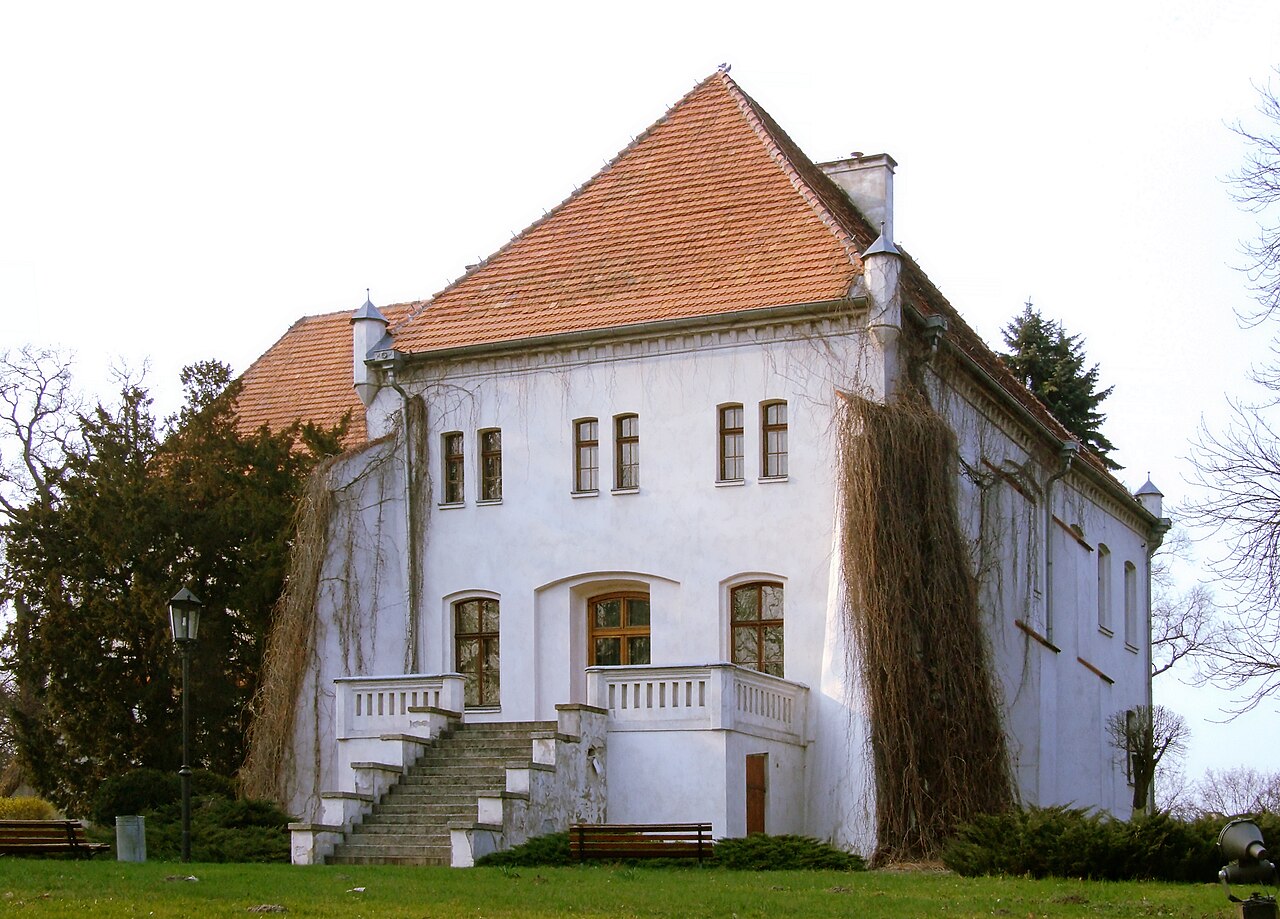
Photo by Roweromaniak • CC BY-SA 3.0
Renaissance expansions and enhancements
In 1499, Piotr Szamotulski's granddaughter, Katarzyna, brought half of Szamotuły as a dowry to her husband, Łukasz II Górka. Around 1518, the castle underwent significant reconstruction. The wooden gallery on the tower was replaced by a masonry circular staircase, and a buttress was added to the south side, creating a bay window overlooking the town on the third floor. The top floor was transformed into a representative hall, with machicolation openings sealed and larger windows installed. The interiors of the tower's other floors were richly decorated in Renaissance style.
Łukasz Górka's son, Andrzej Górka, continued the expansion under the supervision of Poznań master mason Jan Czetterwan. The building with the chimney was raised by an additional floor, housing residential chambers. A square annex was added on the west side, containing a treasury on the ground floor and a chapel above. To the north, a gallery with four large windows was constructed, while the south side featured a Renaissance gallery supported by buttresses. The ground-floor hall received a Renaissance vaulted ceiling supported by two pillars, and new ornate gables crowned the building.
The second building was also heightened, and a vaulted treasury was created beneath it, supported by a central pillar. These two buildings were connected by a new wing, with a cylindrical tower containing a staircase placed at its corner. A new gate with a drawbridge was built, possibly accompanied by two small towers near the gate and at the southeast corner, enhancing the castle's defensive and residential functions.
Baroque transformation and later history
Following the death of Łukasz III Górka in 1573, Szamotuły passed through several noble families, including the Gostyńskis and Rokossowskis, before being acquired by the Kostki family in 1631. In 1660, Jan Korzbok Łącki purchased the estate and transformed the castle into a Baroque residence, removing its defensive features. A connector was built between the two oldest parts of the castle, and the cylindrical staircase was replaced by Baroque stairs leading to a room with five windows and a polychrome ceiling.
The eastern wing's former treasury cellars were converted into storage for honey and wine, while the upper floor housed a grand dining hall, the most impressive room of the period. The northern wing featured the so-called marble room. The palace's entrance was relocated to the north side, facing the former gallery, creating a ceremonial courtyard surrounded by new service buildings. In 1675, Jan Korzbok Łącki donated the southern castle, formerly belonging to the Świdwa family, to the Franciscan Reformed Order, who built a Baroque church and monastery on the site.
19th and 20th-century modifications and current status
In 1719, Szamotuły was briefly owned by Władysław Kąsinowski before being sold to Anna Mielżyńska. The castle ceased to be a noble family seat and became a tenant's residence. In 1862, the estate was acquired by Prince Ernest of Saxe-Coburg and Gotha, who remodeled the residence in the popular Neo-Gothic style of the time. Interior layouts were adapted to suit the prince's status, incorporating Gothic revival elements.
After 1918, the property was taken over by the Polish State Treasury. During World War II, the former tower served as the headquarters of the Hitler Youth, and a new concrete staircase was installed. Post-war, the castle was repurposed as a school. In the 1970s, it became the seat of the Museum – Górka Castle, and extensive restoration work began, including partial regothicization of the palace.
Architectural highlights and cultural significance
Despite numerous modifications, Szamotuły castle remains a fascinating example of a knightly residence. The best-preserved and most notable feature is the 15th-century tower, known as the "Baszta Halszka" or "Baszta Czarnej Księżniczki" (Black Princess Tower). This tower is linked to a romantic legend involving Elżbieta Halszka, daughter of the voivode of Bracław, kniaz Eliasz Ostrogski, and Beata Kościelecka. According to the tale, Halszka was abducted and forcibly married, later confined in the tower for 14 years by her husband Łukasz III Górka. However, historical records indicate she frequently appeared alongside her husband at official events, suggesting the legend is more folklore than fact.
Today, the castle houses museum exhibitions showcasing 16th and 17th-century furnishings. Its medieval origins are evident in the preserved Gothic vaults of the cellars, the Renaissance beam ceiling, and fragments of Gothic and Renaissance polychromes. Visitors can also explore the former tower, gaining insight into the castle's defensive and residential past.
Frequently asked questions (FAQ)
- What is the historical significance of Szamotuły Castle?
- Szamotuły Castle, originally built in the 14th century, played a crucial role in the defensive architecture of the region. It served as a residence for Polish nobility and witnessed numerous historical events, reflecting the rich heritage of Poland. Today, it stands as a monument to the medieval era and attracts history enthusiasts from around the world.
- When was Szamotuły Castle built?
- The construction of Szamotuły Castle began in the 14th century, around 1340. It was completed in subsequent years and has undergone several renovations and expansions. The castle's architectural evolution showcases various styles and periods, making it a fascinating site for visitors.
- Can I visit Szamotuły Castle?
- Yes, Szamotuły Castle is open to visitors throughout the year. Guided tours are available, providing insights into its rich history and architectural features. It's advisable to check the castle's official website for any specific visiting conditions or events before planning your visit.
- What are the opening hours of Szamotuły Castle?
- Szamotuły Castle typically opens its doors to visitors from 10 AM to 6 PM, but hours may vary seasonally. It's best to confirm the exact timings on the official website or by contacting the castle administration for the most accurate information. This ensures you have ample time to explore its fascinating interiors.
- Is it possible to buy tickets online for Szamotuły Castle?
- Yes, tickets for Szamotuły Castle can often be purchased online, allowing for a smoother entry experience. Booking in advance is recommended, especially during peak tourist seasons, to secure your spot. Check the castle's official site for ticket prices and online purchase options.
- What is the best time to visit Szamotuły Castle?
- The best time to visit Szamotuły Castle is during the spring and early autumn months when the weather is pleasant and the gardens are in full bloom. These seasons also see fewer tourists, allowing for a more enjoyable experience. Additionally, special events and exhibitions may take place during these times.
- Are there any nearby attractions to visit while in Szamotuły?
- Yes, the area surrounding Szamotuły Castle is rich in attractions, including the picturesque town center of Szamotuły and the nearby Warta River. Visitors can also explore local parks and historical sites. This makes it easy to plan a full day of exploration and enjoyment.
- How accessible is Szamotuły Castle for visitors with disabilities?
- Szamotuły Castle strives to be accessible to all visitors, including those with disabilities. The site has made efforts to provide ramps and other accommodations to facilitate access. However, it's advisable to check ahead for specific accessibility features to ensure a comfortable visit.
Photo gallery

Information
Loading map...
Visitor reviews
No reviews yet. Be the first to share your experience!