Stobnica Castle
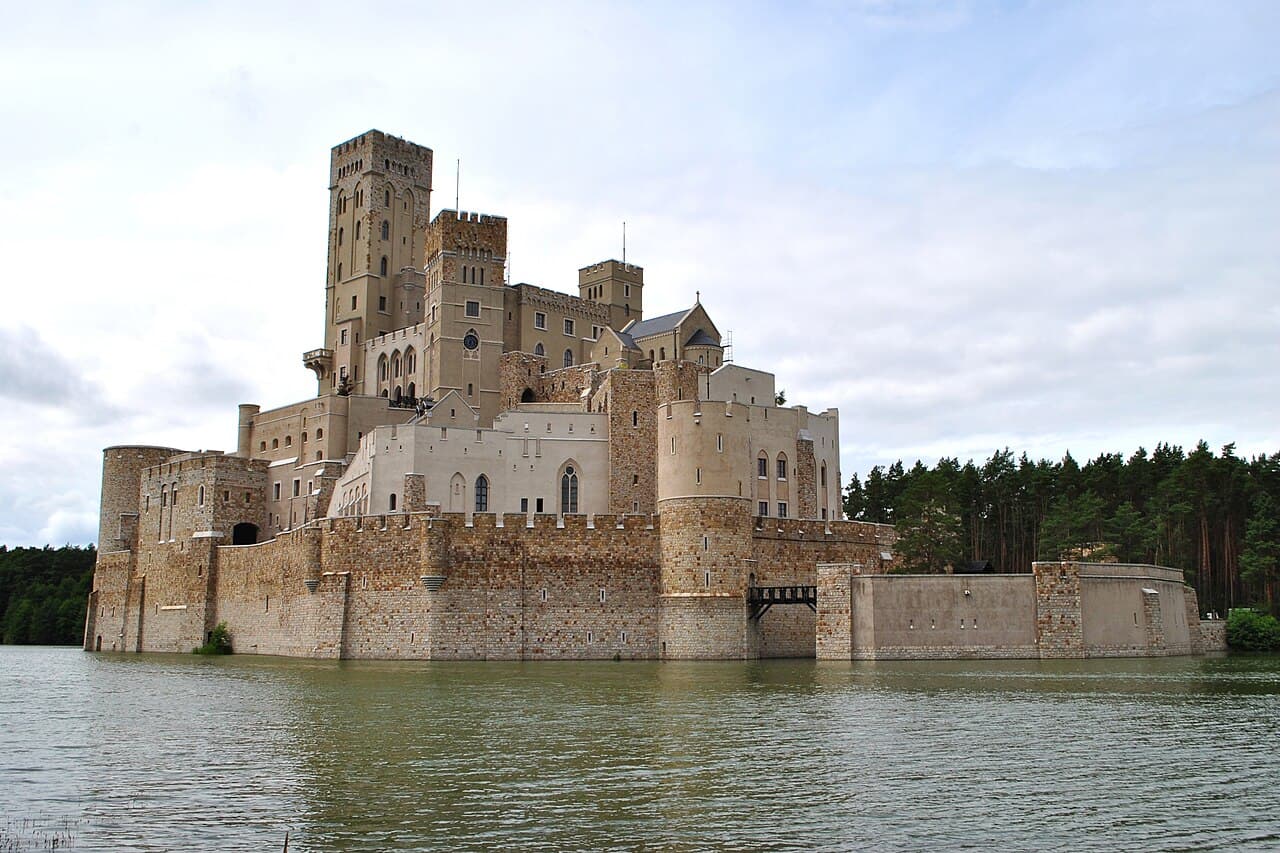
Stobnica Castle is a unique modern architectural project located near the village of Stobnica in Poland. Unlike traditional castles with centuries of medieval history, this castle is a contemporary creation designed to emulate the appearance and atmosphere of a medieval water castle. Its construction began in 2015, making it one of the most ambitious recent attempts to blend historical castle aesthetics with modern residential and commercial use.
Origins and concept
The castle was commissioned by the Poznań-based company D.J.T. and designed by architect Waldemar Szeszuła. The concept was to build a large-scale palace-castle complex on an artificial island within a series of interconnected ponds, imitating the defensive water moats typical of medieval fortresses. This approach sought to recreate the defensive and visual impact of a water castle, a type of fortress historically built on islands or surrounded by water for protection.
Spanning approximately 150 meters in length and 100 meters in width, the complex was planned to include up to fifteen floors with 46 private apartments designed to house nearly one hundred residents. In addition to residential spaces, the castle was intended to incorporate commercial shops, service areas, and technical facilities, blending living and working environments within a castle-inspired setting.
Architectural features and design
The centerpiece of Stobnica Castle is a tall tower rising about 50 meters, modeled after a foreburg—an outer defensive tower or outwork common in medieval castles to protect the main fortification. This tower provides a vertical emphasis and dominates the castle silhouette, echoing the imposing presence of historic fortresses.
The castle’s layout and architectural style are a contemporary interpretation of medieval Revivalism, combining traditional castle elements with modern construction techniques and materials. The use of Polish stone in the building process is highlighted along the educational trail surrounding the castle, emphasizing craftsmanship and regional building traditions.
Environmental and legal challenges
The castle’s location on the edge of the Noteć Forest, part of the Natura 2000 protected areas, has led to significant legal and administrative challenges. The building permit issued in 2015 was later found to be non-compliant with environmental regulations, as the local government did not have the authority to approve construction within this protected zone.
From 2018 onward, the project became embroiled in legal disputes, including police detentions of individuals associated with the construction. Regional authorities initially allowed the project to continue despite permit violations, which resulted in political repercussions such as the dismissal of the Greater Poland voivode Łukasz Mikołajczyk in 2020.
Subsequent court rulings have alternately invalidated and reinstated the building permit, with the Supreme Administrative Court ultimately rejecting appeals against the permit’s validity in 2025. Legal proceedings against individuals involved in the development have continued, reflecting ongoing oversight and controversy surrounding the project.
Current state and visitor experience
As of 2024, Stobnica Castle remains under construction, with key features such as the artificial island, foreburg-inspired tower, and residential units partially completed. The castle’s setting within a Natura 2000 protected area creates a distinctive ecological context, juxtaposing modern architectural ambition with environmental conservation concerns.
In 2023, a 2.2-kilometer educational trail was opened around the castle island, featuring informational boards about the local environment and the types of Polish stone used in the castle’s construction. The trail includes a stone mason’s workshop display and a heated wooden pavilion for hands-on learning, offering visitors insight into regional craftsmanship and natural heritage.
Significance and unique aspects
Stobnica Castle stands out as a rare example of a 21st-century Revivalist castle project that deliberately recreates medieval architectural forms on a large scale. Its combination of residential, commercial, and educational functions within a castle framework is unusual, reflecting modern reinterpretations of historic fortresses.
The project also highlights the tensions between development and environmental protection, illustrating the complexities of building in protected natural areas. The castle’s ongoing legal controversies and administrative challenges underscore the difficulties of balancing architectural innovation with regulatory compliance.
Despite these issues, the castle’s partial completion and the establishment of the educational trail provide a new cultural and tourist attraction in the region, inviting visitors to explore both architectural design and natural history.
Frequently asked questions (FAQ)
- How do I visit Stobnica Castle and its educational trail?
- Visitors can access the 2.2-kilometer educational trail around Stobnica Castle, which opened in 2023. While the castle itself is still under construction and not fully open to the public, the trail provides informative displays about the castle's architecture and local environment.
- What is the historical significance of Stobnica Castle?
- Stobnica Castle is a modern architectural project designed to replicate a medieval water castle. It represents a unique 21st-century Revivalist approach rather than a historic medieval fortress, blending residential and commercial uses with castle aesthetics.
- Why has Stobnica Castle faced legal challenges?
- The castle's location within the Natura 2000 protected area led to disputes over the validity of its building permit. Legal and administrative issues arose because the local government lacked authority to approve construction in this environmentally protected zone, resulting in ongoing court cases and political consequences.
- What architectural style characterizes Stobnica Castle?
- Stobnica Castle is designed in a <strong>Romantic Neo-Gothic Revival</strong> style, combining medieval castle elements with modern construction. Its tall foreburg-inspired tower and water-surrounded layout evoke traditional Gothic fortress features in a contemporary form.
- Is the castle accessible for visitors currently?
- As of 2024, the castle is still under construction and not fully accessible inside. However, the educational trail around the castle island is open to visitors, offering insights into the building materials, local nature, and regional craftsmanship.
Photo gallery

Information
Sources & official resources
Verify the information above using these authoritative references.
Loading map...
Visitor reviews
No reviews yet. Been here? Write the first review and help other travelers!
Write the first reviewVisited this castle? Share your experience
Your review helps other travelers and adds first-hand knowledge to our encyclopedia.