
Stary Książ Castle
Stary Książ Castle, located in the municipality of Wałbrzych, Poland, stands as a remarkable testament to the region's layered medieval and romantic architectural heritage. Originally established by medieval Slavic builders who fortified a strategic hill overlooking the Pełcznica River gorge, the site evolved through centuries of military and residential use. Its long history reflects the shifts in regional power, architectural styles, and cultural significance from the early Middle Ages to the modern era.
The earliest defensive structures at Stary Książ date back to the late 9th or early 10th century, marking it as one of the oldest fortified sites in the region. However, the castle as it is most notably recognized began construction in the late 13th century under Duke Bolko I, known as Bolko I the Strict, ruler of Jawor. Bolko I replaced earlier wooden and earthwork fortifications with a robust stone castle composed of three major sections: an upper stone stronghold and two bailey courtyards fortified by earth ramparts. Around 1290, Bolko I moved his residence here from Lwówek Śląski, elevating the castle to the status of a ducal seat and making it a center of regional authority and governance.
Medieval strategic importance and decline
During the 14th century, Stary Książ Castle played a significant role in the defense and administration of the Duchy of Jawor. However, its strategic importance diminished after the incorporation of the duchy of Świdnica-Jawor into the Bohemian Crown in 1392. The castle's military relevance further declined during the Hussite Wars, when it fell under Hussite control in 1428. Subsequently, the fortress became a stronghold for robber knights, who exploited its defensive advantages until its destruction in 1484. Following this event, the castle was abandoned and gradually fell into ruin by the early 16th century.
Ownership by the hochberg family and romantic revival
In 1509, ownership of the site passed to the Hochberg family, who retained the property for several centuries. The castle ruins remained largely neglected until the late 18th century, when a significant transformation was commissioned by Hans Heinrich VI von Hochberg. Between 1794 and 1797, the architect Christian Wilhelm Tischbein undertook an ambitious project to create romantic-style artificial ruins near the nearby Książ Castle. Tischbein's work reimagined the medieval remains as a picturesque backdrop designed to evoke a chivalric atmosphere, blending authentic Renaissance and Baroque architectural elements sourced from local sites such as the castle in Trzebień. This intervention altered the site's appearance so fundamentally that for a long time it was mistaken for entirely artificial ruins rather than a reconstructed medieval fortress.
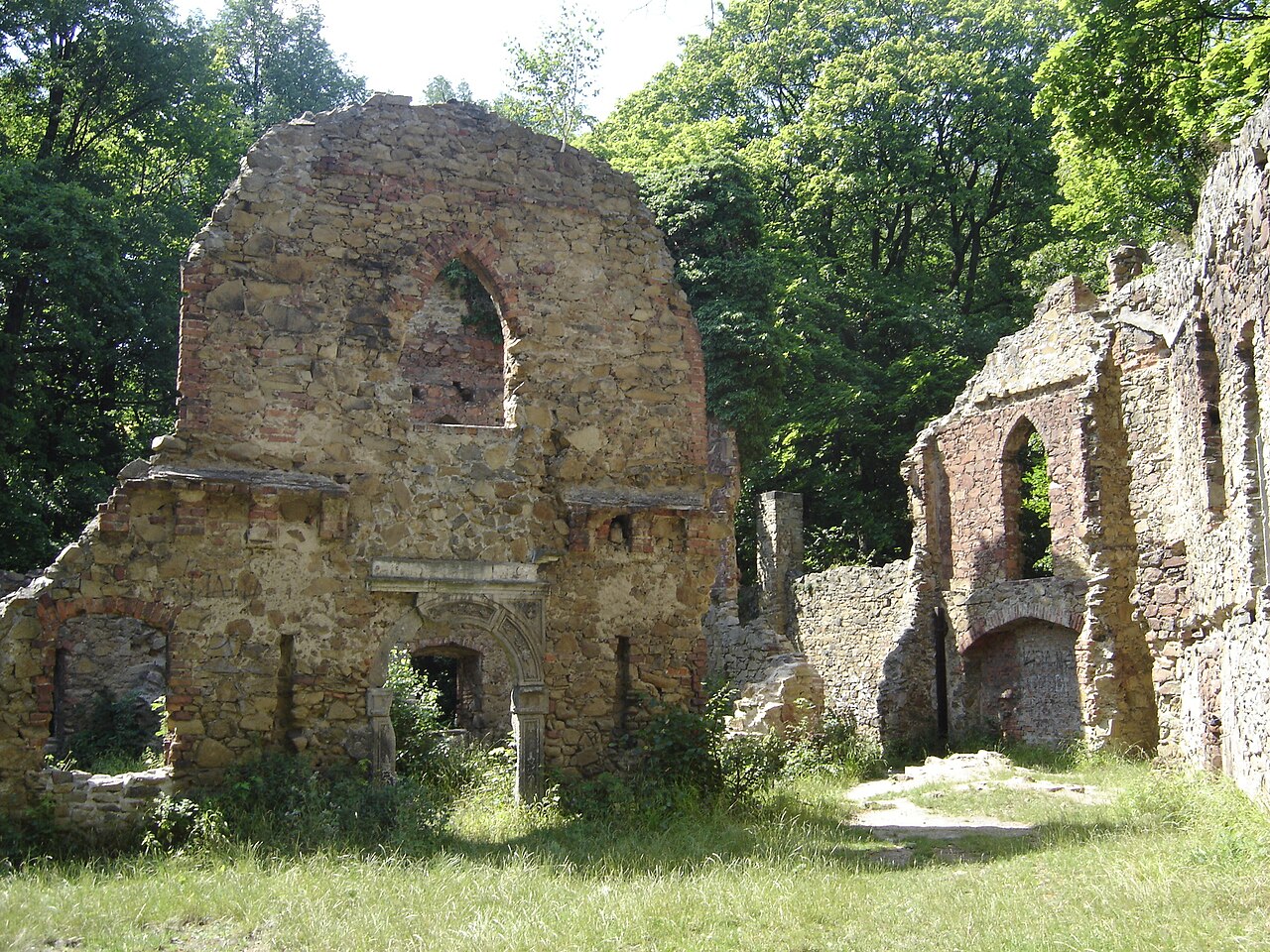
Photo by Lotharson • CC BY 3.0
Damage and preservation in the 20th century
During the summer of 1945, the castle suffered significant damage when Soviet troops set fire to the site. Despite this destruction, parts of Tischbein's late 18th-century reconstruction remain visible today, alongside fragments of the original medieval castle structures. These surviving elements provide valuable insights into the site's complex history and architectural evolution.
Architectural features and layout
Medieval castle design
The medieval castle was laid out in a distinctive triangular shape, incorporating the main castle and two triangular bailey courtyards arranged westward in sequence. A notable defensive feature was a rock-cut moat separating the first bailey from the upper castle; this moat measured approximately 20 meters in width and 4.5 meters in depth, providing a formidable barrier against attackers. Archaeological excavations within the first bailey have revealed the foundations of a building constructed from stone and clay along the inner defensive perimeter, likely part of the castle's internal support structures.
Castle structures and functions
The main castle building, connected to a tower, originally housed a variety of specialized rooms including a representative hall, armory, bedrooms, a courtroom, a prison with an adjoining torture chamber, and a chapel. Beneath the chapel lies a medieval dungeon, connected to the main structure by a series of cloisters. This complex layout highlights the castle's multifunctional role as a residence, judicial center, and place of detention.
Romantic-era reconstruction features
The late 18th-century renovation introduced an eclectic romantic ruin style to the site. The reconstructed ruins were enclosed by a moat and defensive wall and featured an entrance gate flanked by two small towers. This renovation incorporated numerous authentic Renaissance and Baroque architectural elements sourced from nearby castles and local sites, blending historical authenticity with romantic imagination. These additions partially concealed the medieval origins of the castle, leading to historical confusion about its authenticity.
Current condition and surviving elements
Today, the castle ruins preserve a complex stratification of architectural history. Surviving details include two Renaissance portals embedded in the remaining walls and fragments of an old gallery wall extending toward the chapel. Only the chapel's walls and remnants of its adjoining tower persist from the original medieval structure. The ruins lack ceilings, and only parts of the original medieval tower remain standing. Together, these elements offer a tangible connection to the site's multifaceted past, encompassing medieval fortification, Renaissance artistry, and 18th-century romantic reconstruction.
Cultural and historical significance
Stary Książ Castle is a unique cultural landmark that illustrates the evolution of castle architecture and regional history in southwestern Poland. Its combination of authentic medieval remains and romantic-era reconstruction reflects changing attitudes toward heritage and the romanticization of the medieval past during the late 18th century. The castle's layered history makes it an important site for understanding the political and social transformations of Silesia from the Middle Ages through the modern period.
Visitors to Stary Książ Castle can explore the evocative ruins that tell stories of ducal power, military conflict, noble residence, and artistic revival. The site remains a compelling destination for those interested in medieval architecture, romantic historicism, and the complex narratives embedded in Poland's castle heritage.
Frequently asked questions (FAQ)
- When was Stary Książ Castle originally built?
- The earliest fortifications at Stary Książ Castle date back to the late 9th or early 10th century, with the stone castle construction beginning in the late 13th century under Duke Bolko I.
- What architectural styles are visible at Stary Książ Castle?
- The castle features medieval stone fortifications from the 13th century and romantic-style artificial ruins from the late 18th century, incorporating Renaissance and Baroque elements.
- Can visitors see the medieval dungeon at Stary Książ Castle?
- Yes, the medieval dungeon beneath the chapel is part of the ruins and connected by cloisters, offering insight into the castle's multifunctional role.
- Why was the castle transformed into romantic ruins in the 18th century?
- Hans Heinrich VI von Hochberg commissioned the transformation to create a picturesque backdrop evoking chivalric atmosphere, blending authentic historic elements with romantic imagination.
- What damage did the castle sustain during World War II?
- In the summer of 1945, Soviet troops set fire to the castle, causing significant damage, though parts of the 18th-century reconstruction and medieval structures remain visible.
Photo gallery

Information
Architect
Christian Wilhelm Tischbein
Loading map...
Visitor reviews
No reviews yet. Be the first to share your experience!