
Östanå Castle
Östanå Castle (Swedish: Östanå slott) is a historic manor located in Åkersberga, within the Österåker Municipality of Stockholm County, Sweden. The castle commands a strategic position overlooking the main shipping channel into Stockholm through the Stockholm archipelago. Adjacent to the castle lies the ferry port of Östanå, providing connections to the island of Ljusterö, emphasizing the estate's long-standing importance in regional transport and defense.
Early history and noble ownership
The Östanå estate is first recorded in 1433, when it was owned by Anders Isaksson Baner. Throughout the following centuries, the estate was held by prominent Swedish noble families, including the Fleming and Wrede families, reflecting its status as a significant aristocratic residence. By 1687, the property was under the ownership of Fabian Wrede, a notable figure in Swedish nobility.
Destruction and rebuilding after the Great Northern War
The original manor house was a wooden structure dating from the 1680s. This building was destroyed in 1719 during the Russian Pillage (also known as the Russian raids during the Great Northern War), when the Russian army conducted extensive coastal raids on Sweden. The burning of the manor was part of a broader campaign that devastated many coastal estates and towns.
Following this destruction, the estate remained without its main residence for several decades until the current manor house was constructed between 1791 and 1794. This new building was commissioned by Simon Bernhard Hebbe, who designed the manor in a style characteristic of the late 18th century, reflecting the post-Renaissance architectural trends prevalent in Sweden at the time.
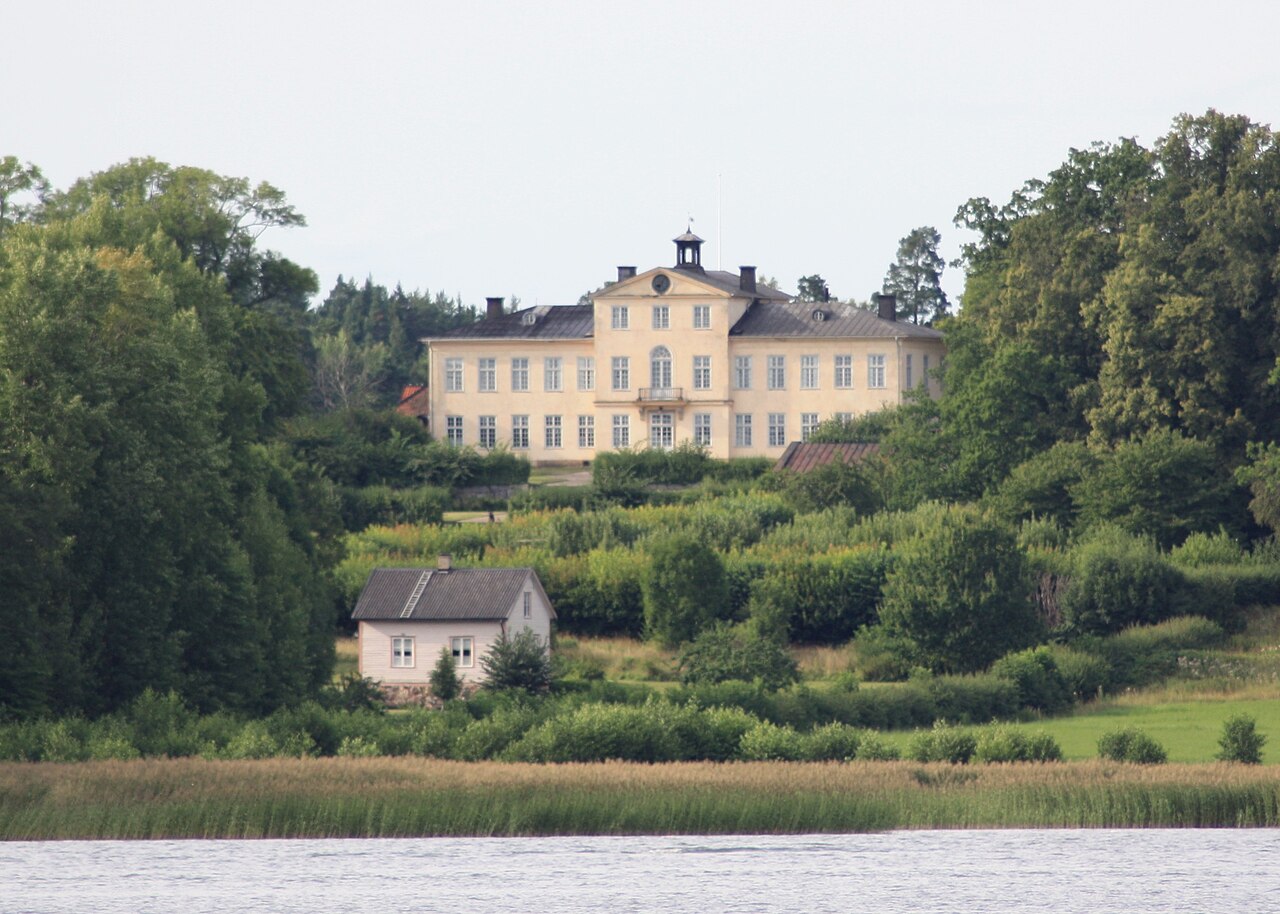
Photo by Janders • Public domain
Architectural features and style
The present manor house of Östanå Castle is a hill castle type, situated on elevated terrain that provides commanding views of the surrounding waterways. The building exemplifies the post-Renaissance style, characterized by a balanced and symmetrical facade, restrained classical details, and an emphasis on elegant proportions rather than the defensive features typical of medieval castles.
While the castle no longer serves a military function, its location and design continue to underscore its historic role as a noble residence overseeing vital maritime routes. The manor includes formal reception rooms, private chambers, and service areas arranged to suit aristocratic life in the late 18th and 19th centuries.
Notable residents and later history
In the late 19th century, Östanå Castle was the residence of Erik Gustaf Boström, who served as the Prime Minister of Sweden. His tenure at the castle marks a significant chapter in its history, linking the estate to Sweden's political developments during that period.
The Boström family maintained ownership of the castle until 2006, when it was sold. By 2016, the property had fallen into a poor state of repair, reflecting the challenges of maintaining historic estates in the modern era. At that time, it was listed for sale with an asking price of 35 million kronor.
Geographical and cultural significance
Östanå Castle's location near the main shipping channel into Stockholm highlights its historical importance in controlling and overseeing maritime traffic through the archipelago. The proximity to the ferry port connecting to Ljusterö continues to make the site a focal point for transport and tourism in the region.
The castle remains a symbol of Sweden's noble heritage and architectural evolution from the late 17th century through the post-Renaissance period. Its history encapsulates themes of war, reconstruction, aristocratic life, and political significance, making it a noteworthy subject for historical and architectural study.
Visiting and preservation status
As of the last decade, Östanå Castle has not been fully restored and remains in a state requiring significant renovation. Its preservation status reflects the broader challenges faced by many historic estates in Sweden and Europe, balancing heritage conservation with modern use and economic viability.
Visitors to the region can appreciate the castle's exterior and its commanding views over the archipelago, although public access to the interior may be limited depending on ownership and restoration progress.
Frequently asked questions (FAQ)
- When was Östanå Castle originally built and who commissioned the current manor house?
- The original wooden manor was built in the 1680s but was destroyed in 1719 during the Russian Pillage. The current manor house was constructed between 1791 and 1794, commissioned by Simon Bernhard Hebbe.
- What is the architectural style of Östanå Castle?
- Östanå Castle is built in the post-Renaissance style, featuring a balanced and symmetrical facade with classical details typical of late 18th-century Swedish manor houses.
- Who were some notable owners of Östanå Castle?
- Notable owners include Anders Isaksson Baner, the Fleming and Wrede families, and Erik Gustaf Boström, who was Prime Minister of Sweden in the late 19th century.
- Is Östanå Castle open to the public?
- As of recent years, the castle is in a poor state of repair and may have limited public access. Visitors can view the exterior and surrounding landscape, but interior access depends on current ownership and restoration status.
- Where is Östanå Castle located and what is its geographical significance?
- Östanå Castle is located in Åkersberga, Stockholm County, overlooking the main shipping channel into Stockholm through the archipelago. It is near the ferry port to Ljusterö, highlighting its historical role in maritime navigation and defense.
Photo gallery

Photo by Janders•Public domain
Information
Loading map...
Visitor reviews
No reviews yet. Be the first to share your experience!