
São Jorge Castle
São Jorge Castle, also known as the Castle of Saint George, is a prominent historic fortress located on a commanding hilltop in the heart of Lisbon, Portugal. Overlooking the city and the Tagus River, this castle has a rich history that spans several millennia, reflecting the diverse cultures and rulers that have shaped Lisbon. It is one of the city's most iconic landmarks and a major tourist attraction, offering visitors both a glimpse into Portugal's medieval past and breathtaking panoramic views.
The site of São Jorge Castle has been occupied since at least the 8th century BC, with archaeological evidence revealing human presence in the Tagus valley dating back to the 6th century BC. Before the castle's construction, the hill was used by indigenous Celtic tribes and later by Phoenicians, Greeks, and Carthaginians as a strategic outpost. The earliest fortifications were established by the Romans in the 2nd century BC, when Lisbon was known as Olisipo and later classified as a Roman municipality in 48 BC.
Early fortifications and Moorish period
Following the Roman era, the site came under the control of the Suebi and Visigoths. In the early Middle Ages, particularly during the 10th century, Muslim Berber forces fortified the hilltop, constructing the Cerca Moura, or "Moorish Encirclement," a defensive wall that formed the core of the castle's early fortifications. This Moorish fortification likely included walls and towers that took advantage of the hill's natural defensive features.
The Christian reconquest and medieval royal palace
In 1147, during the Christian Reconquista, Portuguese forces led by Afonso Henriques, the first King of Portugal, captured the castle and the city of Lisbon from the Moors after a lengthy siege. This victory was notably aided by northern European crusaders en route to the Holy Land during the Second Crusade. According to legend, the knight Martim Moniz sacrificed himself by blocking a castle door to prevent the Moors from closing it, allowing Christian forces to enter.
After the conquest, the castle became a royal residence and military stronghold. When Lisbon was declared the capital of Portugal in 1255, the castle's defenses were significantly enhanced under the reigns of Kings Afonso III and Denis I. Around 1300, King Denis I transformed the Moorish alcáçova into a royal palace, adding residential quarters and fortifications. The castle complex included 11 towers, two parade grounds, a barbican, a dry moat, and an outer castle area housing a royal palace, a bishop's palace, and a chapel.
The Cerca Fernandina walls
Between 1373 and 1375, King Ferdinand I commissioned the construction of the Cerca Fernandina, a vast new walled enclosure that encircled Lisbon and incorporated São Jorge Castle. This wall, built by master builders João Fernandes and Vasco Brás, featured 77 towers and numerous gates, spanning approximately 5,400 meters. It replaced older Moorish walls and greatly expanded the city's defenses.
Dedication to Saint George and cultural significance
In the late 14th century, King John I dedicated the castle to Saint George, the warrior saint popular in both Portugal and England, reflecting his marriage to Philippa of Lancaster. The castle housed important kingdom records in the Torre do Tombo (Tower of the Archive) and served as a royal residence and administrative center. The castle also hosted a royal menagerie in the early 15th century, including Barbary lions brought from Ceuta.
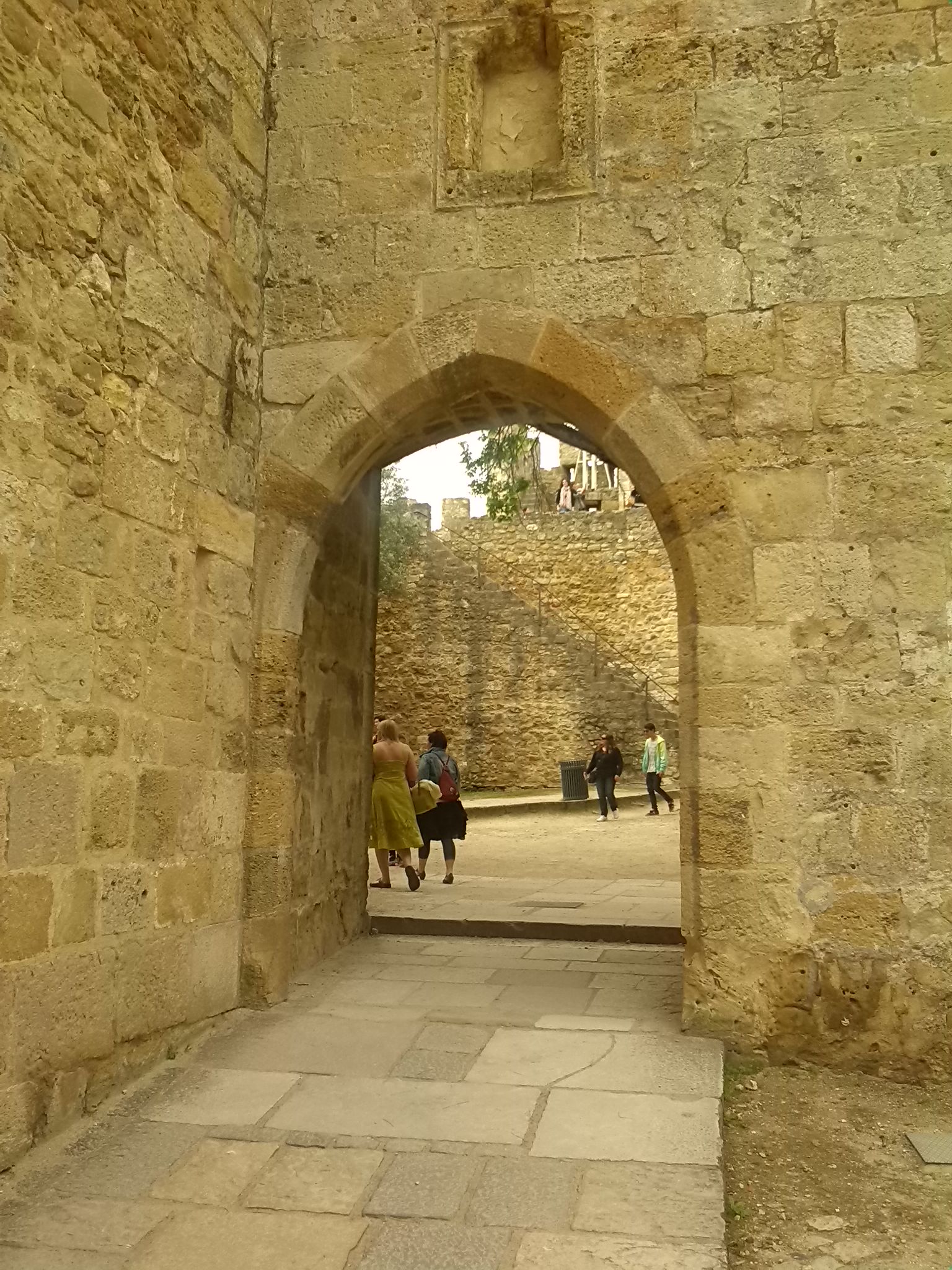
Photo by Mecanismo • CC BY-SA 3.0
Later history and decline
By the early 16th century, the construction of the Ribeira Palace shifted royal residence away from São Jorge Castle, leading to a gradual decline in its importance. The castle suffered damage in the 1531 earthquake and was partially rebuilt under King Sebastian in 1569, but his untimely death halted further renovations. Following the Portuguese dynastic crisis, the castle was converted into military barracks, a hospital, and a prison during the period of Spanish rule (1580–1640).
After Portugal regained independence, restoration and fortification efforts resumed under architects Nicolau de Langres and Mateus do Couto, continuing into the 18th century. The castle remained a military garrison and also hosted the Casa Pia charitable institution from 1780 to 1807. In 1788, Portugal's first geodetic observatory was established atop the Torre do Observatório within the castle.
Impact of the 1755 earthquake and modern restoration
The devastating 1755 Lisbon earthquake caused severe damage to São Jorge Castle, destroying many buildings and leaving the site in ruins. Despite this, the castle continued to serve military functions until the mid-20th century. Extensive restorations were undertaken in the 20th century, particularly during the government of António de Oliveira Salazar, which removed later incongruous structures and partially restored medieval features.
Today, São Jorge Castle is well-preserved as a historic monument and tourist attraction. Visitors can explore the castle's walls, towers, and courtyards, including the Praça d'Armas square with its cannons and a bronze statue of Afonso Henriques. The castle's battlements and towers offer spectacular views over Lisbon's historic districts, the Tagus River, and beyond. The Torre de Ulisses features a camera obscura projecting a 360-degree panorama of the city.
Architectural features and layout
The castle occupies Lisbon's highest hill and has a roughly square plan. Its main castle, or castelejo, is situated at the northwest corner, the highest point of the citadel. The complex includes gardens, ancillary buildings, and a large terraced square. Defensive features include a barbican on the southern and eastern sides designed to prevent siege engines from approaching the walls, as well as a partially dry moat and a stone bridge leading to the main entrance.
The castle's walls and towers have been rebuilt and heightened during 20th-century restorations, which shaped much of its current medieval appearance. The long curtain wall extends downhill on the west side, ending at the Torre de São Lourenço, a tower that guarded a gate in the Cerca Fernandina walls.
Visiting São Jorge Castle
São Jorge Castle is open to the public for a fee and is one of Lisbon's most visited historic sites. Due to its popularity, the castle can be crowded, especially during peak tourist seasons. While the castle's interior is relatively sparse, the site offers a rich historical experience and some of the best viewpoints in Lisbon. The surrounding Alfama district, with its narrow streets and traditional cafes, adds to the visitor experience.
The castle is accessible via ancient stone walls and paths that wind through the historic neighborhoods. Nearby attractions include the Lisbon Cathedral (Sé de Lisboa) and other historic sites within walking distance.
Frequently asked questions (FAQ)
- What is the historical significance of São Jorge Castle?
- São Jorge Castle, also known as Castelo de São Jorge, is a historic fortress that dates back to the medieval period. It played a crucial role in the defense of Lisbon and has witnessed many significant events in Portuguese history, including the Reconquista and the establishment of the city.
- When was São Jorge Castle built?
- Construction of São Jorge Castle began in the 11th century during the Moorish period and continued into the 12th century after the Christian conquest. Its strategic location on a hilltop made it an essential site for military defense and surveillance over the Tagus River.
- What are the opening hours for São Jorge Castle?
- São Jorge Castle is typically open to visitors from 9 AM to 6 PM, with extended hours during the summer months. It's advisable to check the official website for any seasonal changes or special events that may affect visiting times.
- Can I buy tickets online for São Jorge Castle?
- Yes, tickets for São Jorge Castle can be purchased online through the official website. This allows visitors to skip long lines at the entrance and gain immediate access to the castle's stunning views and historical exhibitions.
- Is São Jorge Castle accessible for visitors with disabilities?
- São Jorge Castle has made efforts to improve accessibility for all visitors, including ramps and designated paths. However, due to the castle's historic nature and hilly terrain, some areas may still pose challenges for those with mobility impairments.
- What is the best time to visit São Jorge Castle?
- The best time to visit São Jorge Castle is during the spring and fall months when the weather is mild, and crowds are smaller. Early mornings or late afternoons are particularly pleasant for enjoying the views and exploring the grounds.
- What nearby attractions can I visit after São Jorge Castle?
- After visiting São Jorge Castle, you can explore the charming Alfama district, known for its narrow streets and traditional Fado music. Additionally, the Lisbon Cathedral and the National Pantheon are just a short walk away, making for a delightful day of sightseeing.
- How much do tickets cost for São Jorge Castle?
- As of now, tickets for São Jorge Castle are priced at approximately €10 for adults, with discounts available for seniors and children. Family tickets and guided tours may also be available at different rates, so it’s a good idea to check for current pricing before your visit.
Photo gallery

Photo by Desiree M


Information
Loading map...
Visitor reviews
No reviews yet. Be the first to share your experience!