
Sölvesborg Castle Ruins
Sölvesborg Castle ruins stand as a significant medieval fortress located in Sölvesborg, Blekinge, Sweden. Established in the 13th century during Danish rule, this hill castle was strategically positioned between a natural ridge and the bay, controlling the vital connection between the Danish provinces of Skåne and Blekinge. Its imposing remains, including a large round defensive tower, reflect its historical importance in regional power struggles and military conflicts.
Historical background and political significance
The castle's origins trace back to the early 1200s when Danish builders constructed the fortress to assert control over the borderlands. In 1263, Valdemar Braunschweig was the lord of Blekinge and Sölvesborg, marking the castle's early role as a noble seat. Throughout the 14th century, the fortress witnessed fluctuating control: seized by Swedish forces in 1332, then reclaimed by King Valdemar III of Denmark in 1359. This tug-of-war highlights the castle's strategic value in the Danish-Swedish border region.
In the early 15th century, the castle gained prominence as a royal residence for notable monarchs such as Queen Margrethe I and King Erik of Pomerania. It hosted a significant meeting of Danish and Swedish councilors in 1402, underscoring its political importance. The fortress also became embroiled in regional conflicts, including the 1436 uprising led by Engelbrekt Engelbrektsson, during which it changed hands multiple times.
Military conflicts and decline
The castle endured numerous sieges and was occasionally pawned due to financial pressures. During the Northern Seven Years' War (1563–1570), a pivotal event occurred in 1564 when the Danish lensman Verner Parsberg set fire to the castle while retreating from advancing Swedish troops. Subsequently, the Swedish army plundered and further destroyed the fortress. This marked the beginning of its permanent decline as a military stronghold.
Despite its military downfall, the castle continued serving as an administrative center for the Sølvesborg len, a territorial division responsible for tax collection under the Danish-Norwegian crown until 1662. Swedish forces occupied and reinforced the castle and town harbor in 1645 to solidify their control. The final Danish official, Niels Krabbe, formally transferred the castle to Sweden in 1658, ending Danish administration.
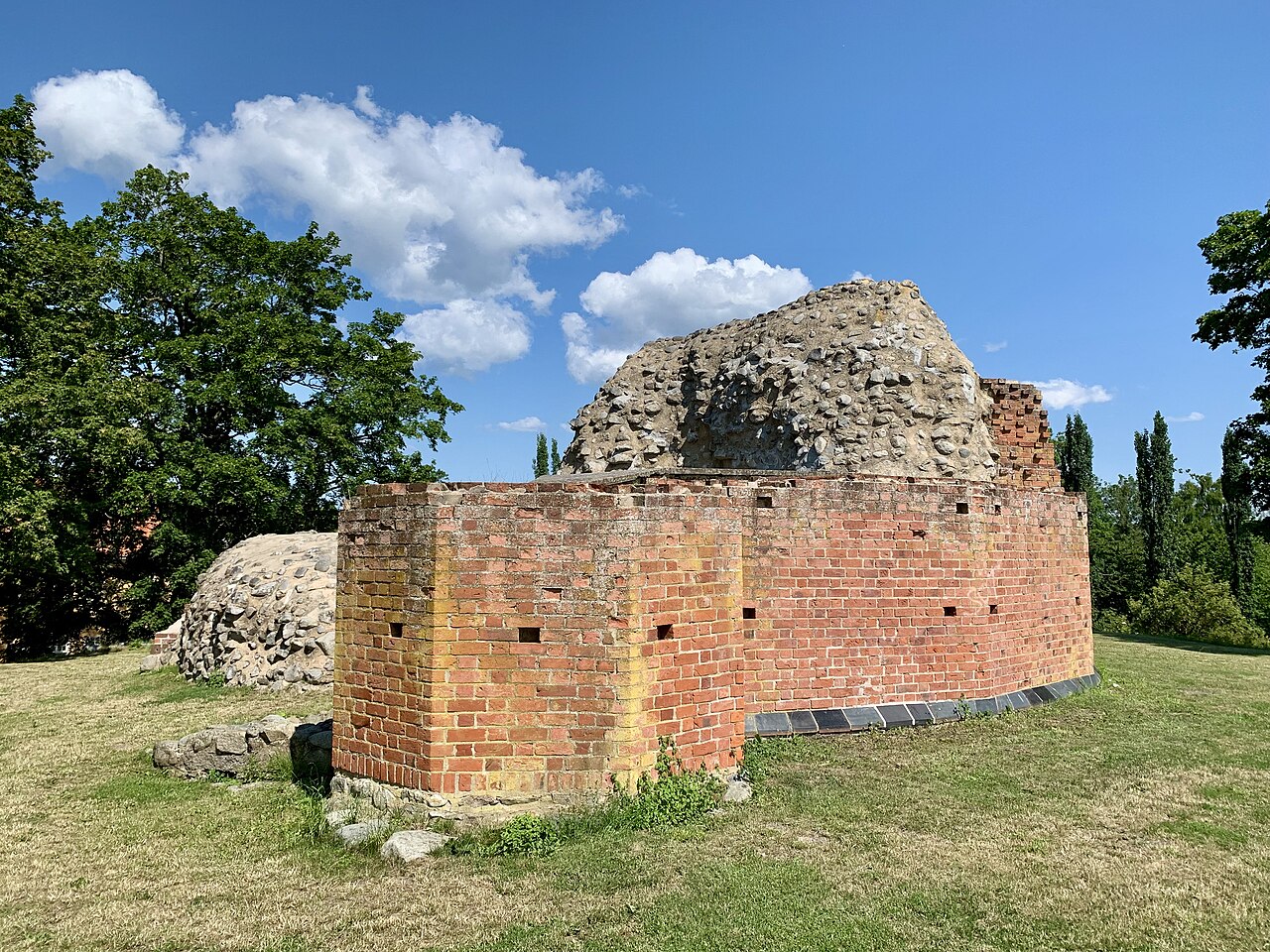
Photo by Orf3us • CC BY-SA 4.0
Architectural features and construction techniques
The ruins reveal a complex layout centered around a raised mound artificially elevated by approximately three meters during the castle's final construction phase. Atop this mound stands the remains of a large, round defensive tower approximately 17 meters in diameter. The tower's walls are exceptionally thick, reaching up to 5.5 meters, constructed using the "skalmursteknik" method. This technique involves two outer brick shells filled with a mortar and large stone mixture, creating a robust and resilient structure.
Architecturally, the tower's lower section likely formed a sixteen-sided polygon transitioning to an octagonal shape in its upper part. Inside, floors were connected by a projecting stair tower, facilitating vertical movement. The tower ruins currently rise to about eleven meters, although much of the original brickwork has been removed over time due to quarrying.
Beneath the tower lies a deep cellar room, preserved relatively intact. Local legend claims that this cellar once hid treasure buried by the famed admiral Søren Norby, though archaeological excavations found no evidence to support this. Surrounding the main fortress, a wide moat approximately 15 meters across provided an additional defensive barrier. To the west, a medieval outer bailey contained farm buildings and stables essential for the castle's operation.
Archaeological excavations and preservation efforts
In the 18th century, parts of the castle and its prominent tower were dismantled for building materials, despite protective laws enacted in 1816. Archaeological excavations conducted between 1940 and 1942 under intendant Lars Göran Kindström uncovered multiple construction phases and structural details, enriching the understanding of the fortress's development.
Today, the ruins include the castle courtyard and adjacent structures, marking the footprint of the medieval fortress. The site also preserves Blekinge's largest copper beech tree, notable for its impressive circumference of 430 centimeters, adding a natural monument to the cultural landscape.
The castle's role in regional trade and legacy
Sölvesborg Castle controlled a bay that served as a crucial medieval landing area facilitating border trade between Danish Blekinge and Swedish Småland. This strategic location enhanced its military and economic significance throughout the Middle Ages. Although the castle fell into ruin after the 16th century, its remains continue to offer valuable insights into medieval fortification techniques and Scandinavian history.
In the 19th century, a manor house known as Corps de logi was constructed on the site, reflecting the continued use of the location beyond its military past. The castle ruins remain a protected cultural heritage site, attracting visitors interested in medieval architecture and Nordic history.
Frequently asked questions (FAQ)
- How do I get to Sölvesborg Castle ruins?
- Sölvesborg Castle ruins are located in the town of Sölvesborg in Blekinge, Sweden. They can be reached by car or local public transport, with signage directing visitors to the site near the town center.
- What is the best time to visit Sölvesborg Castle ruins?
- The best time to visit is during the late spring to early autumn months when the weather is mild and the surrounding park is lush. The site is open year-round but may be less accessible in winter due to weather conditions.
- Can I explore the castle ruins freely?
- Yes, visitors can freely explore the castle ruins and the surrounding park. However, some areas may be restricted for safety reasons. Informational signs provide historical context throughout the site.
- Is there an entrance fee to visit Sölvesborg Castle ruins?
- Visiting the Sölvesborg Castle ruins is free of charge, making it accessible to all visitors interested in medieval history and architecture.
- What architectural features are notable at Sölvesborg Castle ruins?
- The most notable feature is the large round defensive tower with thick walls built using the skalmursteknik technique. The moat and outer bailey remains also highlight the castle's defensive design.
- Are there guided tours available at Sölvesborg Castle ruins?
- Guided tours may be available seasonally or by arrangement through the Municipality of Sölvesborg. Visitors should check local tourism resources for current offerings.
Photo gallery

Information
Current owner
Municipality of Sölvesborg
Loading map...
Visitor reviews
No reviews yet. Be the first to share your experience!