
Søborg Castle Ruins
Søborg Castle, located south of Gilleleje in North Zealand, Denmark, stands as a significant medieval fortress whose ruins reflect a rich history of military strength and royal intrigue. Established in the 12th century, Søborg was one of the strongest castles in Denmark and served multiple roles including a defensive stronghold, a royal residence, and a prison for high-profile captives.
The castle's strategic position on an island in a fjord connected to the Kattegat Sea provided natural defenses enhanced by man-made fortifications. Over time, the fjord was drained, transforming the landscape and leaving Søborg Castle surrounded by land rather than water. Despite its ruinous state today, the castle's remains reveal important insights into medieval Danish architecture and the evolution of fortification techniques.
Medieval origins and historical significance
The earliest known records of Søborg Castle date back to the 12th century, when it was transferred from the Danish king to the bishop of Roskilde. Traditionally, Archbishop Eskil of Lund has been credited with expanding earlier structures into a fully fortified castle featuring defensive walls and a moat. However, archaeological evidence suggests that the main castle buildings, including the palace, were constructed later, in the late 13th century, after Eskil's death in 1181.
The castle played a prominent role throughout the High Medieval period, serving as a royal prison for notable figures such as Bishop Valdemar (imprisoned 1198–1206), Valdemar IV, Duke of Schleswig (1285–86), and Archbishop Jens Grand. It was also the birthplace of Queen Margaret I in 1353, born while her mother was detained at Søborg by King Valdemar IV, underscoring its importance in Danish royal history.
The count's feud and decline
Søborg Castle was inhabited and operational until the turbulent Count's Feud (Grevens Fejde) of 1534–35, a civil war that led to its destruction. By 1577, the castle had fallen into ruin, and permission was granted to the local feudal tenant to quarry stone from the site, accelerating its physical decline.
Architectural features and archaeological findings
The castle's fortifications included a broad earthen rampart approximately 11 meters wide, which encircled the site and provided a formidable defensive barrier. Alongside the rampart stood an octagonal brick tower, a distinctive feature built during the same early phase of construction. The use of brick was innovative for Denmark at the time, introduced from Lombardy in northern Italy. The bricks found at Søborg are irregular in shape and size, reflecting the early stage of brick production in the region.
The octagonal tower likely served as a key defensive stronghold within the castle complex, while the main palace or palatium, constructed in the late 13th century, functioned as the residential and administrative center. This palace was built after the tower and ramparts, indicating a phased development of the castle's layout.
The castle's defensive system was closely integrated with its natural environment. Originally situated on an island surrounded by a moat connected to a fjord, Søborg's location maximized its defensive capabilities. The fjord, later known as Søborg Sø, was drained between 1872 and 1896, significantly altering the castle's setting.
Construction materials and techniques
Søborg Castle's brickwork is notable for its early Danish style, with bricks smaller and more uneven than those seen in contemporary sites such as Ringsted and Sorø. This points to the novelty of brick construction in Denmark during the late 12th and 13th centuries. The tiles and bricks found at the site provide valuable evidence of the transfer of building technology from Lombardy to Scandinavia.
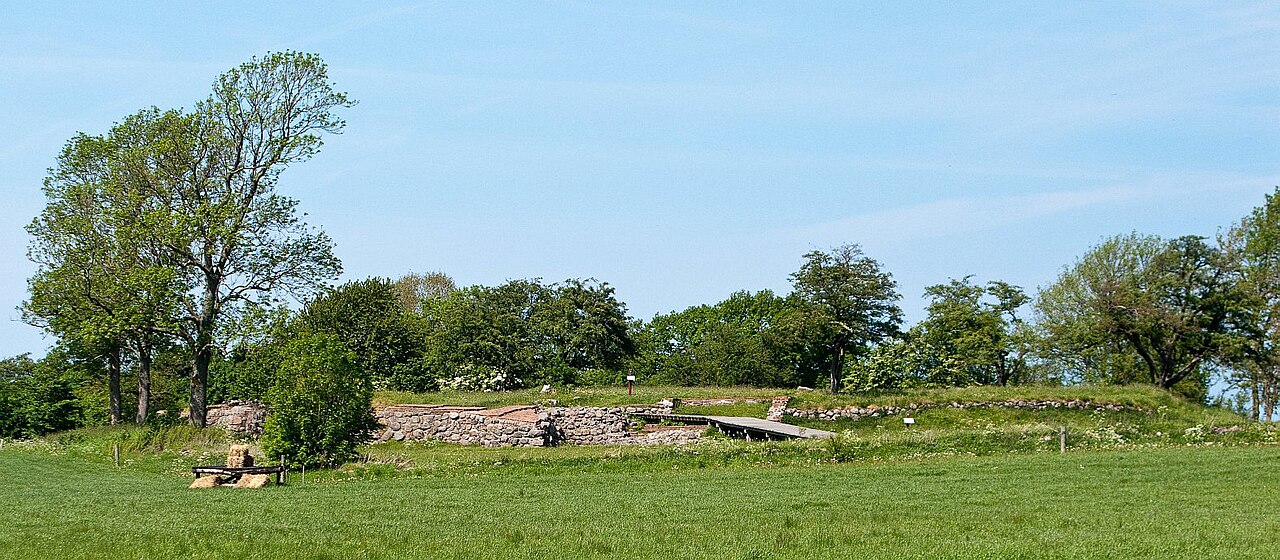
Photo by Knud Winckelmann • CC BY-SA 3.0
Associated structures and local context
Near the castle, Søborg Church was established around 1180, serving the religious needs of the castle's community and the emerging market town of Søborgby. The church remains an important historical feature, illustrating the close relationship between ecclesiastical institutions and fortified sites in medieval Denmark.
The castle's location near Gilleleje, a town on the Kattegat coast, placed it within a network of important medieval trade and military routes. Its position allowed control over access to the sea and surrounding lands, enhancing its strategic and economic significance.
Modern archaeological investigations
In 1985, archaeologists Robert Egevang and Søren Frandsen conducted trench excavations to clarify the relationship between the octagonal tower and the main castle structures. Their work confirmed the early date of the ramparts and tower and helped establish the timeline for the castle's development, distinguishing the phases of construction and usage.
These excavations have contributed significantly to understanding the architectural evolution of Søborg Castle and its role in Danish medieval history. The findings also highlight the castle's importance as an early adopter of brick construction in Denmark.
Current condition and visitor information
Today, Søborg Castle stands as ruins, with remnants of its walls, ramparts, and the octagonal tower visible to visitors. The site offers a glimpse into medieval fortification techniques and the historical landscape of North Zealand. While much of the castle has been lost to time and quarrying, the ruins remain a valuable cultural heritage site.
Visitors to Søborg Castle can explore the grounds and appreciate the castle's historical significance within the context of Danish medieval architecture and history. The surrounding landscape, once dominated by water defenses, now presents a contrasting environment shaped by centuries of human activity.
Frequently asked questions (FAQ)
- When was Søborg Castle built and who was responsible for its construction?
- Søborg Castle dates back to the 12th century, with the main palace constructed in the late 13th century. While Archbishop Eskil of Lund is traditionally credited with early expansions, archaeological evidence suggests later construction phases.
- What role did Søborg Castle play during the Middle Ages?
- Søborg Castle served as one of Denmark's strongest fortresses, a royal prison for notable figures, and the birthplace of Queen Margaret I, highlighting its political and strategic importance.
- Why is the octagonal tower at Søborg Castle significant?
- The octagonal tower is a distinctive early brick structure reflecting the introduction of brick building techniques from Lombardy to Denmark, marking an important architectural development.
- What happened to Søborg Castle during the Count's Feud?
- The castle was inhabited until the Count's Feud in 1534–35, during which it was destroyed. Subsequently, the ruins were used as a quarry, accelerating the castle's decline.
- Is it possible to visit Søborg Castle ruins today?
- Yes, visitors can explore the ruins of Søborg Castle, which remain visible and offer insights into medieval fortifications and Danish history, although facilities and detailed visitor services are limited.
Photo gallery

Information
Website
Visit websiteLoading map...
Visitor reviews
No reviews yet. Be the first to share your experience!