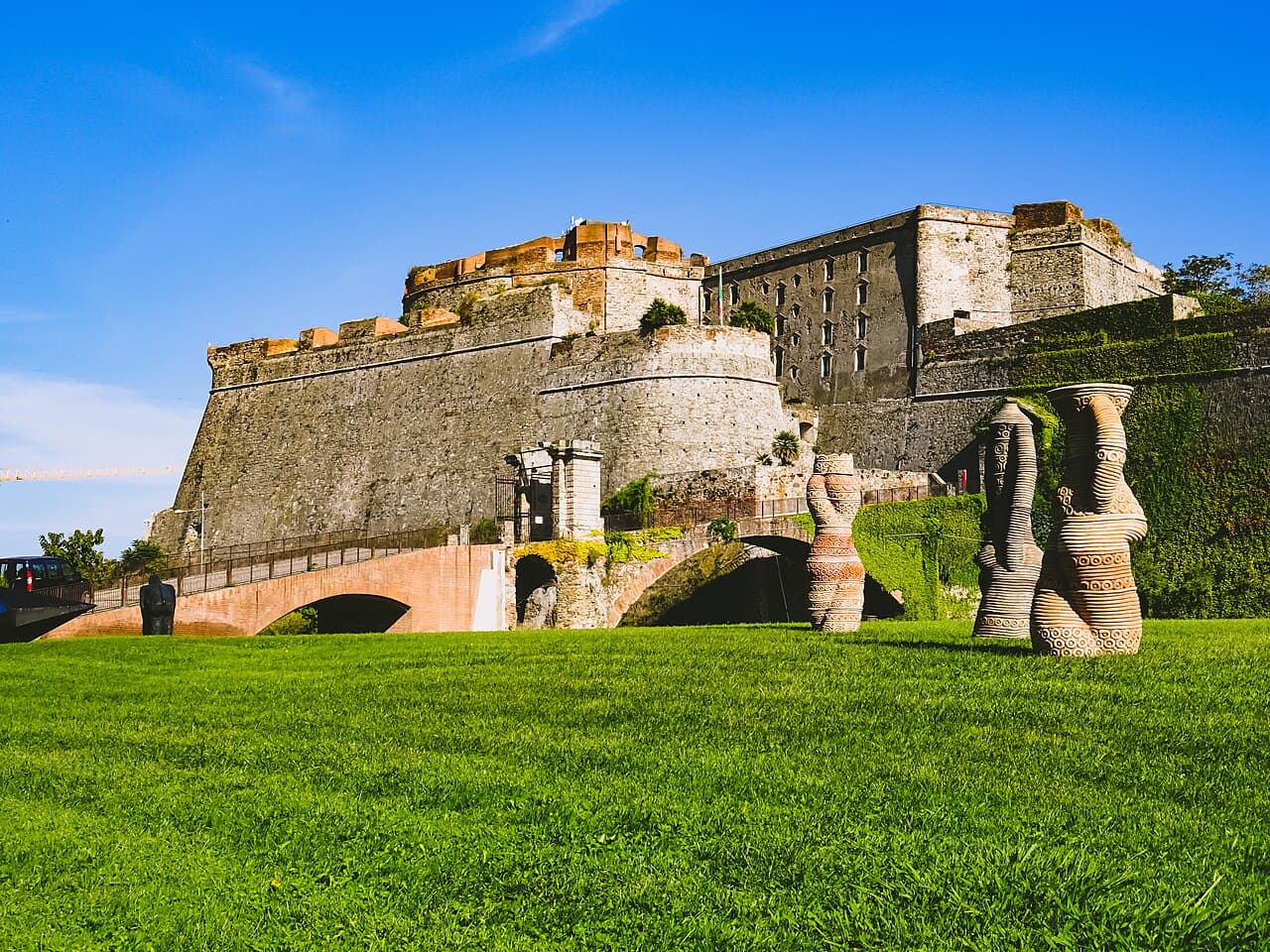
Priamar Fortress
Priamar Fortress stands prominently on the hill of the same name overlooking the port city of Savona in the Liguria region of northern Italy. Constructed in 1542 by the Republic of Genoa, this Renaissance bastioned fortress was designed by the architect Giovanni Maria Olgiati to serve as a strategic military stronghold controlling access to the Ligurian coast. The fortress occupies a site of great historical significance, where archaeological excavations have uncovered traces of pre-Roman, Roman, and Byzantine settlements, reflecting the area's long-standing importance as a cultural and commercial hub.
Historical background and construction
The location of Priamar Fortress was originally the core of medieval Savona, but the construction of the fortress involved the demolition of many medieval structures, including the city’s cathedral, which itself had been built in the 9th century atop a pagan temple. The fortress was part of the Republic of Genoa’s efforts to consolidate control over its territories and protect against rival powers in the region. The initial design by Olgiati focused on a compact, defensible structure suitable for the coastal terrain.
Expansion and fortification enhancements
During the 17th century, the fortress underwent significant modifications with the addition of bastions designed by the Spanish Royal engineer Domenico Sirena. These bastions enhanced the fortress’s defensive capabilities, reflecting advances in military architecture that emphasized angled walls and artillery placements to better withstand cannon fire. The 18th century saw further expansions with the construction of several palatial buildings within the fortress complex, including the commissar's palace, officers' palace, and the Sibilla palace. These additions transformed the fortress from a purely military installation into a more complex administrative and residential center.
Role in military conflicts and prison use
Priamar Fortress played a notable role during the War of Austrian Succession in 1746, when it was stormed by Piedmontese grenadiers, highlighting its strategic importance in regional conflicts. Following the annexation of Liguria to Piedmont in 1820, the fortress was repurposed as a prison. It became one of Italy’s main military prisons, capable of housing up to 500 prisoners. Among its most famous inmates was the Italian patriot Giuseppe Mazzini, who was imprisoned there during the Risorgimento, the movement for Italian unification.
Later history and current status
Priamar Fortress remained a key military prison until 1903, when its function was transferred to the castle of Gaeta. Today, the fortress is recognized for its architectural and historical significance, with parts of the structure preserved as a cultural monument. The archaeological finds from the site, including artifacts from the pre-Roman and Roman periods, are exhibited in the Savona Archaeological Museum, providing visitors with insight into the long history of human settlement on the Priamar hill.
Architectural features and layout
The fortress exemplifies Renaissance military architecture with its bastioned design, which was state-of-the-art in the 16th and 17th centuries. The bastions allowed defenders to cover all approaches with overlapping fields of fire, a significant improvement over earlier medieval fortifications. The complex includes thick curtain walls, defensive towers, and a series of palatial buildings that served administrative and residential purposes. The layout was carefully planned to integrate the natural topography of the hill, maximizing defensive advantages.
Archaeological significance
Excavations at the Priamar site have revealed layers of occupation dating back to pre-Roman times, including Roman and Byzantine remains. These findings demonstrate the strategic importance of the location through various historical epochs. The archaeological museum in Savona houses many of these artifacts, which include pottery, coins, and structural remnants that shed light on the ancient urban fabric that once existed beneath the fortress.
Visiting Priamar Fortress today
Visitors to Priamar Fortress can explore its extensive fortifications and palaces, gaining an understanding of Renaissance military engineering and the fortress’s role in Italian history. The site offers panoramic views over the Ligurian Sea and the city of Savona, making it a popular destination for history enthusiasts and tourists alike. The fortress’s preservation as a cultural landmark ensures that its historical narratives and architectural grandeur continue to be accessible to the public.
Frequently asked questions (FAQ)
- What is the historical significance of Priamar Fortress?
- Priamar Fortress, located in Savona, Italy, is a remarkable example of military architecture from the Renaissance period. Built in the 16th century, it played a crucial role in the defense of the city against naval invasions and reflects the strategic importance of Savona during that era.
- When was Priamar Fortress constructed?
- The construction of Priamar Fortress began in 1542 and was completed in 1640. The fortress was designed to protect the city of Savona and to serve as a stronghold against attacks, showcasing the military engineering of its time.
- Can I visit Priamar Fortress?
- Yes, visitors can explore Priamar Fortress and its surrounding grounds. The fortress is open to the public, allowing guests to appreciate its historical architecture and enjoy panoramic views of the city and the sea.
- What are the opening hours for Priamar Fortress?
- Priamar Fortress is typically open to visitors from Tuesday to Sunday, with varying hours depending on the season. It’s best to check the official website or local tourism information for the most current opening times before planning your visit.
- Is it possible to access Priamar Fortress with a wheelchair?
- Yes, Priamar Fortress is accessible for visitors with mobility challenges. While some areas may have uneven surfaces, efforts have been made to accommodate all guests to ensure an enjoyable experience.
- What are the ticket prices for visiting Priamar Fortress?
- Ticket prices for Priamar Fortress are generally quite affordable, with discounts available for students, seniors, and children. It's advisable to check for any special events or exhibitions that may affect pricing during your visit.
- When is the best time to visit Priamar Fortress?
- The best time to visit Priamar Fortress is during the spring and early autumn months when the weather is mild and pleasant. These seasons also offer fewer crowds, allowing for a more enjoyable and relaxed experience while exploring the fortress.
- What nearby attractions can I visit after Priamar Fortress?
- After visiting Priamar Fortress, you can explore the beautiful beaches of Savona, the historic city center, or the nearby Priamar Beach. Additionally, there are several charming restaurants and cafes where you can enjoy local Italian cuisine.
Photo gallery

Information
Loading map...
Visitor reviews
No reviews yet. Been here? Write the first review and help other travelers!
Write the first reviewVisited this castle? Share your experience
Your review helps other travelers and adds first-hand knowledge to our encyclopedia.


