
Ängsö Castle
Ängsö Castle stands as a significant historical monument near Västerås, Sweden, reflecting a complex evolution from a medieval fortress to a refined noble residence and now a public museum. Its origins trace back to the late 12th century when it was first mentioned as "Engsev" in a royal charter by King Canute I of Sweden (r. 1167–1196), who inherited the property from his father, Eric IX of Sweden.
Originally under the ownership of Riseberga Abbey until 1272, the estate transitioned into noble hands when Gregers Birgersson took possession. The castle's most transformative period began in the 1480s under the direction of Bengt Fadersson Sparre, a member of the Swedish council of nobles (riksråd), who constructed the fortress in stone and brick, establishing the core structure that endures today. This late medieval fortress was designed for defense, with thick walls and a compact, cubic form rising four stories high.
Medieval origins and strategic importance
The castle's strategic role was underscored during the Swedish War of Liberation, when Knut Bengtsson Sparre, son of Bengt Fadersson, sided with Christian II of Denmark against the Swedish rebellion. In 1522, the castle was besieged and captured by King Gustav Vasa's forces, marking a pivotal moment in Swedish history. Despite this, ownership was restored to the Sparre lineage through Knut's daughter, Hillevi Knutsdotter, in 1538, who brought the estate into the Trolle family by marriage.
Architectural evolution from fortress to noble residence
While the castle's lower levels preserve the original medieval masonry, the building underwent significant modifications in the 17th and 18th centuries. The 1630s saw expansions and interior redecorations that softened the fortress's military character, adapting it for residential use. The most notable architectural transformation occurred between 1740 and 1741 under the guidance of architect Carl Hårleman, a leading figure in Swedish Baroque architecture. He added the fourth story and a distinctive mansard roof topped with a lantern, enhancing both the castle's silhouette and natural lighting.
Additional 18th-century enhancements included the construction of two wings facing the gardens and a new two-story building, reflecting the era's emphasis on comfort and aesthetic appeal rather than defense. The castle's interiors retain several rooms with original 18th-century decorative schemes, offering insight into the period's aristocratic tastes.
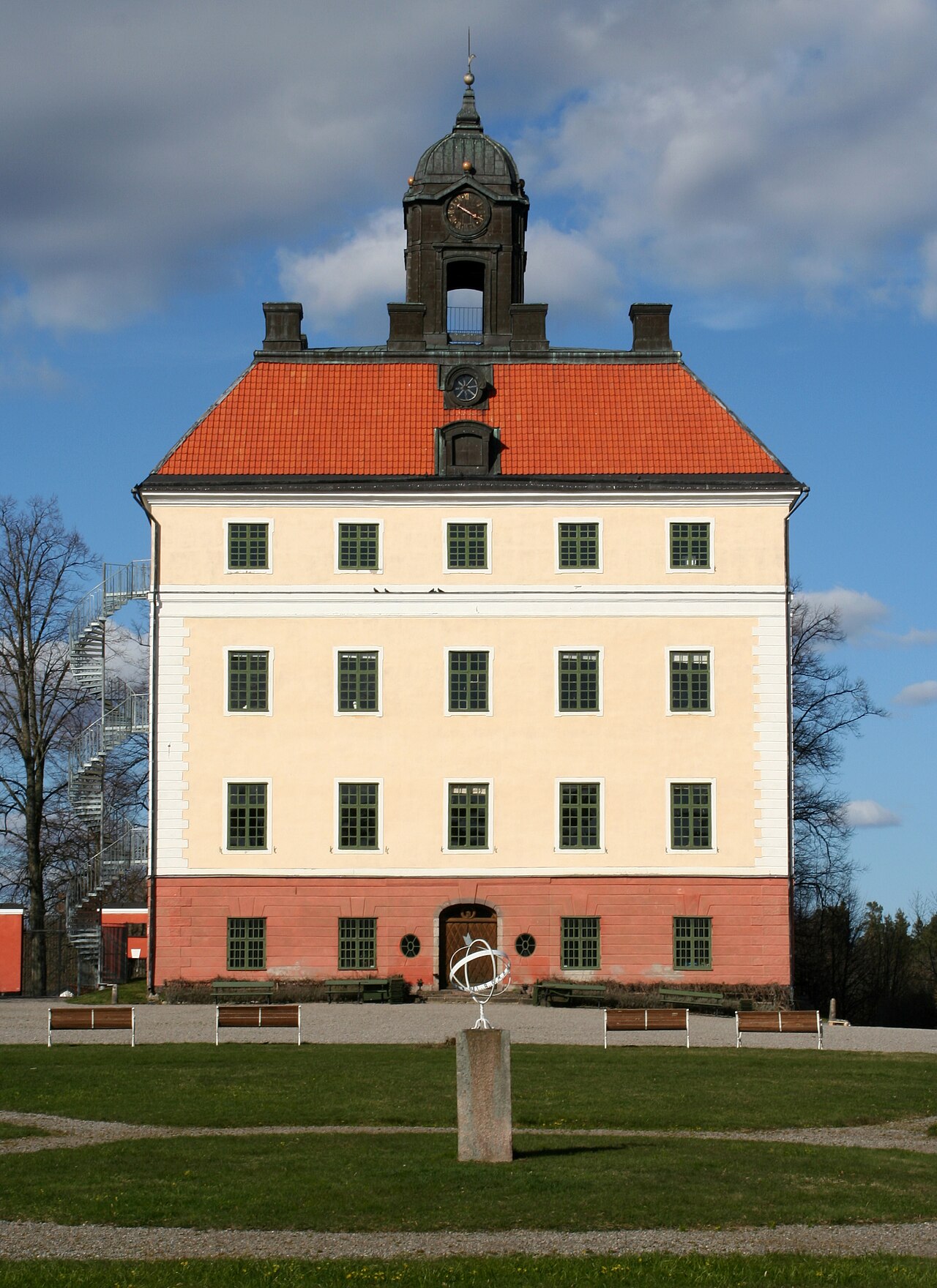
Photo by User Tor Svensson • CC BY-SA 3.0
Ownership and cultural significance
From 1475 until 1710, the castle remained in the hands of the Sparre family, after which it was acquired by Carl Piper and Christina Piper in 1710. The Piper family held the estate as a fideicommissum until 1971, preserving the property intact through generations. The last fideicommissary died in 1968, though the family continued to lease and inhabit the castle into the 21st century.
In 1959, Ängsö Castle was converted into a museum, opening its doors to the public and marking a shift toward preservation and education. It was officially listed as a protected building in 1965, recognizing its architectural and historical value. Ownership transferred to the Westmannastiftelsen foundation in 2010, ensuring ongoing conservation efforts.
Architectural features and surroundings
The castle's cubical form with four stories is built primarily of stone and brick, with the lower sections dating back to the original late medieval fortress. The mansard roof with a lantern is a characteristic feature added in the 18th century. The estate is surrounded by an extensive park that includes a notable collection of portraits depicting Swedish nobility, emphasizing the castle's long-standing aristocratic connections.
Inside, visitors can find artifacts such as a gold chain linked to local legends and the "blood stone" embedded in the nearby churchyard wall, both tied to the castle's folklore. These elements contribute to the castle's cultural aura and have inspired ghost stories and paranormal investigations, including a feature on the television program "Det okända" in 2007.
Public access and preservation status
Today, Ängsö Castle is well preserved and operates as a museum, welcoming visitors during the summer months. Its layered history is visible in the architecture, from the medieval defensive core to the 18th-century Baroque enhancements. The castle offers a tangible connection to Sweden's noble past and architectural heritage.
Visitors can explore the castle's interior rooms, the surrounding park, and learn about the families who shaped its history. The castle's status as a listed building ensures its protection and maintenance for future generations.
Frequently asked questions (FAQ)
- When was Ängsö Castle originally built?
- Ängsö Castle was originally constructed as a fortress in the 1480s by Bengt Fadersson Sparre, with lower parts of the building dating back to this period.
- What architectural styles are represented in Ängsö Castle?
- The castle features a combination of late medieval fortress architecture in its lower sections and 18th-century Baroque style enhancements, including a mansard roof designed by Carl Hårleman.
- Can I visit Ängsö Castle year-round?
- No, Ängsö Castle is typically open to visitors during the summer months, from June to August, with daily visiting hours usually between 10:00 and 17:00.
- Who owns Ängsö Castle today?
- The castle is currently owned and managed by the Westmannastiftelsen foundation, which oversees its preservation and public access.
- Are there any ghost stories associated with Ängsö Castle?
- Yes, the castle is linked to several local ghost stories, including tales about former inhabitants such as Brita Bååt and Anders Luxemburg, and has been featured in paranormal investigations.
Photo gallery

Information
Opening hours
Open to visitors during summer months, generally June to August, daily 10:00-17:00
Ticket prices
Varies by season, typically around 100 SEK for adults
Current owner
Westmannastiftelsen foundation
Website
Visit websiteLoading map...
Visitor reviews
No reviews yet. Be the first to share your experience!