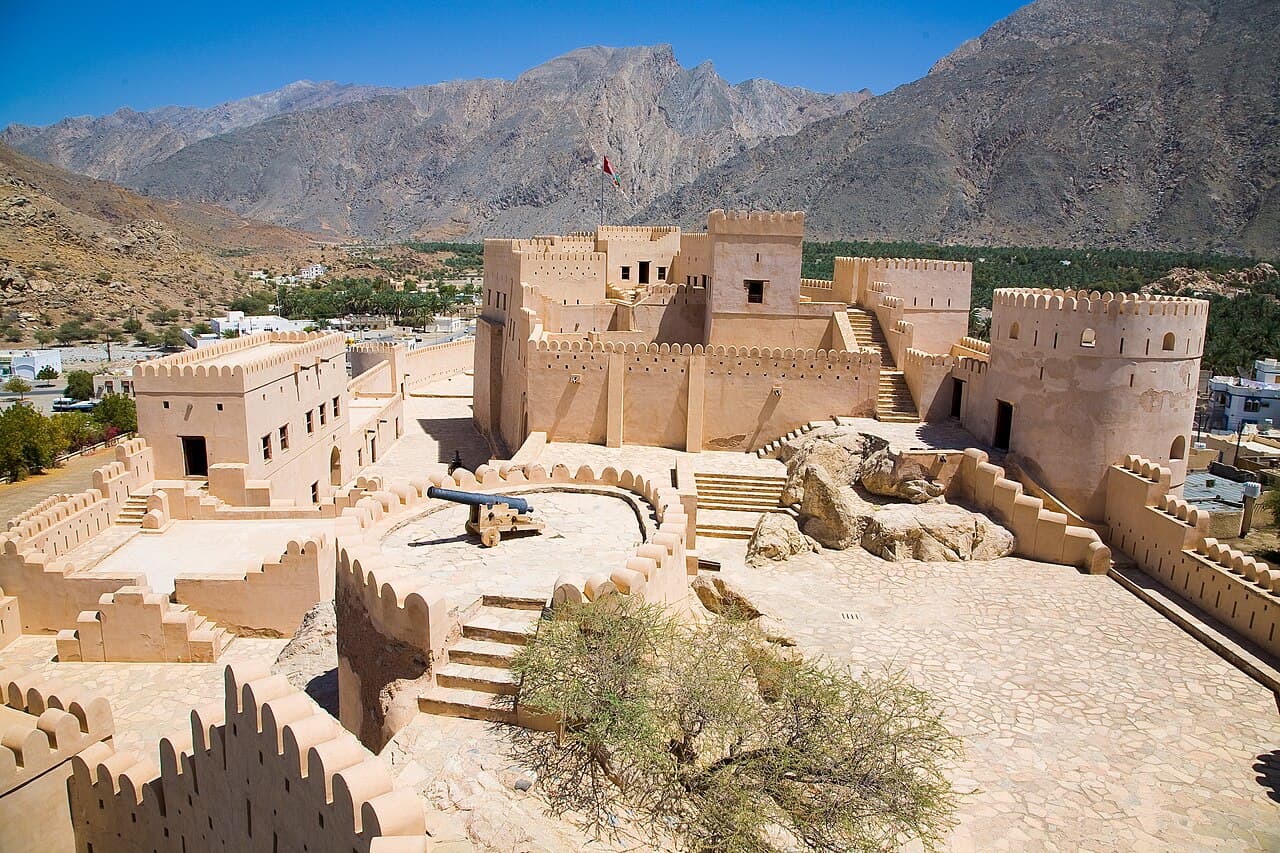
Nakhal Fort, also known as Al-Haim Fort, stands as one of the most significant historical and archaeological monuments in the Sultanate of Oman. Located at the entrance of the Wilayat of Nakhal within the Al Batinah South Governorate, this imposing fortress rises atop a rocky hill at the base of Jabal Nakhal in the foothills of the Western Hajar Mountains. The fort’s elevation reaches approximately 200 feet above the surrounding landscape, offering commanding views over the extensive palm groves and fertile agricultural lands below. It lies about 120 kilometers from Muscat, making it a notable attraction for visitors exploring northern Oman.
The fort’s construction is remarkable for its adaptation to the natural terrain. Unlike many castles with regular geometric layouts, Nakhal Fort is an irregularly shaped bastioned fortress built around a large, oddly shaped boulder that protrudes into the interior spaces. This unique design integrates natural rock formations into the structure itself, especially visible in some of the towers on the western side. The irregular shape reflects the fort’s organic growth and continuous modifications over many centuries.
Historical significance and construction phases
The origins of Nakhal Fort trace back to the pre-Islamic era, with construction believed to have been initiated by the Sassanid Empire. The exact date of the original foundation remains uncertain, but it served as a strategic defensive outpost guarding important trade routes and agricultural areas against incursions by Arab tribes. This early military function laid the groundwork for the fort’s sustained importance in the region.
Throughout its history, the fort underwent several significant renovations and expansions. In 170 AH (786 CE), Imam Al-Salt bin Malik Al-Kharousi undertook restoration works to enhance its defensive capabilities and to oversee the verdant palm plantations spreading beneath the mountain. Further modifications occurred during the 3rd and 10th centuries AH under the reign of the Imams of Bani Kharous and the Ya’arubah dynasty, reflecting the fort’s dual role as a military stronghold and a residence for ruling families.
A major phase of construction took place in 1250 AH (1834 CE) during the reign of Imam Said bin Sultan. This period saw the erection of the fort’s outer gate, the defensive walls, and numerous towers, which significantly bolstered its fortifications in response to evolving military technologies and threats. These additions exemplify the fort’s role as a bastioned fortress designed to withstand artillery and prolonged sieges.
Architectural features and layout
Integration with natural landscape
The fortress’s layout is dictated by the natural contours of the rocky outcrop on which it stands. The incorporation of the large boulder within the fort’s interior spaces creates a distinctive architectural character. This rock formation is especially prominent in the western towers, where it rises alongside the built structures, merging natural and man-made elements.
Defensive structures and towers
The fort is enclosed by thick defensive walls punctuated by approximately twenty external towers distributed strategically around the perimeter. Among these, three large cylindrical towers located on the eastern, western, and central parts of the fort serve as key lookout and defense points. These bastions were designed to provide overlapping fields of fire, enabling defenders to monitor and repel attackers effectively.
The walls and towers incorporate gun openings and other defensive features suited to the use of firearms, reflecting adaptations made during the early 19th century renovations. The fortified outer gate constructed in 1834 serves as a controlled entry point, reinforcing the fort’s security.
Interior spaces and functional areas
Nakhal Fort comprises two main floors, each serving distinct purposes. The ground floor contains storage rooms for agricultural produce such as dates, water wells essential for sustaining the garrison, small chambers, and a mosque that highlights the fort’s religious significance. This floor was primarily functional, supporting the daily needs of the inhabitants and defenders.
The upper floor houses the residential quarters, including the governor’s living rooms, family chambers, guest accommodations, and designated areas for women’s rest. Seasonal rooms designed for winter and summer use demonstrate an understanding of local climate conditions and comfort. Notably, one guest room features intricately decorated ceilings with geometric patterns and Arabic calligraphy, showcasing traditional Omani craftsmanship.
The interiors are further enhanced by traditional Omani wooden ceilings adorned with vibrant painted motifs. These artistic elements contribute to the cultural value of the fort and reflect the aesthetic sensibilities of its historical occupants.
Cultural importance and modern restoration
Over the centuries, Nakhal Fort transitioned from a purely military installation to a symbol of political authority and cultural heritage. It served as a residence for the imams of Wadi Bani Kharous and the ruling family of the Ya’arubah dynasty, cementing its role in the governance and social life of the region.
The fort’s strategic location also enabled it to protect the fertile palm plantations and oversee vital trade routes, linking economic prosperity with military security. Its elevated position offers panoramic views of the Al Batinah region, integrating the natural environment with human settlement and defense.
In 1990, a comprehensive restoration was undertaken to preserve the fort’s historical fabric and to equip it with displays of traditional handicrafts and antiques. This restoration transformed Nakhal Fort into a major tourist destination and cultural attraction, managed by Oman’s Ministry of Tourism. Visitors can explore the fort’s museum, which exhibits historical weapons such as swords and cannons, traditional furniture, and artifacts illustrating Omani heritage.
The fort continues to serve as a living cultural site, hosting a weekly goat auction market within its grounds, maintaining its connection to local community life and traditions.
Visitor experience and significance
Today, Nakhal Fort is one of the most visited historical sites in Oman. Its unique combination of natural rock formations and human architecture offers visitors a glimpse into centuries of Omani history, military strategy, and cultural development. The fort’s elevated position provides breathtaking views of the surrounding palm groves and mountains, enhancing the visitor experience.
Exploring the fort allows insight into traditional Omani architecture, including bastioned fortifications, defensive towers, and residential quarters that have evolved over more than a millennium. The presence of a mosque within the fort underscores the integration of religious practice within military and domestic life.
Visitors can appreciate the craftsmanship evident in the painted wooden ceilings and the Arabic inscriptions, which highlight the cultural richness of the region. The fort’s museum offers educational displays that contextualize its historical role and significance within Oman’s broader heritage.
Overall, Nakhal Fort embodies a remarkable fusion of natural landscape and human ingenuity, reflecting Oman’s rich history from the pre-Islamic era through to modern times. It stands as a testament to the enduring importance of strategic defense, cultural identity, and architectural adaptation in the Arabian Peninsula.
Frequently asked questions (FAQ)
- How do I get to Nakhal Fort?
- Nakhal Fort is located in the Al Batinah Region of Oman, approximately 120 kilometers from Muscat. You can reach the fort by car via the Muscat-Nakhal road, and there are also local taxis available for hire. The scenic drive offers beautiful views of the Omani countryside, making your journey enjoyable.
- What is the historical significance of Nakhal Fort?
- Nakhal Fort has a rich history dating back to the 17th century and served as a strategic military stronghold in the region. It played a crucial role in the defense of the area against invaders and has been an important landmark in Oman's heritage. Today, it stands as a symbol of Omani culture and architectural ingenuity.
- When was Nakhal Fort built?
- Nakhal Fort was constructed in the mid-17th century, during the reign of Sultan bin Saif al-Yarubi. The fort has undergone various renovations over the years, particularly in the 1990s, to restore its original structure and enhance its historical features. It remains one of the best-preserved forts in Oman.
- Can I visit Nakhal Fort year-round?
- Yes, Nakhal Fort is open to visitors throughout the year. However, the best time to visit is during the cooler months from October to March when temperatures are more pleasant for exploring the fort and its surroundings. Visiting during these months allows you to fully enjoy the outdoor scenery and historical significance of the site.
- Why is the architecture of Nakhal Fort unique?
- The architecture of Nakhal Fort is unique due to its strategic design, which combines defensive features with aesthetic elements. Its high walls, watchtowers, and intricate stonework reflect the traditional Omani building techniques and military architecture of the time. The fort also incorporates natural elements, blending seamlessly with the surrounding landscape.
- Is it possible to access the interior of Nakhal Fort?
- Yes, visitors can access the interior of Nakhal Fort, where they can explore various rooms, including the barracks, storage areas, and the main courtyard. The interior is well-maintained, allowing guests to appreciate the historical artifacts and learn more about the fort's past. Guided tours are often available to enhance your experience.
- What are the opening hours for Nakhal Fort?
- Nakhal Fort is typically open from 8:00 AM to 4:00 PM, Saturday through Thursday. The fort is closed on Fridays, so plan your visit accordingly. It's always a good idea to check for any seasonal changes or special events that might affect opening hours.
- Are there any nearby attractions to visit?
- Yes, there are several nearby attractions, including the Nakhal Hot Springs and the picturesque Wadi Mistal. Visitors can also explore the local markets in Nakhal town, which offer a glimpse of Omani culture and traditions. These attractions make for a well-rounded day trip in the Al Batinah Region.
- What are the ticket prices for entering Nakhal Fort?
- The entry fee for Nakhal Fort is very affordable, typically around 1 Omani Rial for adults. Children and Omani nationals often receive discounts or free entry. This makes it an excellent value for those looking to explore Oman's rich history without breaking the bank.
Photo gallery

Information
Loading map...
Visitor reviews
No reviews yet. Been here? Write the first review and help other travelers!
Write the first reviewVisited this castle? Share your experience
Your review helps other travelers and adds first-hand knowledge to our encyclopedia.


