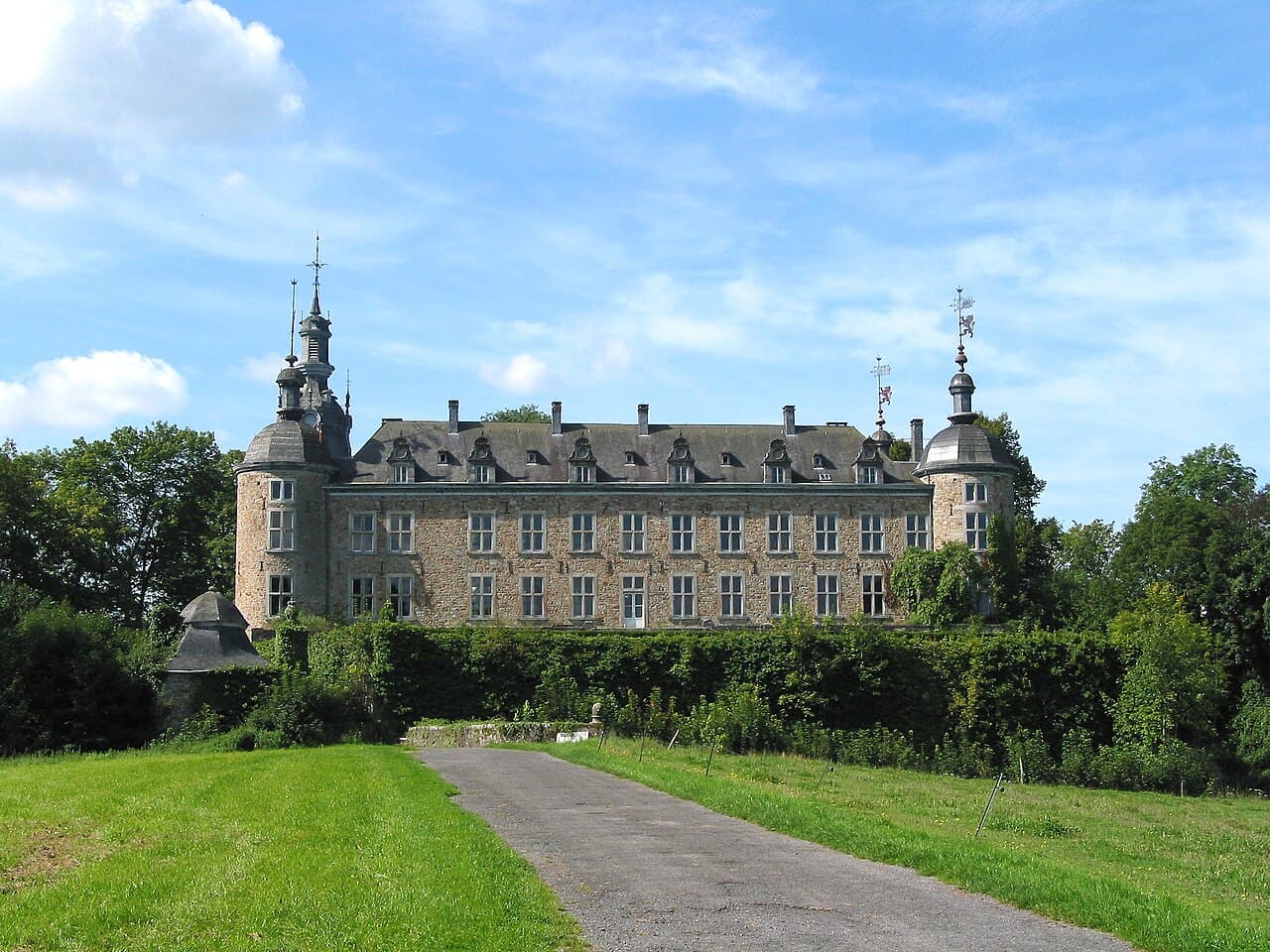
Mirwart Castle
Mirwart Castle stands prominently on a rocky hill overlooking the Valley of the Lomme in Saint-Hubert, Belgium. This hill castle traces its origins back to the 11th century, making it a significant relic of the High Medieval period. Originally constructed as a strategic fortress by the lords of Lorraine, the castle was intended to protect their domain from rival feudal lords such as the lords of Bouillon and Orchimont. Its position on a natural rock outcrop provided a commanding view and strong defensive advantage over the surrounding valley, a typical feature of medieval hill castles designed for both military and territorial control.
Early history and medieval conflicts
The earliest parts of Mirwart Castle date to the early 11th century, when the duchy of Lorraine established it as a stronghold. Throughout the late 11th century, the castle became embroiled in numerous feudal disputes, particularly with the powerful Saint-Hubert Abbey and its monastic community. The abbey was supported by the influential Prince-Bishop of Liège, Henry of Verdun, who played a pivotal role in the castle's history. Between 1077 and 1082, Henry of Verdun reinforced the castle, but following complaints from the abbey, there were orders for its destruction. However, the bishop did not approve the demolition at that time.
In 1099, after regaining control of the fief, Bishop Otbert of Liège ordered the reconstruction of the castle and granted it as a fief to Bavon de Waha. Bavon and his descendants maintained control for nearly two centuries, during which the castle was a focal point of regional power struggles. The castle's fortifications were likely enhanced during this period to withstand ongoing conflicts.
Ownership disputes and regional power struggles
In 1293, the castle was acquired by Jean d'Avesnes against the wishes of the Prince-Bishop of Liège. This acquisition sparked a prolonged conflict involving several regional powers, including the Counts of Hainaut, Luxembourg, Namur, and Loon, as well as the Dukes of Brabant. Control of Mirwart Castle changed hands multiple times during these turbulent years, reflecting the shifting alliances and power dynamics of the region.
Eventually, the castle came under the control of Prince-Bishop Adolph II of the Marck. Later, it passed to the Dukes of Burgundy, and in 1471, Charles the Bold granted it to Eberhard van der Mark and the counts of La Mark, further embedding the castle within the complex feudal hierarchy of the late medieval period.
Military significance and architectural evolution
Throughout the 16th and 17th centuries, Mirwart Castle was a strategic military site during the numerous wars involving the Netherlands, Spain, the Habsburg monarchy, and France. The castle endured several sieges and sustained damage but was repeatedly restored and fortified. These restorations likely included strengthening the walls, towers, and battlements to adapt to evolving military technology and siege tactics.
By the late 17th and early 18th centuries, the castle underwent significant renovations that gradually transformed it from a purely defensive fortress into a more comfortable and elegant residence. This period of relative peace allowed for extensive embellishments, including the possible addition of residential wings, ornamental gardens, and refined interior spaces. The castle's fortified character diminished as its role shifted towards that of a stately country home.
18th and 19th century transformations
In the early 18th century, the castle entered a long period of tranquility, enabling these renovations and embellishments to flourish. By the 19th century, Aimé-Gabriel d'Artigues, the founder of the renowned Vonêche glassworks, acquired Mirwart Castle. Under his ownership and that of subsequent families such as the Van der Linden d'Hoogvorst, d'Arrigade, and von der Becke, the castle was further transformed into a beautiful country residence.
The mid-19th century renovation was notably overseen by Alphonse Balat, the esteemed architect to King Leopold II of Belgium. Balat's work contributed significantly to the castle's current appearance, blending elements of historic architecture with contemporary tastes of the period. These renovations likely included updates to the façades, interior layouts, and decorative details, enhancing the castle's elegance and livability.
Modern history and preservation efforts
After World War II, the castle was acquired by the province of Luxembourg. Despite renovations, the province struggled to find a sustainable use for the property, leading to gradual neglect. Over time, the castle suffered from looting and the loss of valuable furnishings and decorative fittings, which diminished its historical integrity.
In 2016, the castle was sold to ICM SA, which initiated extensive restoration efforts aimed at reviving Mirwart Castle's cultural and historical significance. The restoration project plans to convert the site into a luxury hotel, thermal baths, concert hall, and restaurant, combining preservation with modern hospitality functions. This adaptive reuse seeks to safeguard the castle's architectural heritage while making it accessible and relevant to contemporary audiences.
Architectural features and layout
Mirwart Castle exhibits a complex architectural evolution, with its core medieval fortifications still visible alongside later residential additions. The original 11th-century structures include robust stone walls and defensive towers strategically positioned on the rocky promontory. These features underscore the castle's initial role as a military stronghold.
Subsequent modifications introduced more refined elements such as ornamental façades, larger windows, and landscaped grounds, reflecting changing tastes and functions. The castle's layout includes multiple courtyards, residential wings, and service buildings, illustrating its transition from fortress to stately home.
While detailed documentation of interior decoration is limited, the castle once housed valuable artworks and furnishings, many of which were lost during the mid-20th century abandonment. Current restoration aims to recover and preserve as much of the original fabric as possible while adapting the interiors for modern use.
Cultural and historical significance
Mirwart Castle is a prominent example of a medieval hill castle that evolved through centuries of conflict, ownership changes, and architectural transformations. Its history encapsulates key themes of feudal power struggles, religious influence, and the shifting nature of military architecture in the region.
The castle's association with notable historical figures such as Henry of Verdun, Bishop Otbert, Jean d'Avesnes, and Alphonse Balat enriches its narrative and cultural value. Furthermore, its survival through wars, sieges, and neglect highlights the resilience of such heritage sites.
Today, Mirwart Castle stands as a testament to the layered history of the Ardennes region and the broader historical currents of Belgium and neighboring territories. Its ongoing restoration and adaptive reuse promise to secure its place as a cultural landmark and tourist destination.
Visiting and future prospects
While restoration is ongoing, Mirwart Castle is poised to become a unique destination combining historical ambiance with modern luxury. Visitors can anticipate experiencing a rich blend of medieval architecture and contemporary amenities once the project is completed. The castle's location in the scenic Ardennes region adds to its appeal, offering opportunities for cultural tourism and nature exploration.
Frequently asked questions (FAQ)
- When was Mirwart Castle originally built?
- Mirwart Castle was originally constructed in the 11th century as a strategic hilltop fortress by the lords of Lorraine.
- What architectural styles are visible at Mirwart Castle?
- The castle exhibits a mix of medieval fortifications from the High Medieval period and 19th-century renovations by architect Alphonse Balat, blending historic and residential styles.
- Is Mirwart Castle open to visitors?
- Currently, Mirwart Castle is undergoing restoration and is not fully open to the public, but future plans include a luxury hotel and cultural venue accessible to visitors.
- What historical conflicts affected Mirwart Castle?
- The castle was involved in feudal disputes with neighboring lords, conflicts with the Prince-Bishopric of Liège, and later wars involving Spain, Austria, and France during the 17th and 18th centuries.
- Who owns Mirwart Castle today?
- Mirwart Castle is currently owned by ICM SA, which is leading restoration efforts to convert it into a luxury hotel and cultural site.
Photo gallery

Information
Sources & official resources
Verify the information above using these authoritative references.
Loading map...
Visitor reviews
No reviews yet. Been here? Write the first review and help other travelers!
Write the first reviewVisited this castle? Share your experience
Your review helps other travelers and adds first-hand knowledge to our encyclopedia.



