Lewice
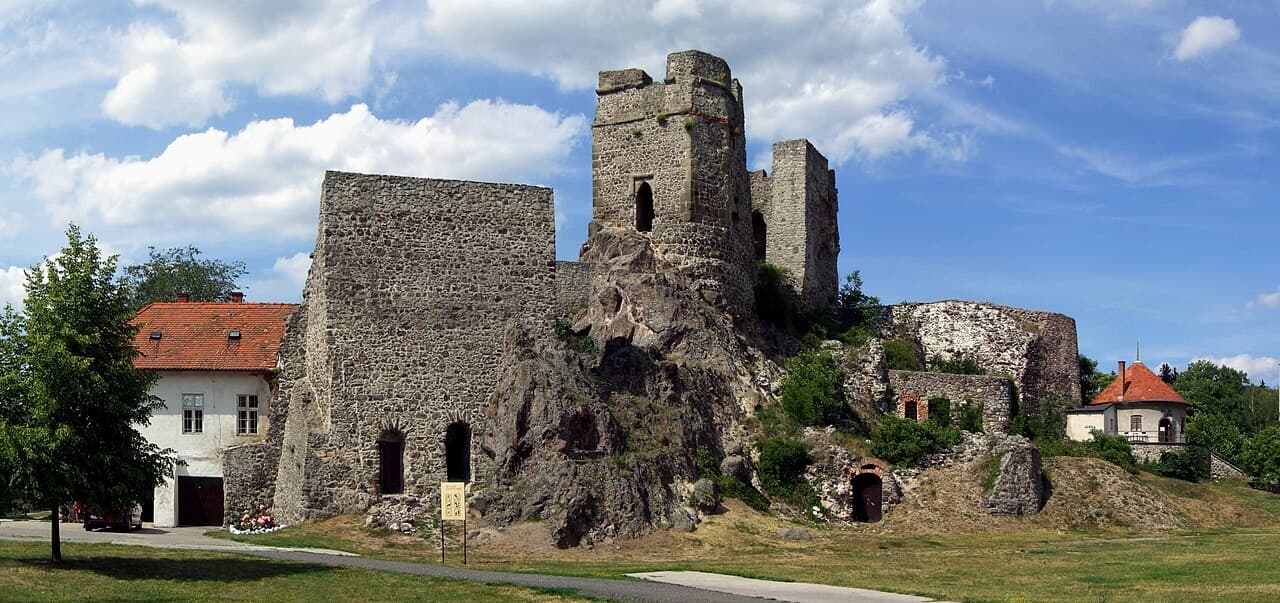
Levice Castle stands as a remarkable example of a 13th-century bastioned fortress in Slovakia, embodying centuries of military, architectural, and political history. Constructed in the late 1200s on a rocky hill surrounded by marshlands nourished by the Hron River and the Podlužiansky stream, the castle was strategically positioned to protect vital mining towns such as Banská Štiavnica, Kremnica, and Banská Bystrica. Its location atop an andesite rock formation, a remnant of Neogenic volcanic activity, provided natural defenses enhanced by the marshy terrain, making it a formidable stronghold in the High Medieval period.
The earliest records of the castle date back to 1274, marking its establishment as a crucial defensive site during a time when the importance of nearby fortresses like Tekovsky waned due to the devastation wrought by the Tartars. Initially, the castle featured Gothic architectural elements, including perimeter walls, a residential building, and a quadrangular tower, all adapted to the rocky terrain on which it was built. Over the centuries, the castle evolved significantly, reflecting changes in military technology and political power.
Medieval origins and early history
Levice Castle was first mentioned in 1274 and initially served as a royal fortress guarding the southern approaches to the economically vital mining towns of central Slovakia. The castle's early ownership included notable figures such as Imrich Bečej and the powerful noble Matúš Čák Trenčiansky. After Čák's death in 1321, the castle reverted to royal control under King Charles Robert, becoming the seat of the Tekov župa (county).
In the late 14th century, the castle came under the ownership of the Levický family, who lent their name to the castle and the surrounding region. Despite suffering a devastating fire in 1434, the fortress was quickly rebuilt, including the addition of a round tower on the eastern side, enhancing its defensive capabilities.
Renaissance transformations and military significance
The 16th century marked a period of significant transformation for Levice Castle, driven largely by the need to counter the expanding Ottoman threat. After returning to royal possession in 1529, the castle was integrated into a broader system of fortifications. Around 1560, the renowned military leader Stefan Dobó, famed for his role in the defense of Eger, was appointed commander of the castle's garrison. Under his leadership, the castle underwent extensive renovations to bolster its defenses.
These upgrades included the construction of a large southern courtyard capable of housing a substantial military force, protected by curtain walls on the east and a quadrangular bastion and the so-called Captain's House on the west. A Renaissance-style long building was added in the southern section, separated from the town by a wide moat and accessible via a drawbridge. The castle's middle ward was also fortified with a northern bastion, reflecting contemporary military architectural trends.
Further enhancements in 1635 introduced two massive bastions flanking the Renaissance palace, which itself was connected to the town's defensive walls. The previously dry moat was filled with water, increasing the fortress's resilience. Despite these improvements, the castle fell to the Ottomans in 1663, who briefly occupied it and converted the chapel in the western bastion into a mosque. The Habsburg forces recaptured the castle the following year and initiated extensive restoration efforts.
Decline and legacy
Following the weakening of the Ottoman threat, Levice Castle's military importance declined. In 1696, a catastrophic fire damaged both the town and the fortress. The castle was purchased by Palatine Paul Eszterházy in 1688, but the diminished strategic value and repeated destruction led to neglect. During the early 18th century, the castle was occupied by rebels during the Rákóczi uprising, who partially destroyed the bastions before retreating.
Subsequent repairs focused mainly on the Renaissance palace, Captain's House, and bastion, leaving much of the original Gothic structure in ruins. Today, the castle remains a ruined bastioned fortress, with the lower castle area best preserved and housing the Tekov Museum. The southwestern bastion has been adapted into an amphitheater, blending the site's historical legacy with contemporary cultural use.
Architectural features and layout
Levice Castle's architecture reflects its long history and strategic adaptations. The original Gothic castle was built to conform to the irregular shape of the rocky hilltop, featuring a quadrangular tower and residential buildings surrounded by defensive walls. The Renaissance period introduced bastions and curtain walls designed to withstand artillery attacks, a common evolution in fortress architecture during the 16th and 17th centuries.
The castle complex included an upper castle with the main Gothic palace and a lower courtyard added later to accommodate military needs. The Renaissance manor house, constructed around 1571, is a notable two-story building with corner bastions, exemplifying the fusion of residential comfort and military defense.
The outer fortifications were connected to the town's defenses by walls and a moat, creating an integrated defensive system. The natural marshes and waterways surrounding the castle augmented its protection, making direct assaults difficult. Some defensive structures, such as the eastern bastion, have been repurposed for modern use, including a restaurant and tea house, preserving the castle's historical footprint.
Cultural and historical significance
Levice Castle played a pivotal role in regional defense during the turbulent centuries of the Middle Ages and the Ottoman wars. Its strategic position and robust fortifications made it one of the most important strongholds in the Kingdom of Hungary's defense system. The castle's history is intertwined with notable figures such as Stefan Dobó and the Esterházy family, reflecting broader political and military trends in Central Europe.
Today, Levice Castle serves as a cultural monument and museum, offering visitors insight into the region's medieval and Renaissance heritage. The preservation of its ruins and adaptive reuse of bastions for cultural events help maintain the castle's relevance and accessibility, connecting past and present.
Frequently asked questions (FAQ)
- What is the historical significance of Lewice Castle?
- Lewice Castle, located in Levice, Slovakia, has a rich history that dates back to the 13th century. It played a strategic role in various conflicts and served as a residence for many noble families, contributing to the cultural heritage of the region.
- When was Lewice Castle built?
- Construction of Lewice Castle began in the early 13th century, with significant modifications made in later centuries. The castle showcases a blend of Gothic and Renaissance architectural styles, reflecting the evolution of its design over the years.
- Can I visit Lewice Castle?
- Yes, visitors are welcome to explore Lewice Castle. The site is open to the public, offering guided tours that provide insight into its history and architecture.
- What are the opening hours of Lewice Castle?
- Lewice Castle typically opens daily from 10 AM to 6 PM during the peak tourist season. It's advisable to check the official website or contact local tourism offices for any seasonal changes to the hours.
- Is it possible to access Lewice Castle with a wheelchair?
- Accessibility to Lewice Castle may be limited due to its historical architecture and terrain. However, the staff is accommodating and can assist visitors with special needs; it's recommended to reach out in advance for specific arrangements.
- What is the best time to visit Lewice Castle?
- The best time to visit Lewice Castle is during the spring and early autumn months when the weather is pleasant and the surrounding landscapes are vibrant. Additionally, consider visiting during local festivals for a richer cultural experience.
- What are the ticket prices for Lewice Castle?
- Ticket prices for Lewice Castle are generally affordable, with discounts available for students and seniors. It's best to check the official website for the most current pricing and any special promotions.
- Are there nearby attractions to explore while visiting Lewice Castle?
- Yes, there are several attractions near Lewice Castle, including the historic town of Levice and its charming streets. Visitors can also explore nearby natural parks and hiking trails that showcase the beautiful Slovak countryside.
Photo gallery

Information
Website
Visit websiteSources & official resources
Verify the information above using these authoritative references.
Loading map...
Visitor reviews
No reviews yet. Been here? Write the first review and help other travelers!
Write the first reviewVisited this castle? Share your experience
Your review helps other travelers and adds first-hand knowledge to our encyclopedia.