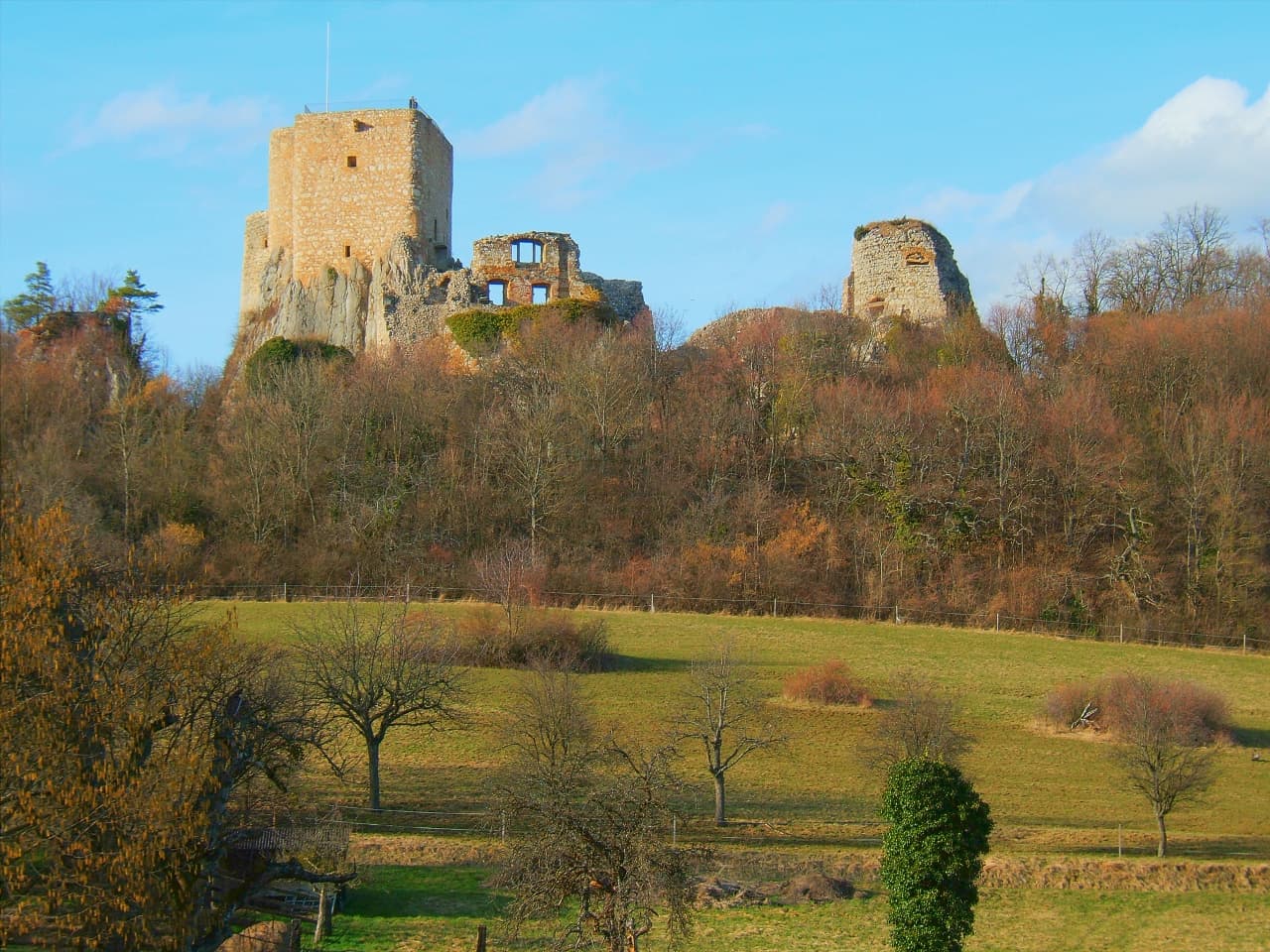
Landskron Castle
Landskron Castle, also known as Château de Landskron, is a remarkable medieval fortress ruin located on a commanding hill just south of the village of Leymen in the Haut-Rhin department of France. Nestled in the region of Southern Alsace, also referred to as the Alsatian Jura or the Sundgau, the castle's strategic position near the border with Switzerland and overlooking the city of Basel has shaped its history and significance.
Constructed in the 13th century, Landskron Castle was built before 1297 to control vital geographic points including the Eastern Sundgau, the bend of the Rhine River, and the city of Basel. Its location on an elongated hill provided a natural defensive advantage and allowed surveillance over important trade and military routes. The castle was initially contested by noble families such as the Lords of Münch and the Lords of Rötteln, with ownership disputes reflecting the turbulent political landscape of the High medieval period. The Habsburg dynasty eventually gained control, linking Landskron with other regional strongholds like the Château de Ferrette and Château de Morimont.
Medieval origins and early history
The castle's earliest documented history involves its role as a contested fortress among powerful families vying for control after the death of King Rudolf I of Habsburg in the late 13th century. The castle was part of a broader network of fortifications that asserted Habsburg influence in the region. Landskron's initial construction featured a large rectangular keep (donjon) with walls approximately two meters thick, typical of high medieval military architecture.
The devastating 1356 Basel earthquake severely damaged Landskron and the neighboring castle on the same hill. The fortress was subsequently rebuilt by the Margraves of Hachberg-Sausenberg, reflecting the importance of maintaining control over this strategic site.
Adaptations to gunpowder warfare and renaissance transformations
By the early 16th century, the emergence of firearms necessitated significant modifications to the castle's defenses. Around 1515-1516, under the direction of the Habsburg emperor Maximilian I and the stewardship of the Lords of Lupfen, notably Sébastien de Reichenstein, Landskron was modernized to resist artillery. These changes included thickening the walls of the keep to four to five meters and adding artillery platforms and battlements designed for gunpowder weapons.
The castle's layout was expanded to include a fortified outer bailey (Vorburg) with a zwinger—a narrow defensive corridor—and shell towers that provided wide angles of fire. A hornwork outwork further protected the entrance, which was accessed via a vaulted tunnel and two drawbridges spanning a now-filled moat. The eastern curtain wall, approximately seven meters thick, featured a prominent powder tower with a vaulted ceiling over one meter thick, designed to safely store gunpowder.
Military significance and vauban's renovations
Following the Thirty Years' War and the Peace of Westphalia in 1648, Landskron passed from Habsburg to French control, marking a significant geopolitical shift in the Alsace region. From 1665 onward, the renowned French military engineer Vauban undertook extensive renovations to transform Landskron into a modern military garrison. Vauban's work included strengthening the fortifications and adapting the castle to contemporary military tactics, ensuring its continued strategic relevance.
Despite many other Alsatian castles being abandoned and falling into ruin during this period, Landskron was maintained as a state fortress. By the 1690s, it was repurposed as a state prison, primarily holding political prisoners and individuals detained under royal orders without trial. The castle's prison history is exemplified by the case of Bernard Duvergez de Soubardon, a French courtier imprisoned from 1769 until 1790, who suffered prolonged solitary confinement and died shortly after the French Revolution.
Sieges, destruction, and decline
Landskron Castle endured numerous military conflicts, including a siege by Swedish troops during the Thirty Years' War in 1638. Its final major military episode occurred in December 1813 during the Napoleonic Wars, when Austrian and Bavarian forces captured and deliberately set fire to the fortress. The destruction left the castle largely in ruins, sparing only the main keep due to the intervention of a local priest.
Following this devastation, the castle fell into disuse and was gradually quarried for building materials by local inhabitants throughout the 19th century. Its ruins stood as a testament to the region's turbulent history and changing military technologies.
Modern preservation and cultural significance
In the 1970s, the castle ruins served an unusual purpose as a habitat for a colony of Barbary macaques, a unique chapter in its long history. Since 1984, ownership transferred to the Association pour la Sauvegarde du Château de Landskron, a dedicated organization focused on preserving and consolidating the site.
Restoration efforts initiated in the late 20th century have stabilized key structures such as the donjon and curtain walls, preserving them for future generations. Funding from local, regional, and European sources has supported these initiatives, emphasizing the castle's importance as a cultural heritage landmark straddling the French-Swiss border.
Today, Landskron Castle is freely accessible to visitors during daytime hours. Its elevated position offers spectacular views over the surrounding countryside, including the city of Basel just across the border. The castle's ruins provide a vivid glimpse into medieval and early modern military architecture, reflecting centuries of strategic importance and historical events.
Architectural features and layout
The keep and inner bailey
The centerpiece of Landskron Castle is its imposing rectangular keep (donjon), dating back to the 13th century. Originally constructed with robust walls about two meters thick, the keep was later reinforced to withstand artillery attacks with walls up to five meters thick. Its distinctive semicircular western extension and battlements with artillery platforms illustrate adaptations to evolving military technology.
Adjacent to the keep lies the palas, the main residential building rebuilt in 1516 atop older foundations. The palas features a vaulted ground floor with thick walls that taper on the upper stories. An external staircase provides access to both the palas and the keep. In the 18th century, parts of the palas were converted to kitchen and hospital quarters.
Outer defenses and water supply
The castle's outer bailey (Vorburg) is protected by a narrow zwinger and two shell towers, designed to deliver flanking fire against attackers. A hornwork outwork further enhanced the defenses at the entrance, which was originally accessed by two drawbridges over a moat that has since been filled in. The vaulted entrance tunnel remains a notable architectural feature.
Water management was critical for the castle's sustainability during sieges. A deep well approximately 56 meters deep was dug before 1545, covered by a small shelter. Later, a large cistern over 10 meters deep and 4.5 meters wide was constructed after 1687 to collect rainwater. This cistern included a water wheel mechanism to facilitate water retrieval and a system to channel excess water into the well below. After 1700, an external water source was also incorporated to ensure a reliable supply.
Fortress ring and additional structures
The eastern part of the castle is enclosed by a massive curtain wall about seven meters thick, featuring three towers including a powder tower used for gunpowder storage. The eastern gate is decorated with a carved relief of the imperial double-headed eagle flanked by the Austrian Bindenschild shield and the date 1516, commemorating the castle's fortification under Emperor Maximilian I and the Markgraves of Baden.
The northwest bastion, known as the "Mehlturm," housed a triple gate system, a mill, and living quarters on its upper floor. Near this bastion are the remains of a 16th-century outwork beyond the neck ditch, an additional defensive trench separating the inner bailey from the outer bailey.
Frequently asked questions (FAQ)
- How do I get to Landskron Castle?
- Landskron Castle is located in Leymen, France, near the border with Switzerland. You can reach the castle by car, with ample parking available nearby, or via public transport from major cities like Basel. The scenic drive offers beautiful views of the surrounding landscape.
- What is the historical significance of Landskron Castle?
- Landskron Castle dates back to the 13th century and played a vital role in the region's defense against invasions. It has witnessed numerous historical events and changes in ownership, reflecting the rich tapestry of medieval history. Today, it stands as a testament to the architectural and historical heritage of the area.
- When was Landskron Castle built?
- Construction of Landskron Castle began in the 1200s, with various modifications and expansions occurring over the centuries. The castle's strategic location and robust design were crucial for its defensive purpose. Its historical architecture showcases elements from different periods, making it a fascinating site for history enthusiasts.
- Can I visit Landskron Castle year-round?
- Yes, Landskron Castle is open to visitors year-round, but hours may vary seasonally. It’s advisable to check the official website for specific opening times, especially during holidays. Visiting during the warmer months offers a chance to explore the beautiful gardens and surrounding nature.
- Why is Landskron Castle popular among tourists?
- Landskron Castle attracts visitors due to its stunning views of the Alsatian plain and the Jura Mountains. The combination of historical significance, unique architecture, and picturesque surroundings creates a memorable experience. Additionally, the castle hosts various events and exhibitions that enrich the visitor experience.
- Is it possible to access Landskron Castle with limited mobility?
- While efforts have been made to improve accessibility at Landskron Castle, some areas may present challenges due to steep paths and uneven surfaces. The main visitor areas are generally accessible, but it is recommended to check in advance for specific accessibility features. Contact the castle management for detailed information to plan your visit accordingly.
- What are the ticket prices for visiting Landskron Castle?
- Ticket prices for Landskron Castle typically vary based on age and group size, with discounts often available for students and seniors. Family tickets and group rates may also be offered, making it a budget-friendly option for visitors. For the most accurate pricing, please refer to the official website before your visit.
- What is the best time to visit Landskron Castle?
- The best time to visit Landskron Castle is during the spring and early autumn when the weather is mild, and the surrounding nature is in full bloom. These seasons also tend to see fewer crowds compared to peak summer months. Visiting during this time allows for a more leisurely exploration of the castle and its grounds.
- Are there any attractions near Landskron Castle?
- Yes, there are several attractions near Landskron Castle, including the charming village of Leymen and various hiking trails in the surrounding hills. Additionally, the city of Basel, just a short drive away, offers a rich cultural experience with museums, galleries, and dining options. Exploring these nearby sites can enhance your visit to the castle.
Photo gallery

Information
Sources & official resources
Verify the information above using these authoritative references.
Loading map...
Visitor reviews
No reviews yet. Been here? Write the first review and help other travelers!
Write the first reviewVisited this castle? Share your experience
Your review helps other travelers and adds first-hand knowledge to our encyclopedia.


