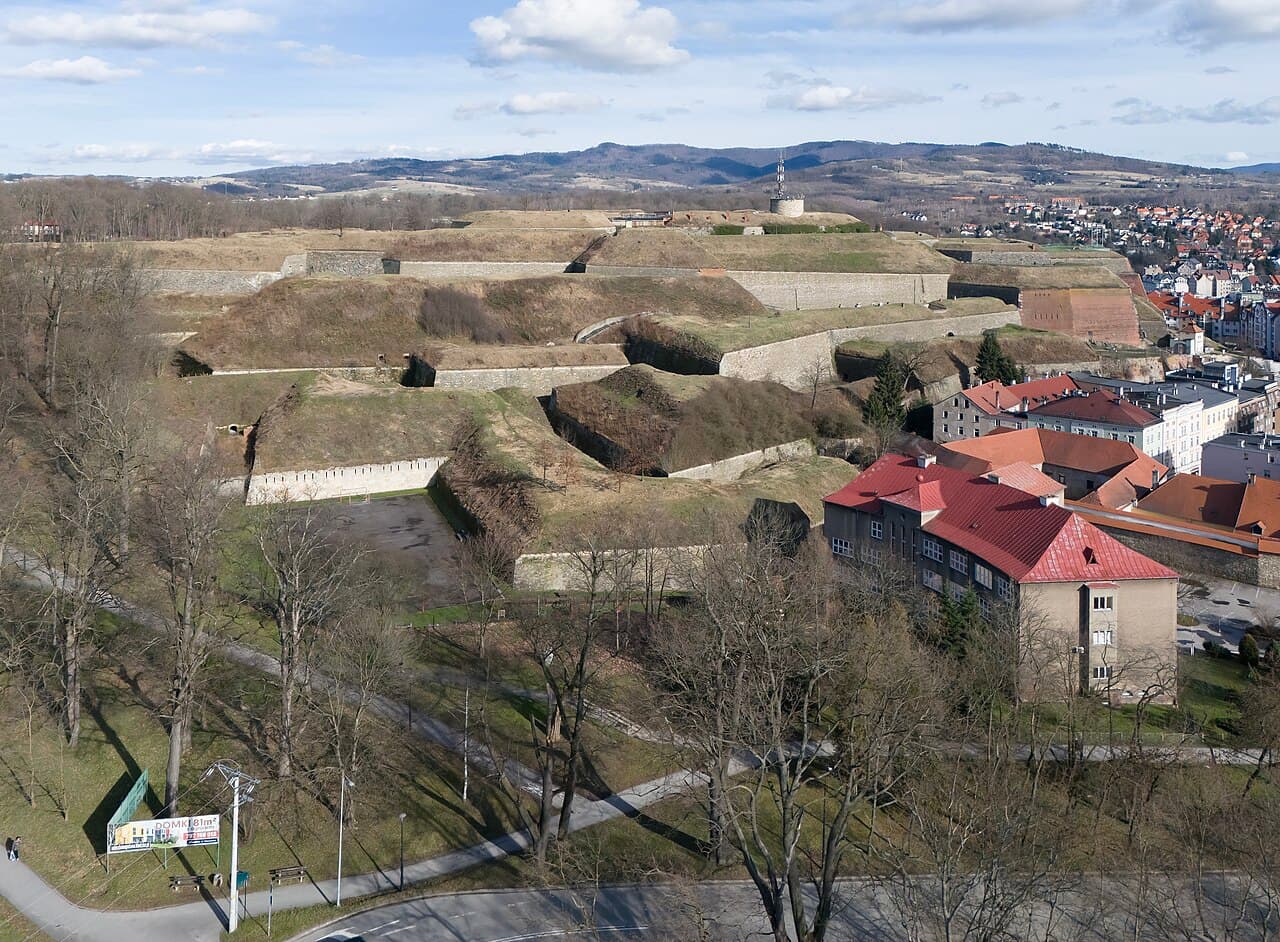
Klodzko Fortress
Kłodzko Fortress is a remarkable bastioned fortress complex located in the town of Kłodzko in southwestern Poland. This fortification, covering an extensive area of approximately 17 hectares, stands as one of the largest and best-preserved examples of its kind in Poland. Its strategic position on Castle Hill overlooking the Kłodzko Valley has made it a significant military stronghold throughout history, especially in the context of the turbulent borderlands of Silesia.
The fortress’s origins date back to the early medieval period, with the first recorded mention of a stronghold on Castle Hill appearing in the Chronicle of Bohemians. Initially, this was likely a wooden complex protected by a palisade, serving as a defensive and administrative center. The town of Kłodzko itself lies on a vital trade and military route connecting Wrocław and Prague, which contributed to its early importance as a trading hub and fortified settlement.
The early history and medieval development
In 1114, the original stronghold was captured and destroyed by Czech forces under Prince Soběslav, who reconquered the region. By 1129, Soběslav had rebuilt the town and established a castellan to administer the area, marking the beginning of more permanent and organized fortifications. Around the year 1300, the wooden structures were replaced by a more substantial stone castle complex, which became the seat of the Kłodzko County. Over the following centuries, the castle expanded to include additional buildings such as a church and chapel, reflecting its dual military and administrative roles.
Architectural expansions in the Renaissance
In 1557, the architect Lorenz Krischke, associated with the court of Prince Ernest of Bavaria, designed and constructed the Lower Castle, a significant Renaissance addition to the fortress complex. During this period, the castle was equipped with multiple wells, including one dating back to 1393, which ensured a reliable water supply during sieges. These enhancements signified the fortress’s growing importance and adaptation to evolving military technologies.
Military significance and sieges
The fortress played a critical role during the Thirty Years’ War. In 1622, after a prolonged siege by the Austrian army, the fortress was captured. The city of Kłodzko resisted the attackers for months until the Austrians employed heavy artillery to breach the walls, forcing surrender on October 25 of that year. Following the capture, the Austrians undertook major modernization efforts, replacing older medieval fortifications with state-of-the-art bastions designed to withstand contemporary artillery.
Prussian conquest and further fortifications
In 1742, during the War of the Austrian Succession, the fortress and the town were seized by Prussian forces under King Frederick II. While the town surrendered relatively quickly, the fortress’s garrison of 2,000 soldiers held out until starvation compelled surrender in April. The Prussians then expanded and reinforced the fortress, continuing construction and upgrades through the Silesian Wars until about 1770. Despite these efforts, the fortress was never fully completed, illustrating the immense scale and complexity of the project.
Role in the 19th and 20th centuries
During the Napoleonic Wars, the fortress was captured in 1807 by French forces supported by Bavarian troops. Subsequently, it was converted into a prison, a function it retained into the 20th century. Notably, in the early 19th century, economic hardships meant prisoners’ earnings were so low that some inmates were sent into the town to beg for assistance. Among its prisoners was British Army Captain Bertrand Stewart, who was accused of espionage in 1911 and released in 1913.
In World War II, the fortress served as a prisoner-of-war camp and functioned as a sub-camp of the notorious Gross-Rosen concentration camp. After the war, in 1945, the fortress and the town of Kłodzko became part of Poland, marking a new chapter in its history.
Architectural features and current state
The fortress occupies a commanding position on Castle Hill, with walls up to 11 meters thick at the base and about 4 meters thick at the upper levels. Its design incorporates extensive bastions, curtain walls, and defensive towers typical of bastioned fortresses, reflecting the military architectural advancements from the 17th to 18th centuries. The complex includes a vast network of underground tunnels and cellars, excavated primarily in the 19th century by prisoners of war. These subterranean passages form an impressive labyrinth that is open to visitors today.
Today, Kłodzko Fortress remains one of the main tourist attractions in the region. Visitors can explore the fortress’s ramparts, bastions, and underground corridors, as well as enjoy panoramic views of the Kłodzko Valley. The fortress also houses a collection of historical artifacts, including old fire engines and local glassware, enriching the visitor experience with cultural and historical context.
Preservation and tourism
The fortress is well preserved, maintaining much of its appearance from around 200 years ago with minimal alterations. Its preservation allows for a vivid understanding of the evolution of military architecture in Central Europe. The site is accessible to the public, offering guided tours that explain its complex history and architectural significance. The combination of above-ground fortifications and the underground labyrinth makes it a unique destination for those interested in military history, architecture, and regional heritage.
Frequently asked questions (FAQ)
- When was Kłodzko Fortress originally built?
- The initial stone castle at Kłodzko Fortress was constructed around the year 1300, replacing earlier wooden fortifications.
- What architectural style characterizes Kłodzko Fortress?
- Kłodzko Fortress is primarily a bastioned fortress featuring military architectural elements from the late medieval period through Renaissance and early modern modifications.
- Can visitors explore the underground tunnels at Kłodzko Fortress?
- Yes, visitors can explore an extensive labyrinth of underground tunnels and cellars excavated mainly in the 19th century, which are open to the public.
- What role did Kłodzko Fortress play during the Thirty Years’ War?
- During the Thirty Years’ War, Kłodzko Fortress was besieged and captured by Austrian forces in 1622 after a prolonged siege and artillery bombardment.
- Is Kłodzko Fortress accessible year-round for tourists?
- The fortress is generally open to visitors year-round, but it is advisable to check specific opening hours and seasonal schedules before planning a visit.
- What significant events occurred at Kłodzko Fortress during the 18th century?
- In the 18th century, the fortress was captured by Prussia in 1742 during the War of the Austrian Succession and underwent extensive expansions and modernizations.
Photo gallery

Information
Current owner
Municipality
Loading map...
Visitor reviews
No reviews yet. Been here? Write the first review and help other travelers!
Write the first reviewVisited this castle? Share your experience
Your review helps other travelers and adds first-hand knowledge to our encyclopedia.



