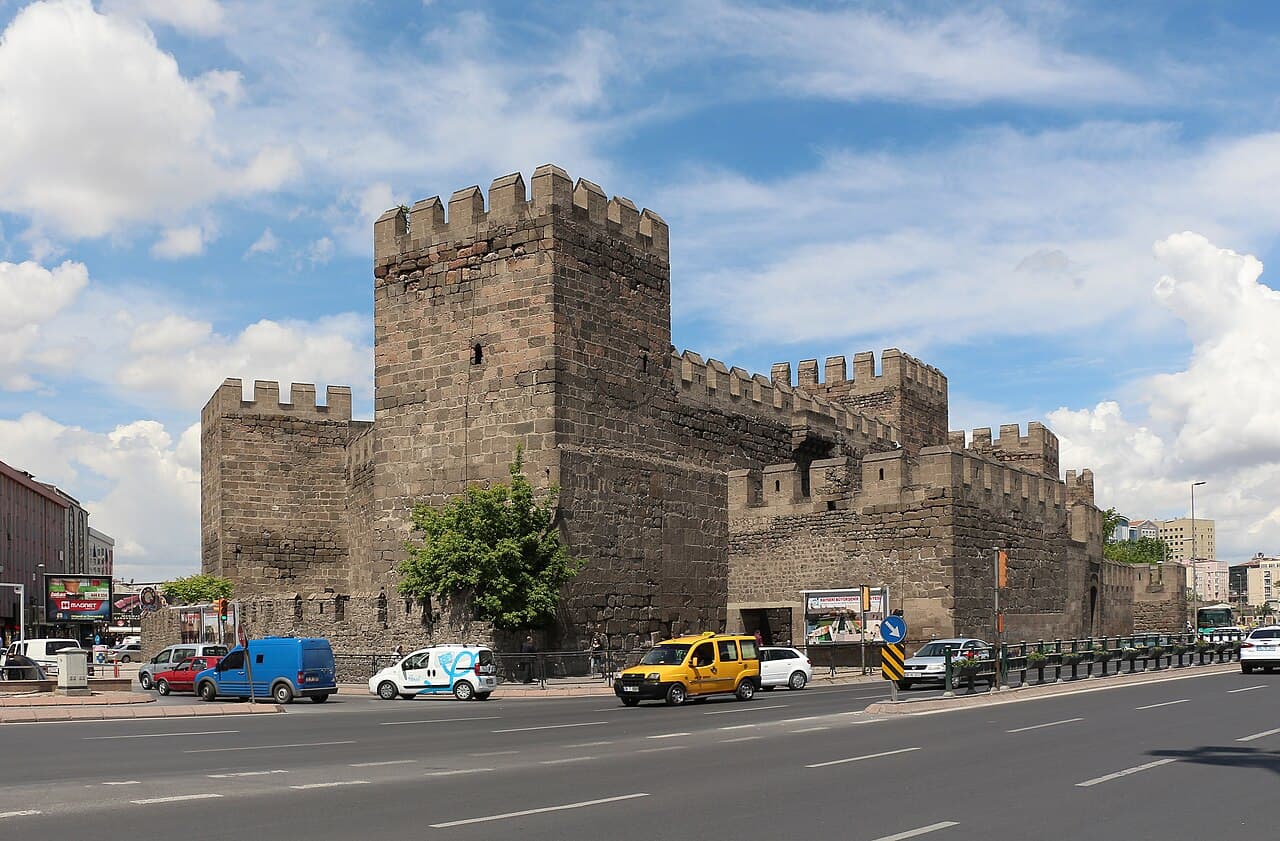
Kayseri Castle
Kayseri Castle, locally known as Kayseri Kalesi, is a prominent historic fortification located in the city of Kayseri, in central Turkey. Its origins trace back to antiquity, with the earliest mentions dating to the 4th century AD when the city was known as Ceasarea. The castle stands as a significant example of layered architectural and historical development, reflecting the influences of Roman, Byzantine, Seljuk, and Ottoman periods.
Early history and roman foundations
The city of Ceasarea was first recorded in the 4th century, enclosed by extensive city walls that protected the urban area. These fortifications were initially Roman in origin, designed to secure the city against invasions and raids during a turbulent period of Late Antiquity. The castle itself was constructed as part of a defensive strategy to strengthen the city’s fortifications.
During the reign of the Byzantine emperor Justinian I in the 6th century, the city walls were contracted to reduce the perimeter and improve defense efficiency. It was in this period, specifically in the second quarter of the 6th century, that the castle was built in a strategic corner of the city walls. This construction phase firmly established the castle as a key military and administrative center.
Byzantine, arab, and seljuk periods
In 647, the city was captured by Arab forces under Mu'awiya I, who later became the first Umayyad caliph. This marked the beginning of a period of conflict and shifting control in the region. The Byzantine Empire eventually lost the city in 1067 when the Seljuk sultan Alp Arslan seized it. Following the conquest, the Seljuks inflicted heavy damage on the city, including massacres and demolition, leaving it largely uninhabited for approximately fifty years.
The city was rebuilt by the Danishmends in 1134, a Turkish dynasty that controlled the region before it returned to Seljuk rule in 1178. The Seljuks further developed the castle and the city, with notable enhancements during the reign of Kayqubad I (1220–1237), who is credited with much of the castle’s present-day appearance. The Mongol invasion in 1243 briefly disrupted Seljuk control, but the city was restored afterward.
Ottoman era and later transformations
By 1515, Kayseri had come under Ottoman control. During the Ottoman period, the castle gradually lost its military significance. By the mid-18th century, the castle's interior had been transformed into a residential neighborhood, reflecting a shift from defensive to domestic use.
In 1925, the residential buildings within the castle were demolished, leaving only a 15th-century mosque and a few other historic structures. The interior then remained largely vacant, with many historical buildings disappearing over the following years. By 1930, the castle's interior had become a marketplace filled with informal slums and booths, lacking any coherent urban planning.
Efforts to restore the castle and convert it into a museum began in the 1970s. However, after the 1980 military coup, economic constraints halted these plans. The castle was repurposed as a gold bazaar, leading to the construction of unregulated buildings inside the walls. This situation persisted until 2013, when the interior was cleared again to establish a museum.
Archaeological excavations and modern restoration
Archaeological excavations conducted during the museum preparations revealed that previous clearings had left little of historical value inside the castle. Nevertheless, the castle walls were restored, preserving the structural integrity and historical appearance of the fortification.
The Kayseri Archaeological Museum opened in 2019 within the castle grounds, serving both as a museum and a venue for cultural events. The castle is freely accessible during daytime, offering visitors the opportunity to explore its impressive walls and remnants of the city fortifications. Portions of the city walls to the west and southeast of the castle remain standing, providing additional insight into the city's historic defenses.
Architectural features and layout
Kayseri Castle is classified as a hill castle, strategically positioned on elevated ground to oversee and control the surrounding area. The castle complex consists of an inner and outer section, fortified by a total of 18 towers that provided defense and observation points.
The castle’s architecture reflects the contributions of various ruling powers over centuries, including the Romans, Byzantines, Danishmends, Seljuks, Dulqadirs, Karamanids, and Ottomans. The most recognizable features date from the Seljuk period, particularly under Sultan Kayqubad I, who enhanced the fortifications with robust stone walls, battlements, and towers exhibiting Seljuk architectural motifs.
Despite the loss of many interior structures due to successive demolitions and unplanned constructions, the castle walls remain a significant example of medieval military architecture in Anatolia. The surviving towers and gates illustrate the strategic design employed to defend the city from invaders.
Visiting kayseri castle today
Visitors to Kayseri Castle can explore the well-preserved walls and towers that dominate the city skyline. The castle grounds are open to the public during daylight hours without an entrance fee, making it an accessible historical site.
The nearby Kayseri Archaeological Museum offers a complementary experience, showcasing artifacts and exhibits related to the region’s extensive history. The castle and museum together provide insight into the complex layers of cultural and military history that have shaped Kayseri over two millennia.
While the interior of the castle no longer contains original residential or military buildings, the site remains a focal point for cultural events and heritage preservation in Kayseri.
Frequently asked questions (FAQ)
- What is the historical significance of Kayseri Castle?
- Kayseri Castle, also known as Kayseri Fortress, dates back to Roman times and has been a crucial military stronghold throughout history. Its location made it strategically important for controlling trade routes and defending against invasions, reflecting the rich history of the region.
- When was Kayseri Castle built?
- The initial construction of Kayseri Castle is believed to have started in the 3rd century AD, with significant expansions and renovations occurring during the Byzantine and Seljuk periods. Over the centuries, it has undergone various modifications, making it a blend of different architectural styles.
- What are the opening hours of Kayseri Castle?
- Kayseri Castle is typically open to visitors from 9 AM to 6 PM daily. However, it's advisable to check local sources for any changes in hours, especially during holidays or special events.
- Is it possible to access the castle with mobility aids?
- While Kayseri Castle has some accessible areas, the terrain can be uneven and steep in places, which may present challenges for those with mobility aids. Visitors are encouraged to plan ahead and consult with staff on-site for the best routes.
- Can I take guided tours of Kayseri Castle?
- Yes, guided tours are available for visitors who wish to learn more about the castle's history and architecture. These tours often provide deeper insights into the various sections of the castle and its significance in Turkish history.
- What is the best time to visit Kayseri Castle?
- The best time to visit Kayseri Castle is during the spring (April to June) and fall (September to October) when the weather is mild and pleasant. This allows for a more enjoyable exploration of the castle and its surroundings.
- Are there any nearby attractions to visit after Kayseri Castle?
- Yes, after visiting Kayseri Castle, you can explore other nearby attractions such as the Gevher Nesibe Museum of Medical History and the Kayseri Archaeological Museum. These sites offer a deeper understanding of the region's rich cultural heritage.
- What are the ticket prices for Kayseri Castle?
- Entry to Kayseri Castle is typically free, allowing all visitors to explore its historical grounds without charge. However, guided tours or special exhibitions may have associated fees, so it's wise to inquire upon arrival.
Photo gallery

Information
Address
Nazmi Toker Cd. No:2, Kayseri, Turkey
Loading map...
Visitor reviews
No reviews yet. Been here? Write the first review and help other travelers!
Write the first reviewVisited this castle? Share your experience
Your review helps other travelers and adds first-hand knowledge to our encyclopedia.



