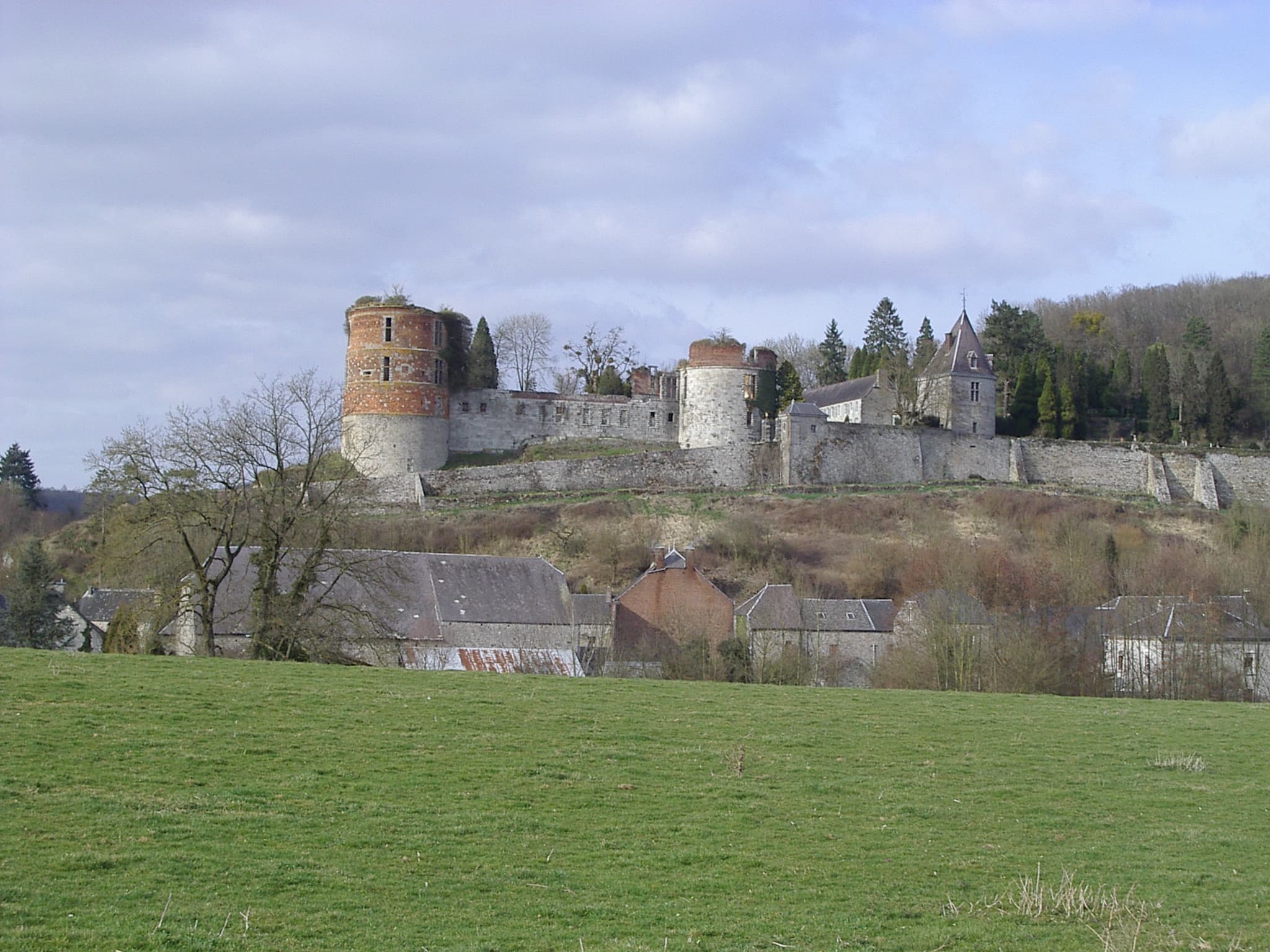
Hierges Castle
Hierges Castle, known locally as Château de Hierges, is a remarkable historical site located in the village of Hierges in the Ardennes department of France. This castle stands as a testament to centuries of European history, blending medieval military architecture with Renaissance stylistic elements. Situated near the border between France and Belgium, the castle overlooks the Joncquière valley, commanding strategic views along the Meuse river corridor.
The origins of Hierges Castle trace back to a fortified castrum established in the 9th century, marking it as a site of early medieval military significance. Initially part of the holdings of the influential House of Ardenne, the castle's early history is intertwined with the feudal dynamics of the region. During the 12th century, the fortress was known as the Castle of Jerusalem due to its connection with the Crusader states. It was home to notable figures such as Manassès de Hierges, who served as Constable of the Kingdom of Jerusalem from 1144 to 1152 during the Second Crusade. The castle's medieval legacy is also linked to Héribrand II de Hierges and his marriage to Hodierna of Rethel, sister of King Baldwin II of Jerusalem, highlighting the family's Crusader ties.
Medieval origins and crusader connections
The first castle on this site was mentioned in the 11th century and served as a fortified stronghold during the turbulent Middle Ages. The original medieval fortress was destroyed by fire in the 13th century but was rebuilt, maintaining its defensive role. The castle controlled an important commercial and strategic route linking Saint-Quentin to Cologne and held significant influence over the Meuse valley.
Throughout the medieval period, the castle was a key military and noble residence within the Principality of Liège. Its location on a rocky spur provided natural defensive advantages, augmented by thick curtain walls and towers designed to repel attackers. The castle's fortifications were typical of medieval military architecture, with round towers and curtain walls forming a protective perimeter.
Renaissance reconstruction and architectural features
In the 16th century, the castle underwent significant transformation. After partial destruction in 1555 by the Duke of Nevers, the castle was rebuilt in 1564 for Gilles de Berlaim, known as "Monsieur de Hierges." This reconstruction embraced the Mosan Renaissance style, characterized by the use of red brick and blue stone sourced locally from the Givet region. The renovations incorporated contemporary defensive features such as openings for firearms, reflecting advances in military technology.
The rebuilt castle featured three large round towers along its curtain walls, designed to provide overlapping fields of fire with gun emplacements. A fourth semi-circular covered tower, constructed entirely of blue stone, remains inhabited by the current owner. Architectural details such as cross mullioned windows demonstrate the blend of military utility and Renaissance aesthetics, emphasizing both defense and comfort.
Additional structures were added in the 18th century, including a former common area and a dovecote, expanding the castle's residential and agricultural functions. The castle's layout reflects a transition from purely military fortress to a princely residence, with gardens restored to evoke the Renaissance period's appearance.

Photo by Adri08 • CC BY-SA 3.0
Impact of the french revolution and subsequent history
The castle's fortunes declined during the French Revolution. It was assaulted by revolutionary troops in 1792 and suffered extensive damage when set on fire on 18 November 1793. This event left the castle largely in ruins, with only parts of the curtain walls and towers surviving.
Despite its ruined state, Hierges Castle remains a significant cultural and historical landmark. It was officially recognized as a historic monument on 30 December 1980, ensuring its protection and conservation. Today, the castle is privately owned, with parts of the site, including the exterior gardens and some castle sections, accessible to the public for visitation.
Architectural remains and current condition
The surviving elements of Hierges Castle include the curtain walls constructed from red brick and blue stone, and three large round towers that are partially ruined but still convey the castle's former defensive strength. The fourth tower, covered and semi-circular, remains habitable and is notable for its blue stone construction.
The castle's design includes strategically placed gun openings that allowed defenders to cover adjacent towers with crossfire, a sophisticated defensive arrangement for the Renaissance period. Some windows feature cross mullions, indicative of Renaissance architectural refinement.
The restored gardens complement the castle's historic character, offering visitors a glimpse of the landscape design typical of the Renaissance era. The castle's position on a rocky spur overlooking the Joncquière valley enhances its imposing presence and strategic importance.
Visiting hierges castle
Hierges Castle can be viewed from the nearby road connecting Dinant in Belgium to Charleville-Mézières in France, situated just a few hundred meters from the Franco-Belgian border. While the castle is privately owned and not always open to the public, parts of the castle and its gardens are accessible during certain times. Visitors are advised to check current opening hours and access conditions before planning a visit.
Its rich history, architectural significance, and scenic location make Hierges Castle a fascinating destination for those interested in medieval and Renaissance fortifications, Crusader history, and the heritage of the Ardennes region.
Frequently asked questions (FAQ)
- When was Hierges Castle originally built?
- Hierges Castle was originally established as a fortified site in the 9th century, with the current Renaissance structure dating from 1564.
- What is the historical significance of Hierges Castle?
- The castle is historically significant for its medieval origins, its connection to the Crusades through Manassès de Hierges, and its Renaissance reconstruction.
- Can visitors tour Hierges Castle?
- Parts of Hierges Castle and its gardens are open to the public, but the castle is privately owned and may have limited visiting hours.
- What architectural styles are present at Hierges Castle?
- Hierges Castle features medieval defensive elements and Renaissance architectural details, including red brick and blue stone construction and cross mullioned windows.
- How was Hierges Castle affected by the French Revolution?
- The castle was assaulted by revolutionary troops in 1792 and was set on fire in 1793, leaving it largely in ruins.
Photo gallery


Information
Sources & official resources
Verify the information above using these authoritative references.
Loading map...
Visitor reviews
No reviews yet. Been here? Write the first review and help other travelers!
Write the first reviewVisited this castle? Share your experience
Your review helps other travelers and adds first-hand knowledge to our encyclopedia.



